National Surgical Adjuvant Breast and Bowel Project Operations and Biostatistical Centers, Pittsburgh, Pennsylvania 15213, USA.
Cancer. 2012 Nov 15;118(22):5614-22. doi: 10.1002/cncr.27593. Epub 2012 May 8.
Neurotoxicity from adjuvant treatment with oxaliplatin has been studied in patients with colorectal carcinoma in short-term studies, but, to the authors' knowledge, the current article is the first long-term assessment which reports the National Surgical Adjuvant Breast and Bowel Project (NSABP) investigation of whether excess neurotoxicity persists beyond 4 years.
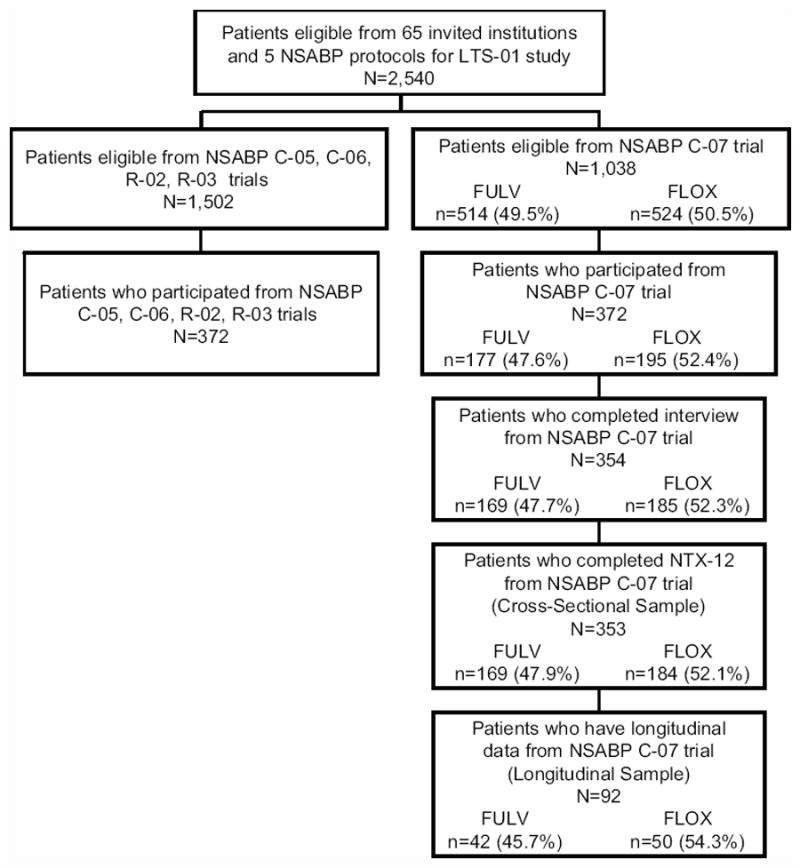
As part of a colorectal cancer long-term survivor study (LTS-01), long-term neurotoxicity was assessed in 353 patients on NSABP Protocol C-07 (cross-sectional sample). Ninety-two of these patients from LTS-01 also had longitudinal data and were reassessed 5 to 8 years (median, 7 years) after random assignment (longitudinal sample). Contingency tables compared cohorts, a mixed model compared neurotoxicity between treatments over time, and a Wilcoxon rank-sum test compared neurotoxicity between treatments (cross-sectional sample).
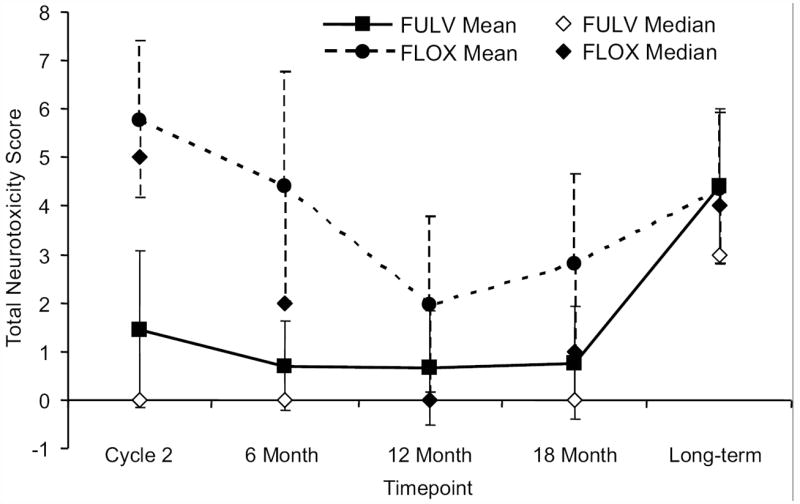
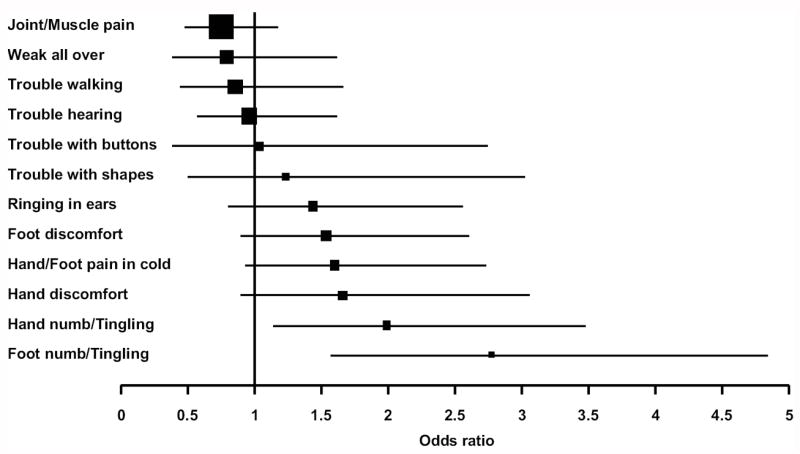
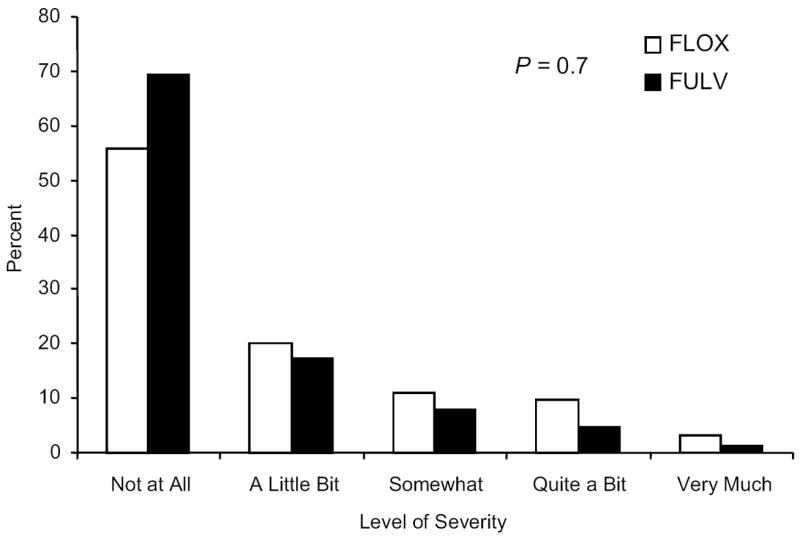
In the cross-sectional sample, the increase in mean total neurotoxicity scores of 1.8 with oxaliplatin was statistically significant (P = .005), but not clinically significant (a minimally important difference of 4 was reported at the long-term assessment). Patients who received oxaliplatin had increased odds of numbness and tingling in hands (odds ratio, 2.00; P = .015) and feet (odds ratio, 2.78; P < .001) versus patients who did not receive oxaliplatin. The magnitude of the oxaliplatin effect varied with time (P < .001) in the longitudinal sample, such that the oxaliplatin-treated group did not have significantly greater total neurotoxicity scores by 7 years.
At the long-term endpoint, there was no clinically significant increase in total neurotoxicity scores for patients who received oxaliplatin, but the specific neurotoxicities of numbness and tingling of the hands and feet remained significantly elevated for oxaliplatin-treated patients.
奥沙利铂辅助治疗引起的神经毒性已在短期研究的结直肠癌患者中进行了研究,但据作者所知,目前的文章是第一项长期评估报告,该报告评估了国家外科辅助乳腺和肠道项目(NSABP)是否存在神经毒性超过 4 年的情况。
作为结直肠癌长期幸存者研究(LTS-01)的一部分,对 NSABP 协议 C-07(横截面样本)中的 353 名患者进行了长期神经毒性评估。LTS-01 中的 92 名患者也具有纵向数据,并在随机分组后 5 至 8 年(中位数为 7 年)重新评估(纵向样本)。列联表比较队列,混合模型比较随时间的神经毒性,Wilcoxon 秩和检验比较治疗之间的神经毒性(横截面样本)。
在横截面样本中,奥沙利铂引起的平均总神经毒性评分增加 1.8,具有统计学意义(P =.005),但无临床意义(长期评估报告为 4 的最小重要差异)。与未接受奥沙利铂的患者相比,接受奥沙利铂的患者手和脚麻木和刺痛的几率增加(比值比,2.00;P =.015)和脚(比值比,2.78;P <.001)。在纵向样本中,奥沙利铂的作用随时间而变化(P <.001),因此,到 7 年时,接受奥沙利铂的组总神经毒性评分没有显着增加。
在长期终点,接受奥沙利铂的患者总神经毒性评分没有明显增加,但手和脚麻木和刺痛的特定神经毒性仍显着升高。