Department of Radiation Oncology, Memorial Sloan-Kettering Cancer Center, New York, New York, USA.
Int J Radiat Oncol Biol Phys. 2012 Oct 1;84(2):e187-93. doi: 10.1016/j.ijrobp.2012.03.030. Epub 2012 May 8.
We used the Female Sexual Function Index (FSFI) to investigate the prevalence of sexual dysfunction (SD) and factors associated with diminished sexual functioning in early stage endometrial cancer (EC) patients treated with simple hysterectomy and adjuvant brachytherapy.
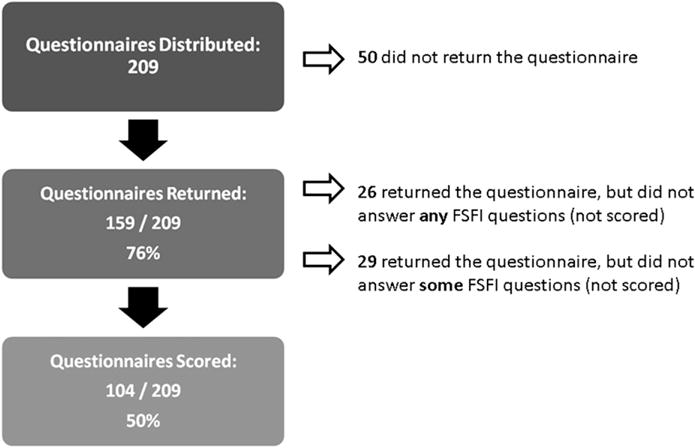
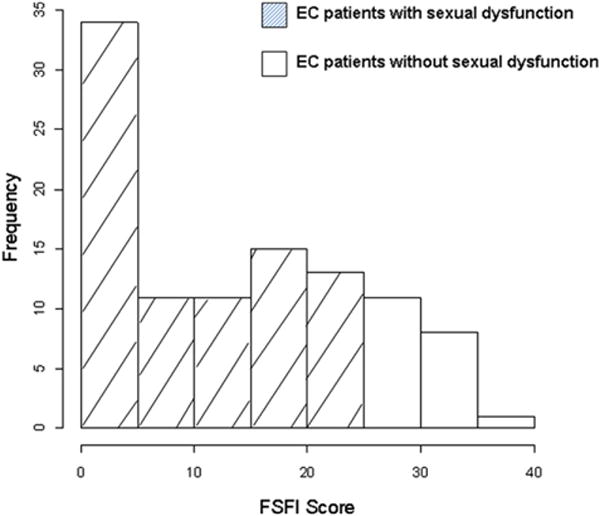
A cohort of 104 patients followed in a radiation oncology clinic completed questionnaires to quantify current levels of sexual functioning. The time interval between hysterectomy and questionnaire completion ranged from <6 months to >5 years. Multivariate regression was performed using the FSFI as a continuous variable (score range, 1.2-35.4). SD was defined as an FSFI score of <26, based on the published validation study.
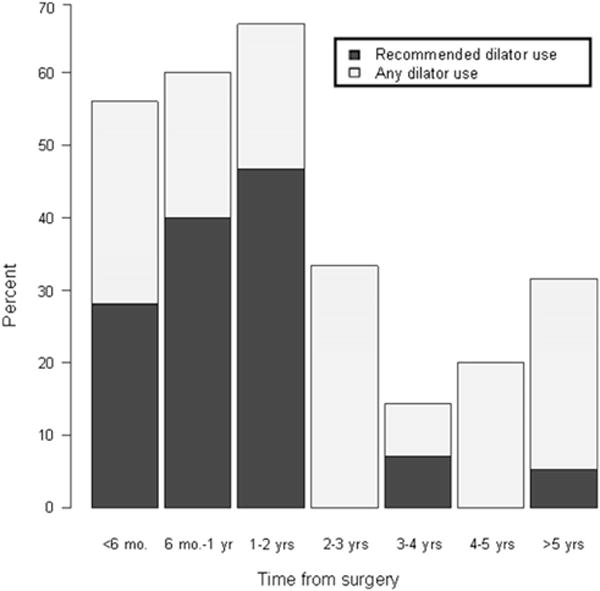
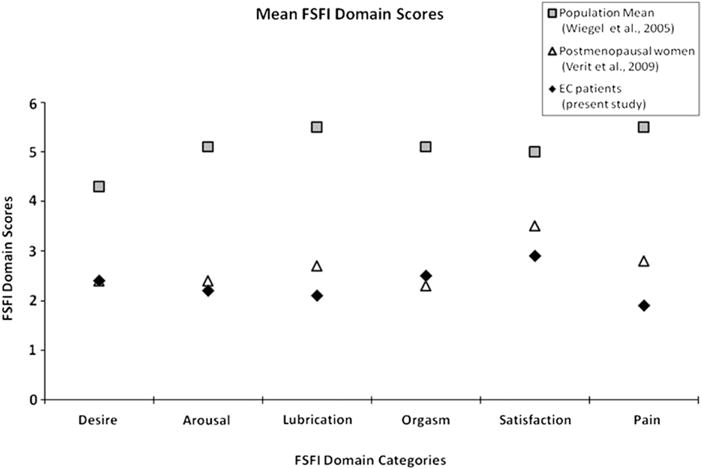
SD was reported by 81% of respondents. The mean (± standard deviation) domain scores in order of highest-to-lowest functioning were: satisfaction, 2.9 (± 2.0); orgasm, 2.5 (± 2.4); desire, 2.4 (± 1.3); arousal, 2.2 (± 2.0); dryness, 2.1 (± 2.1); and pain, 1.9 (± 2.3). Compared to the index population in which the FSFI cut-score was validated (healthy women ages 18-74), all scores were low. Compared to published scores of a postmenopausal population, scores were not statistically different. Multivariate analysis isolated factors associated with lower FSFI scores, including having laparotomy as opposed to minimally invasive surgery (effect size, -7.1 points; 95% CI, -11.2 to -3.1; P<.001), lack of vaginal lubricant use (effect size, -4.4 points; 95% CI, -8.7 to -0.2, P=.040), and short time interval (<6 months) from hysterectomy to questionnaire completion (effect size, -4.6 points; 95% CI, -9.3-0.2; P=.059).
The rate of SD, as defined by an FSFI score <26, was prevalent. The postmenopausal status of EC patients alone is a known risk factor for SD. Additional factors associated with poor sexual functioning following treatment for EC included receipt of laparotomy and lack of vaginal lubricant use.
我们使用女性性功能指数(FSFI)调查了接受单纯子宫切除术和辅助近距离放射治疗的早期子宫内膜癌(EC)患者性功能障碍(SD)的发生率和相关因素。
在放射肿瘤学诊所接受随访的 104 例患者完成了问卷调查,以量化当前的性功能水平。子宫切除术与问卷完成之间的时间间隔从<6 个月到>5 年不等。使用 FSFI 作为连续变量(评分范围为 1.2-35.4)进行多变量回归。根据已发表的验证研究,将 FSFI 评分<26 定义为 SD。
81%的受访者报告了 SD。按照功能最高到最低的顺序,平均(±标准差)域评分分别为:满意度 2.9(±2.0);性高潮 2.5(±2.4);欲望 2.4(±1.3);唤醒 2.2(±2.0);干燥 2.1(±2.1);疼痛 1.9(±2.3)。与 FSFI 截断值验证的指数人群(18-74 岁健康女性)相比,所有评分均较低。与绝经后人群的已发表评分相比,评分无统计学差异。多变量分析孤立出与较低 FSFI 评分相关的因素,包括开腹手术而不是微创手术(效应量-7.1 分;95%CI-11.2 至-3.1;P<.001)、缺乏阴道润滑剂使用(效应量-4.4 分;95%CI-8.7 至-0.2,P=.040)以及子宫切除术后至问卷完成的时间间隔较短(<6 个月)(效应量-4.6 分;95%CI-9.3 至 0.2;P=.059)。
以 FSFI 评分<26 定义的 SD 发生率很高。EC 患者的绝经后状态本身就是 SD 的已知危险因素。与 EC 治疗后性功能不良相关的其他因素包括接受开腹手术和缺乏阴道润滑剂使用。