Institute of Rheumatology, Department of Experimental Rheumatology of the 1st Faculty of Medicine, Charles University in Prague, Na Slupi 4, Prague 2, 128 50, Czech Republic.
Arthritis Res Ther. 2012 May 11;14(3):R111. doi: 10.1186/ar3836.
The purpose of this study was to evaluate and compare the serum levels and local expression of resistin in patients with idiopathic inflammatory myopathies to controls, and to determine the relationship between resistin levels, inflammation and disease activity.
Serum resistin levels were determined in 42 patients with inflammatory myopathies and 27 healthy controls. The association among resistin levels, inflammation, global disease activity and muscle strength was examined. The expression of resistin in muscle tissues from patients with inflammatory myopathies and healthy controls was evaluated. Gene expression and protein release from resistin-stimulated muscle and mononuclear cells were assessed.
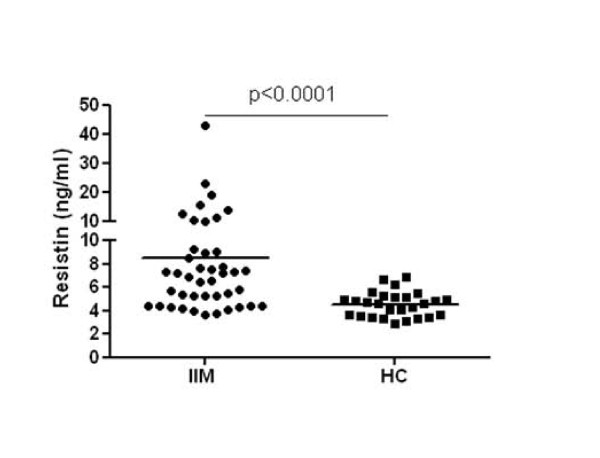
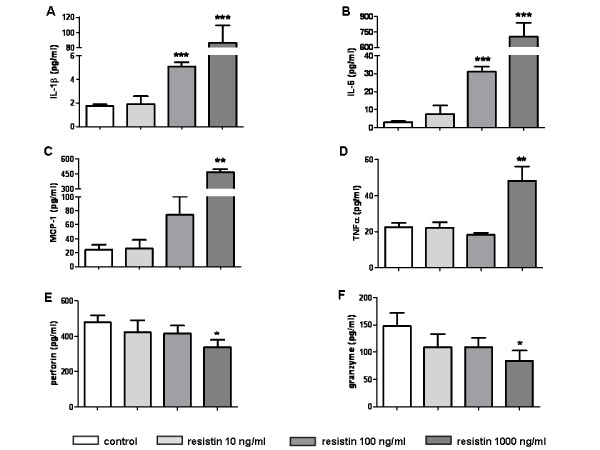
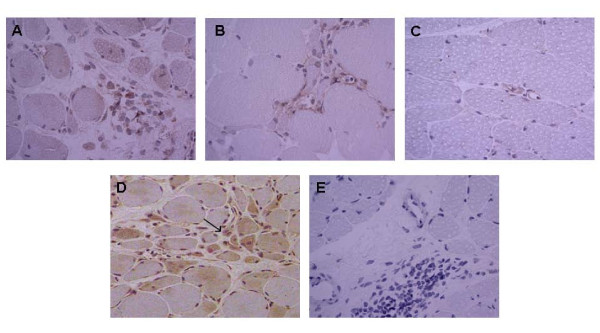
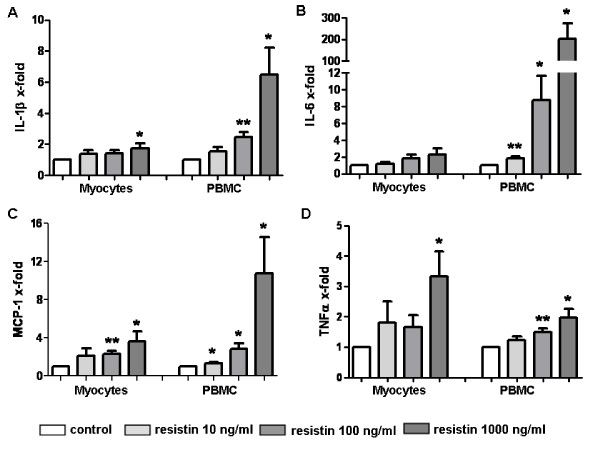
In patients with inflammatory myopathies, the serum levels of resistin were significantly higher than those observed in controls (8.53 ± 6.84 vs. 4.54 ± 1.08 ng/ml, P < 0.0001) and correlated with C-reactive protein (CRP) levels (r = 0.328, P = 0.044) and myositis disease activity assessment visual analogue scales (MYOACT) (r = 0.382, P = 0.026). Stronger association was observed between the levels of serum resistin and CRP levels (r = 0.717, P = 0.037) as well as MYOACT (r = 0.798, P = 0.007), and there was a trend towards correlation between serum resistin and myoglobin levels (r = 0.650, P = 0.067) in anti-Jo-1 positive patients. Furthermore, in patients with dermatomyositis, serum resistin levels significantly correlated with MYOACT (r = 0.667, P = 0.001), creatine kinase (r = 0.739, P = 0.001) and myoglobin levels (r = 0.791, P = 0.0003) and showed a trend towards correlation with CRP levels (r = 0.447, P = 0.067). Resistin expression in muscle tissue was significantly higher in patients with inflammatory myopathies compared to controls, and resistin induced the expression of interleukins (IL)-1β and IL-6 and monocyte chemoattractant protein (MCP)-1 in mononuclear cells but not in myocytes.
The results of this study indicate that higher levels of serum resistin are associated with inflammation, higher global disease activity index and muscle injury in patients with myositis-specific anti-Jo-1 antibody and patients with dermatomyositis. Furthermore, up-regulation of resistin in muscle tissue and resistin-induced synthesis of pro-inflammatory cytokines in mononuclear cells suggest a potential role for resistin in the pathogenesis of inflammatory myopathies.
本研究旨在评估和比较特发性炎性肌病患者与对照组之间血清抵抗素水平和局部表达,并确定抵抗素水平、炎症和疾病活动之间的关系。
测定 42 例炎性肌病患者和 27 例健康对照者的血清抵抗素水平。检测抵抗素水平与炎症、整体疾病活动和肌肉力量之间的关系。评估炎性肌病患者和健康对照者肌肉组织中抵抗素的表达。评估抵抗素刺激的肌细胞和单核细胞中的基因表达和蛋白释放。
炎性肌病患者血清抵抗素水平明显高于对照组(8.53±6.84 vs. 4.54±1.08 ng/ml,P<0.0001),与 C 反应蛋白(CRP)水平(r=0.328,P=0.044)和肌炎疾病活动评估视觉模拟量表(MYOACT)(r=0.382,P=0.026)相关。血清抵抗素与 CRP 水平(r=0.717,P=0.037)和 MYOACT(r=0.798,P=0.007)的相关性更强,在抗 Jo-1 阳性患者中,血清抵抗素与肌红蛋白水平(r=0.650,P=0.067)呈趋势相关。此外,皮肌炎患者血清抵抗素水平与 MYOACT(r=0.667,P=0.001)、肌酸激酶(r=0.739,P=0.001)和肌红蛋白水平(r=0.791,P=0.0003)显著相关,与 CRP 水平呈趋势相关(r=0.447,P=0.067)。与对照组相比,炎性肌病患者的肌肉组织中抵抗素表达明显升高,抵抗素诱导单核细胞中白细胞介素(IL)-1β和 IL-6 以及单核细胞趋化蛋白(MCP)-1的表达,但不能诱导肌细胞表达。
本研究结果表明,肌炎特异性抗 Jo-1 抗体患者和皮肌炎患者血清抵抗素水平升高与炎症、更高的整体疾病活动指数和肌肉损伤相关。此外,肌肉组织中抵抗素的上调和单核细胞中抵抗素诱导的促炎细胞因子的合成提示抵抗素可能在炎性肌病的发病机制中发挥作用。