El Husseny Mostafa Wanees Ahmed, Mamdouh Mediana, Shaban Sara, Ibrahim Abushouk Abdelrahman, Zaki Marwa Mostafa Mohamed, Ahmed Osama M, Abdel-Daim Mohamed M
Faculty of Medicine, Fayoum University, Fayoum, Egypt; NovaMed Medical Research Association, Cairo, Egypt; Fayoum Medical Student Association, Fayoum, Egypt.
Faculty of Medicine, Fayoum University, Fayoum, Egypt.
J Diabetes Res. 2017;2017:8095926. doi: 10.1155/2017/8095926. Epub 2017 Feb 13.
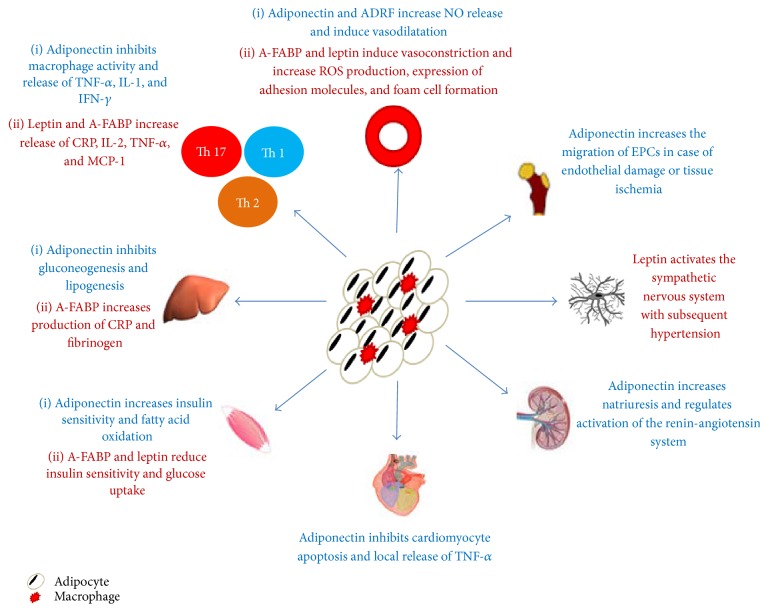
Adipokines are bioactive molecules that regulate several physiological functions such as energy balance, insulin sensitization, appetite regulation, inflammatory response, and vascular homeostasis. They include proinflammatory cytokines such as adipocyte fatty acid binding protein (A-FABP) and anti-inflammatory cytokines such as adiponectin, as well as vasodilator and vasoconstrictor molecules. In obesity and type II diabetes mellitus (DM), insulin resistance causes impairment of the endocrine function of the perivascular adipose tissue, an imbalance in the secretion of vasoconstrictor and vasodilator molecules, and an increased production of reactive oxygen species. Recent studies have shown that targeting plasma levels of adipokines or the expression of their receptors can increase insulin sensitivity, improve vascular function, and reduce the risk of cardiovascular morbidity and mortality. Several reviews have discussed the potential of adipokines as therapeutic targets for type II DM and obesity; however, this review is the first to focus on their therapeutic potential for vascular dysfunction in type II DM and obesity.
脂肪因子是调节多种生理功能的生物活性分子,如能量平衡、胰岛素敏感性、食欲调节、炎症反应和血管稳态。它们包括促炎细胞因子,如脂肪细胞脂肪酸结合蛋白(A-FABP),以及抗炎细胞因子,如脂联素,还有血管舒张剂和血管收缩剂分子。在肥胖症和II型糖尿病(DM)中,胰岛素抵抗会导致血管周围脂肪组织的内分泌功能受损、血管收缩剂和血管舒张剂分子分泌失衡,以及活性氧生成增加。最近的研究表明,针对血浆中脂肪因子的水平或其受体的表达进行干预,可以提高胰岛素敏感性、改善血管功能,并降低心血管疾病发病和死亡风险。已有多篇综述讨论了脂肪因子作为II型糖尿病和肥胖症治疗靶点的潜力;然而,本综述首次聚焦于它们在II型糖尿病和肥胖症血管功能障碍方面的治疗潜力。