Department of Neuropsychiatry, Kochi Medical School, Kohatsu, Kochi 783-8505, Japan.
BMC Psychiatry. 2012 May 14;12:40. doi: 10.1186/1471-244X-12-40.
Family psychoeducation is a relatively simple and straightforward intervention whose prophylactic effectiveness and cost-effectiveness is well-established for schizophrenia. We have recently demonstrated its effectiveness for unipolar depression, but its cost-effectiveness has never been examined. We hereby report a cost-effectiveness analysis alongside a randomized controlled trial in order to assess its cost-effectiveness for preventing relapse/recurrence in depression.
Fifty-seven patients diagnosed with major depression and undergoing its maintenance treatment, and their primary family members were randomized to treatment as usual (TAU) only or to TAU plus family psychoeducation, which consisted of four 2-hour multiple-family sessions consisting of didactic lectures about depression (30 minutes) and group discussion and problem solving (60-90 minutes). The economic analyses were undertaken from the perspective of the National Health Insurance (NHI), assuming the most reasonable price of US$50 per psychoeducation session per patient. The main outcome measures included relapse-free days and direct costs to the NHI.
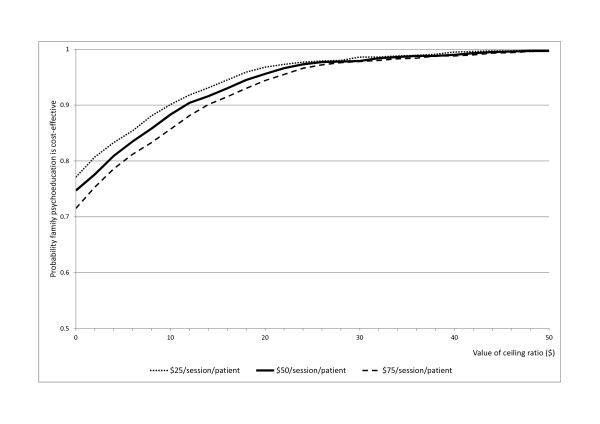
The intervention group enjoyed 272 (SD: 7.1) relapse-free days, while the control group spent 214 (SD: 90.8) relapse-free days (Cox proportional hazard ratio=0.17, 95%CI: 0.04 to 0.75, p=0.002). Cost-effectiveness acceptability curves suggested that the family psychoeducation has 90% or more chances of being cost-effective if the decision-maker is prepared to pay US$20 for one additional relapse-free day. This cost-effectiveness finding was robust when the price for family psychoeducation ranged between 50% to 150% of the baseline scenario in sensitivity analyses. If a relapse-free day is considered to be worth $30 or more, all the pricing scenarios have a close to 100% probability of being cost-effective.
Family psychoeducation is effective in the relapse prevention of depression and is highly likely to be cost-effective if a relapse-free day is valued as US$20 or more.
UMIN-CTR (UMIN000005555).
家庭心理教育是一种相对简单直接的干预措施,其在精神分裂症中的预防效果和成本效益已得到充分证实。我们最近已经证明了它在单相抑郁症中的有效性,但从未对其成本效益进行过检验。为此,我们开展了一项成本效益分析,并结合一项随机对照试验,以评估其在预防抑郁症复发/再发方面的成本效益。
57 名被诊断为重度抑郁症并正在接受维持治疗的患者及其主要家庭成员被随机分配至仅接受常规治疗(TAU)或 TAU 加家庭心理教育,后者包括 4 次 2 小时的多家庭课程,内容包括关于抑郁症的讲座(30 分钟)和小组讨论和解决问题(60-90 分钟)。经济分析从国家健康保险(NHI)的角度出发,假设每个患者每次家庭心理教育的合理价格为 50 美元。主要结局指标包括无复发天数和 NHI 的直接成本。
干预组的无复发天数为 272(SD:7.1)天,而对照组的无复发天数为 214(SD:90.8)天(Cox 比例风险比=0.17,95%CI:0.04 至 0.75,p=0.002)。成本效益接受性曲线表明,如果决策者愿意为额外的无复发天数支付 20 美元,家庭心理教育的成本效益有 90%或更高的可能性。当家庭心理教育的价格在基线情景的 50%至 150%范围内变化时,这一成本效益结果在敏感性分析中是稳健的。如果将无复发天数的价值定为 30 美元或更高,那么所有定价情景的成本效益都有接近 100%的可能性。
家庭心理教育在预防抑郁症复发方面是有效的,如果将无复发天数的价值定为 20 美元或更高,那么它很可能具有成本效益。
UMIN-CTR(UMIN000005555)。