Cyplik Paweł, Marecik Roman, Piotrowska-Cyplik Agnieszka, Olejnik Anna, Drożdżyńska Agnieszka, Chrzanowski Lukasz
Water Air Soil Pollut. 2012 May;223(4):1791-1800. doi: 10.1007/s11270-011-0984-5. Epub 2011 Oct 11.
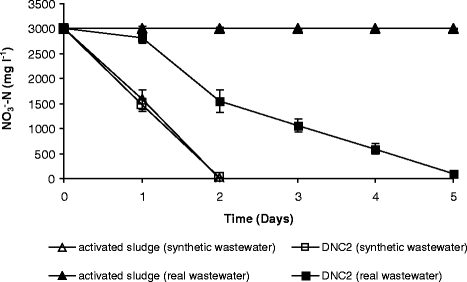
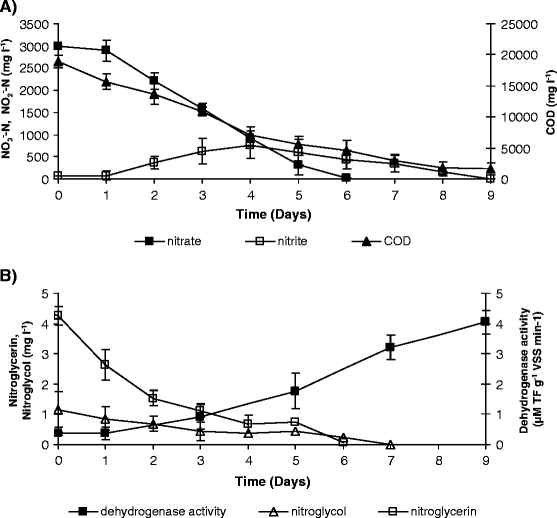
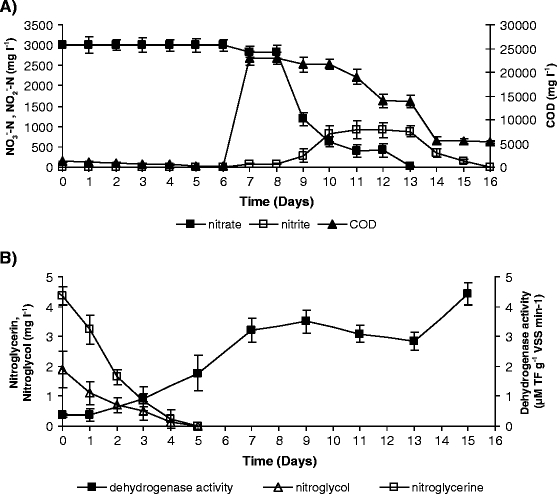
Wastewater samples originating from an explosives production plant (3,000 mg N l(-1) nitrate, 4.8 mg l(-1) nitroglycerin, 1.9 mg l(-1) nitroglycol and 1,200 mg l(-1) chemical oxygen demand) were subjected to biological purification. An attempt to completely remove nitrate and to decrease the chemical oxygen demand was carried out under anaerobic conditions. A soil isolated microbial consortium capable of biodegrading various organic compounds and reduce nitrate to atmospheric nitrogen under anaerobic conditions was used. Complete removal of nitrates with simultaneous elimination of nitroglycerin and ethylene glycol dinitrate (nitroglycol) was achieved as a result of the conducted research. Specific nitrate reduction rate was estimated at 12.3 mg N g(-1) VSS h(-1). Toxicity of wastewater samples during the denitrification process was studied by measuring the activity of dehydrogenases in the activated sludge. Mutagenicity was determined by employing the Ames test. The maximum mutagenic activity did not exceed 0.5. The obtained results suggest that the studied wastewater samples did not exhibit mutagenic properties.
来自一家炸药生产厂的废水样本(硝酸盐含量3000毫克氮/升、硝化甘油含量4.8毫克/升、硝化乙二醇含量1.9毫克/升、化学需氧量1200毫克/升)进行了生物净化处理。在厌氧条件下尝试完全去除硝酸盐并降低化学需氧量。使用了一种从土壤中分离出的微生物群落,该群落能够在厌氧条件下生物降解各种有机化合物并将硝酸盐还原为大气中的氮气。研究结果实现了硝酸盐的完全去除,同时消除了硝化甘油和二硝酸乙二醇(硝化乙二醇)。估计特定硝酸盐还原率为12.3毫克氮/克挥发性悬浮固体·小时。通过测量活性污泥中脱氢酶的活性研究了反硝化过程中废水样本的毒性。采用艾姆斯试验测定致突变性。最大致突变活性不超过0.5。所得结果表明,所研究的废水样本不具有致突变特性。