Li Bing, Ren Ge, Guo Wei, Zhang Jiang, Lam Sai-Kit, Zheng Xiaoli, Teng Xinzhi, Wang Yunhan, Yang Yang, Dan Qinfu, Meng Lingguang, Ma Zongrui, Cheng Chen, Tao Hongyan, Lei Hongchang, Cai Jing, Ge Hong
Department of Radiation Oncology, The Affiliated Cancer Hospital of Zhengzhou University and Henan Cancer Hospital, Zhengzhou, China.
Department of Health Technology and Informatics, The Hong Kong Polytechnic University, Hong Kong SAR, China.
Front Pharmacol. 2022 Sep 19;13:971849. doi: 10.3389/fphar.2022.971849. eCollection 2022.
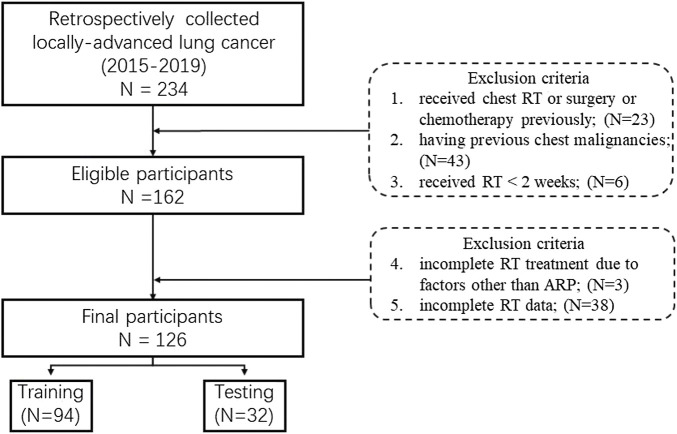
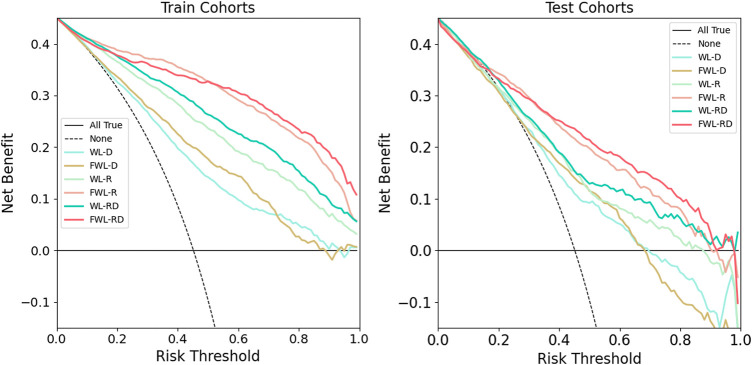
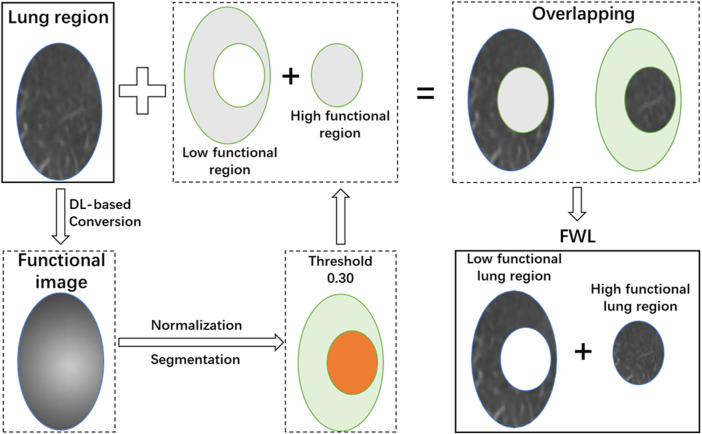
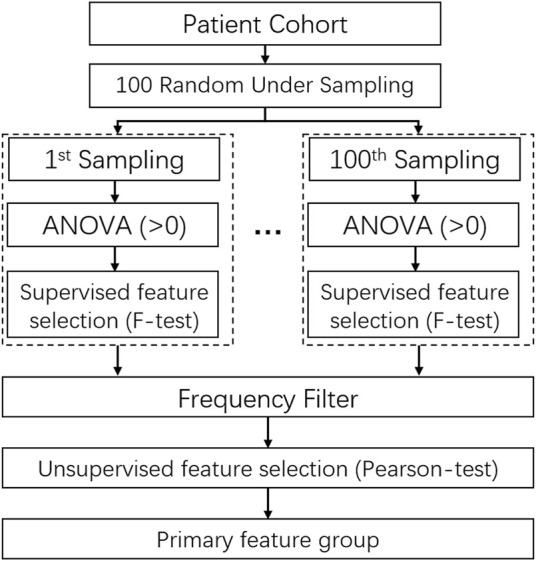
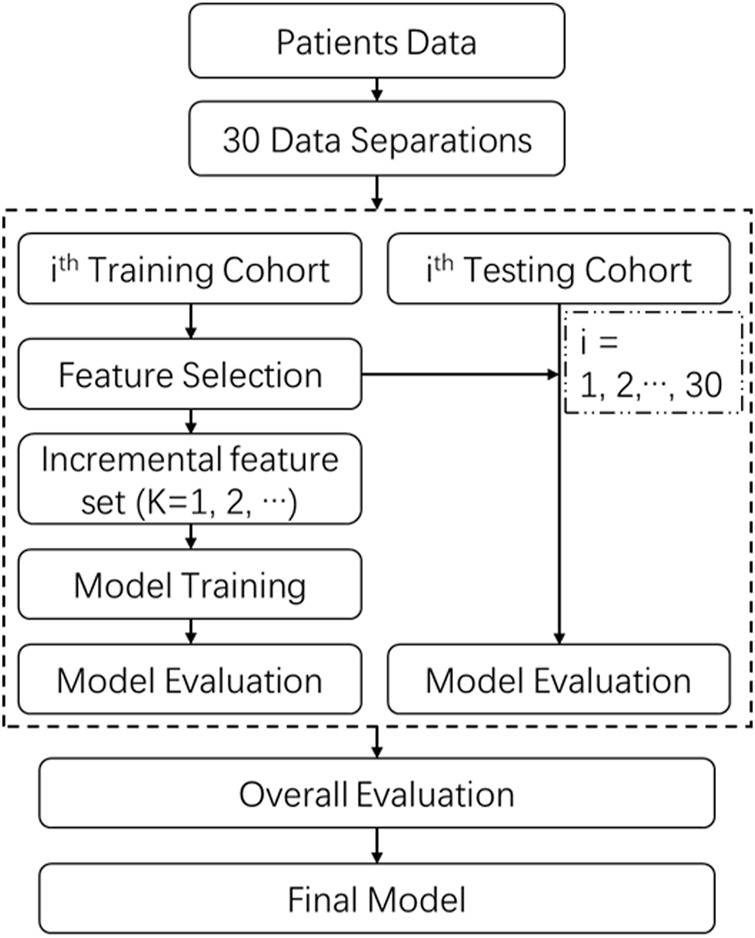
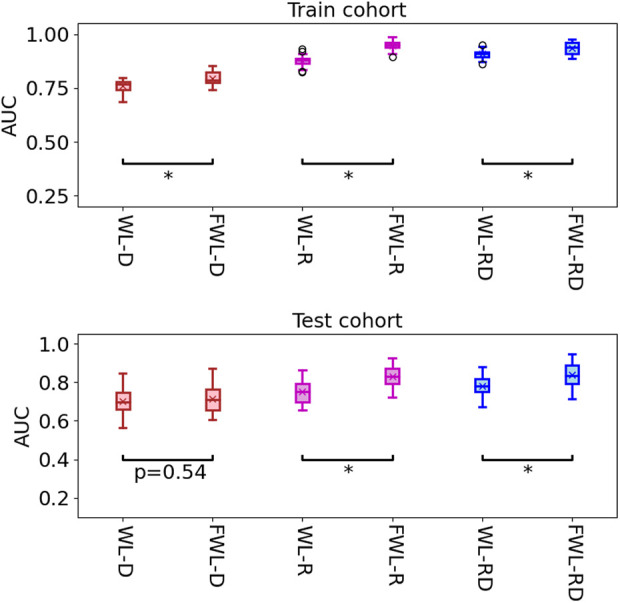
This study investigates the impact of lung function on radiation pneumonitis prediction using a dual-omics analysis method. We retrospectively collected data of 126 stage III lung cancer patients treated with chemo-radiotherapy using intensity-modulated radiotherapy, including pre-treatment planning CT images, radiotherapy dose distribution, and contours of organs and structures. Lung perfusion functional images were generated using a previously developed deep learning method. The whole lung (WL) volume was divided into function-wise lung (FWL) regions based on the lung perfusion functional images. A total of 5,474 radiomics features and 213 dose features (including dosiomics features and dose-volume histogram factors) were extracted from the FWL and WL regions, respectively. The radiomics features (R), dose features (D), and combined dual-omics features (RD) were used for the analysis in each lung region of WL and FWL, labeled as WL-R, WL-D, WL-RD, FWL-R, FWL-D, and FWL-RD. The feature selection was carried out using ANOVA, followed by a statistical F-test and Pearson correlation test. Thirty times train-test splits were used to evaluate the predictability of each group. The overall average area under the receiver operating characteristic curve (AUC), accuracy, precision, recall, and f1-score were calculated to assess the performance of each group. The FWL-RD achieved a significantly higher average AUC than the WL-RD group in the training (FWL-RD: 0.927 ± 0.031, WL-RD: 0.849 ± 0.064) and testing cohorts (FWL-RD: 0.885 ± 0.028, WL-RD: 0.762 ± 0.053, < 0.001). When using radiomics features only, the FWL-R group yielded a better classification result than the model trained with WL-R features in the training (FWL-R: 0.919 ± 0.036, WL-R: 0.820 ± 0.052) and testing cohorts (FWL-R: 0.862 ± 0.028, WL-R: 0.750 ± 0.057, < 0.001). The FWL-D group obtained an average AUC of 0.782 ± 0.032, obtaining a better classification performance than the WL-D feature-based model of 0.740 ± 0.028 in the training cohort, while no significant difference was observed in the testing cohort (FWL-D: 0.725 ± 0.064, WL-D: 0.710 ± 0.068, = 0.54). The dual-omics features from different lung functional regions can improve the prediction of radiation pneumonitis for lung cancer patients under IMRT treatment. This function-wise dual-omics analysis method holds great promise to improve the prediction of radiation pneumonitis for lung cancer patients.
本研究采用双组学分析方法,探讨肺功能对放射性肺炎预测的影响。我们回顾性收集了126例接受调强放疗的Ⅲ期肺癌患者的化疗放疗数据,包括治疗前计划CT图像、放疗剂量分布以及器官和结构的轮廓。使用先前开发的深度学习方法生成肺灌注功能图像。基于肺灌注功能图像,将全肺(WL)体积划分为功能肺(FWL)区域。分别从FWL和WL区域提取了总共5474个放射组学特征和213个剂量特征(包括剂量组学特征和剂量体积直方图因子)。放射组学特征(R)、剂量特征(D)和组合双组学特征(RD)用于WL和FWL各肺区域的分析,分别标记为WL-R、WL-D、WL-RD、FWL-R、FWL-D和FWL-RD。使用方差分析进行特征选择,随后进行统计F检验和Pearson相关性检验。采用30次训练-测试分割来评估每组的可预测性。计算受试者操作特征曲线(AUC)下的总体平均面积、准确率、精确率、召回率和F1分数,以评估每组的性能。在训练队列(FWL-RD:0.927±0.031,WL-RD:0.849±0.064)和测试队列(FWL-RD:0.885±0.028,WL-RD:0.762±0.053,P<0.001)中,FWL-RD组的平均AUC显著高于WL-RD组。仅使用放射组学特征时,在训练队列(FWL-R:0.919±0.036,WL-R:0.820±0.052)和测试队列(FWL-R:0.862±0.028,WL-R:0.750±0.057,P<0.001)中,FWL-R组比使用WL-R特征训练的模型产生了更好的分类结果。FWL-D组在训练队列中的平均AUC为0.782±0.032,比基于WL-D特征的模型(0.740±0.028)具有更好的分类性能,而在测试队列中未观察到显著差异(FWL-D:0.725±0.064,WL-D:0.710±0.068,P = 0.54)。来自不同肺功能区域的双组学特征可以改善调强放疗下肺癌患者放射性肺炎的预测。这种基于功能的双组学分析方法在改善肺癌患者放射性肺炎预测方面具有很大前景。