Department of Psychology, Bowling Green State University, Bowling Green, OH 43403, USA.
J Clin Child Adolesc Psychol. 2012;41(4):402-16. doi: 10.1080/15374416.2012.684274. Epub 2012 May 17.
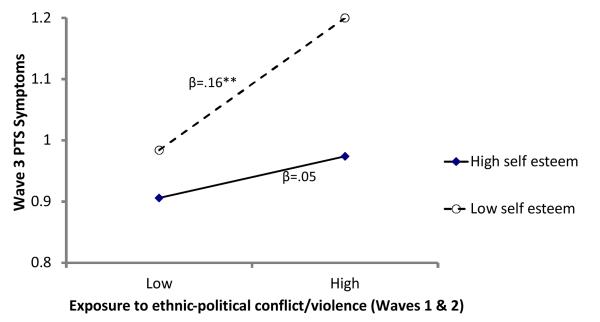
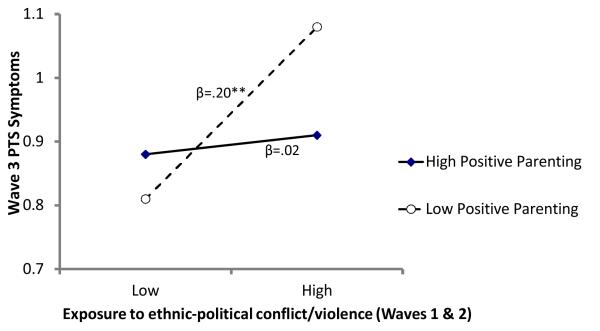
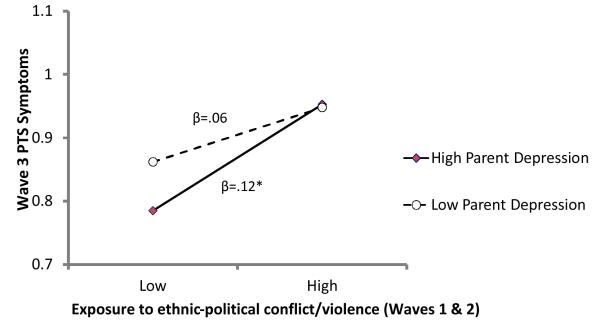
We examine the role of family- and individual-level protective factors in the relation between exposure to ethnic-political conflict and violence and posttraumatic stress among Israeli and Palestinian youth. Specifically, we examine whether parental mental health (lack of depression), positive parenting, children's self-esteem, and academic achievement moderate the relation between exposure to ethnic-political conflict/violence and subsequent posttraumatic stress (PTS) symptoms. We collected three waves of data from 901 Israeli and 600 Palestinian youths (three age cohorts: 8, 11, and 14 years old; approximately half of each gender) and their parents at 1-year intervals. Greater cumulative exposure to ethnic-political conflict/violence across the first 2 waves of the study predicted higher subsequent PTS symptoms even when we controlled for the child's initial level of PTS symptoms. This relation was significantly moderated by a youth's self-esteem and by the positive parenting received by the youth. In particular, the longitudinal relation between exposure to violence and subsequent PTS symptoms was significant for low self-esteem youth and for youth receiving little positive parenting but was non-significant for children with high levels of these protective resources. Our findings show that youth most vulnerable to PTS symptoms as a result of exposure to ethnic-political violence are those with lower levels of self-esteem and who experience low levels of positive parenting. Interventions for war-exposed youth should test whether boosting self-esteem and positive parenting might reduce subsequent levels of PTS symptoms.
我们考察了家庭和个体层面的保护因素在以色列和巴勒斯坦青年遭受族裔政治冲突和暴力与创伤后应激之间的关系中的作用。具体来说,我们考察了父母的心理健康(无抑郁)、积极的育儿方式、儿童的自尊心和学业成绩是否会调节儿童接触族裔政治冲突/暴力与随后的创伤后应激症状之间的关系。我们在 1 年的时间间隔内从 901 名以色列青少年和 600 名巴勒斯坦青少年(三个年龄组:8、11 和 14 岁;每个性别各占一半)及其父母那里收集了三波数据。在研究的前两波中,累积接触族裔政治冲突/暴力的程度越高,随后的创伤后应激症状就越高,即使我们控制了儿童最初的创伤后应激症状水平。这种关系受到青少年自尊心和青少年所接受的积极育儿方式的显著调节。特别是,暴力暴露与随后的创伤后应激症状之间的纵向关系对自尊心较低的青少年和接受较少积极育儿的青少年来说是显著的,但对自尊心较高或自尊心较高的青少年来说则不显著。这些保护资源。我们的研究结果表明,由于接触族裔政治暴力而最容易出现创伤后应激症状的青少年是自尊心较低且经历较少积极育儿的青少年。针对战争中暴露的青少年的干预措施应该测试提高自尊心和积极育儿是否可以降低随后的创伤后应激症状水平。