Department of Neurology, Laboratory for Neurotherapeutics, Seoul National University Hospital, Seoul, South Korea.
PLoS One. 2012;7(5):e36985. doi: 10.1371/journal.pone.0036985. Epub 2012 May 14.
About one third of patients with epilepsy become refractory to therapy despite receiving adequate medical treatment, possibly from multidrug resistance. P-glycoprotein, encoded by multidrug resistance protein-1 (MDR1) gene, at the blood brain barrier is considered as a major factor mediating drug efflux and contributing to resistance. Given that peripheral blood mononuclear cells (PBMNCs) express MDR1, we investigated a MDR1 status of PBMNCs in various subsets of epilepsy patients and demonstrated their association with clinical characteristics.
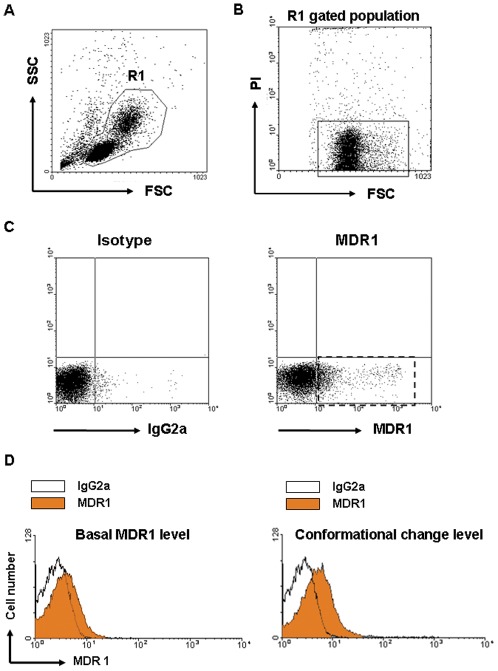
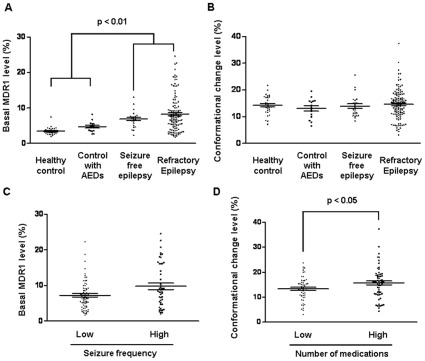
METHODOLOGY/PRINCIPAL FINDINGS: Clinical and MDR1 data were collected from 140 patients with epilepsy, 30 healthy volunteers, and 20 control patients taking anti-epileptic drugs. PBMNCs were isolated, and basal MDR1 levels and MDR1 conformational change levels were measured by flow cytometry. MDR1 profiles were analyzed according to various clinical parameters, including seizure frequency and number of medications used in epilepsy patients. Epilepsy patients had a higher basal MDR1 level than non-epilepsy groups (p<0.01). Among epilepsy patients, there is a tendency for higher seizure frequency group to have higher basal MDR1 level (p = 0.059). The MDR1 conformational change level was significantly higher in the high-medication-use group than the low-use group (p = 0.028). Basal MDR1 (OR = 1.16 [95% CI: 1.060-1.268]) and conformational change level (OR = 1.11 [95% CI: 1.02-1.20]) were independent predictors for seizure frequency and number of medications, respectively.
CONCLUSIONS/SIGNIFICANCE: The MDR1 profile of PBMNCs is associated with seizure frequency and medication conditions in patients with epilepsy.
尽管接受了适当的药物治疗,大约三分之一的癫痫患者仍然对治疗产生抗药性,这可能是由于多药耐药所致。多药耐药蛋白 1(MDR1)基因编码的 P 糖蛋白(P-gp)位于血脑屏障处,被认为是介导药物外排并导致耐药的主要因素。鉴于外周血单核细胞(PBMNCs)表达 MDR1,我们研究了各种癫痫患者亚群中 PBMNCs 的 MDR1 状态,并证明其与临床特征相关。
方法/主要发现:从 140 名癫痫患者、30 名健康志愿者和 20 名服用抗癫痫药物的对照患者中收集临床和 MDR1 数据。分离 PBMNCs,并用流式细胞术测量基础 MDR1 水平和 MDR1 构象变化水平。根据各种临床参数(包括癫痫患者的癫痫发作频率和使用的药物数量)分析 MDR1 谱。癫痫患者的基础 MDR1 水平高于非癫痫组(p<0.01)。在癫痫患者中,癫痫发作频率较高的患者基础 MDR1 水平较高(p=0.059)。高药物使用组的 MDR1 构象变化水平显著高于低使用组(p=0.028)。基础 MDR1(OR=1.16[95%CI:1.060-1.268])和构象变化水平(OR=1.11[95%CI:1.02-1.20])分别是癫痫发作频率和药物使用数量的独立预测因子。
结论/意义:PBMNCs 的 MDR1 谱与癫痫患者的癫痫发作频率和药物使用情况相关。