Millarte Valentina, Farhan Hesso
Department of Biology, University of Konstanz, Universitätsstrasse 10, Konstanz, Germany.
ScientificWorldJournal. 2012;2012:498278. doi: 10.1100/2012/498278. Epub 2012 May 1.
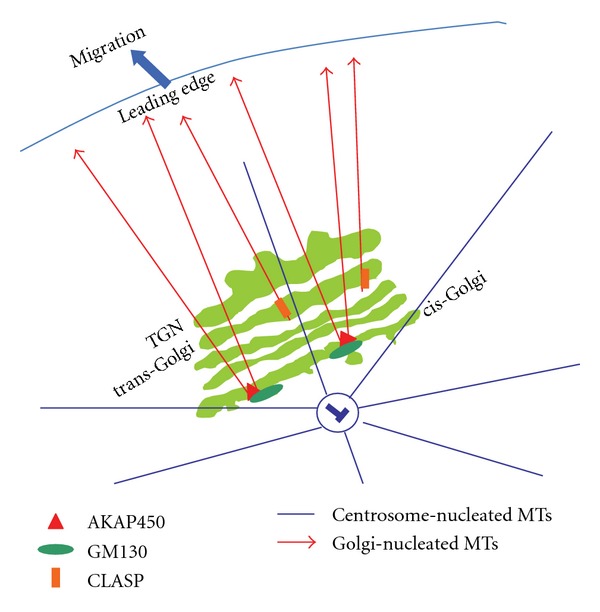
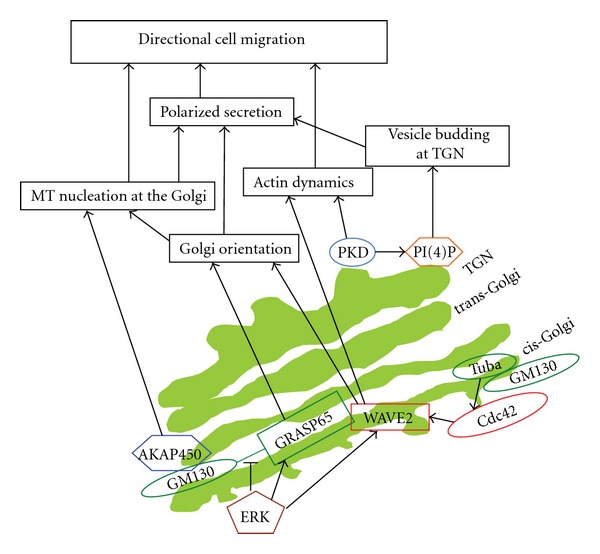
Migration and invasion are fundamental features of metastatic cancer cells. The Golgi apparatus, an organelle involved in posttranslational modification and sorting of proteins, is widely accepted to regulate directional cell migration. In addition, mounting evidence suggests that the Golgi is a hub for different signaling pathways. In this paper we will give an overview on how polarized secretion and microtubule nucleation at the Golgi regulate directional cell migration. We will review different signaling pathways that signal to and from the Golgi. Finally, we will discuss how these signaling pathways regulate the role of the Golgi in cell migration and invasion. We propose that by identifying regulators of the Golgi, we might be able to uncover unappreciated modulators of cell migration. Uncovering the regulatory network that orchestrates cell migration is of fundamental importance for the development of new therapeutic strategies against cancer cell metastasis.
迁移和侵袭是转移性癌细胞的基本特征。高尔基体是一种参与蛋白质翻译后修饰和分选的细胞器,普遍认为它能调节细胞的定向迁移。此外,越来越多的证据表明,高尔基体是不同信号通路的枢纽。在本文中,我们将概述高尔基体处的极化分泌和微管成核如何调节细胞的定向迁移。我们将回顾与高尔基体相互作用的不同信号通路。最后,我们将讨论这些信号通路如何调节高尔基体在细胞迁移和侵袭中的作用。我们认为,通过识别高尔基体的调节因子,或许能够发现未被重视的细胞迁移调节因子。揭示协调细胞迁移的调控网络对于开发对抗癌细胞转移的新治疗策略至关重要。