Department of Chemical Engineering, University of California, Santa Barbara, CA 93106, USA.
J Control Release. 2012 Aug 10;161(3):804-12. doi: 10.1016/j.jconrel.2012.05.035. Epub 2012 May 23.
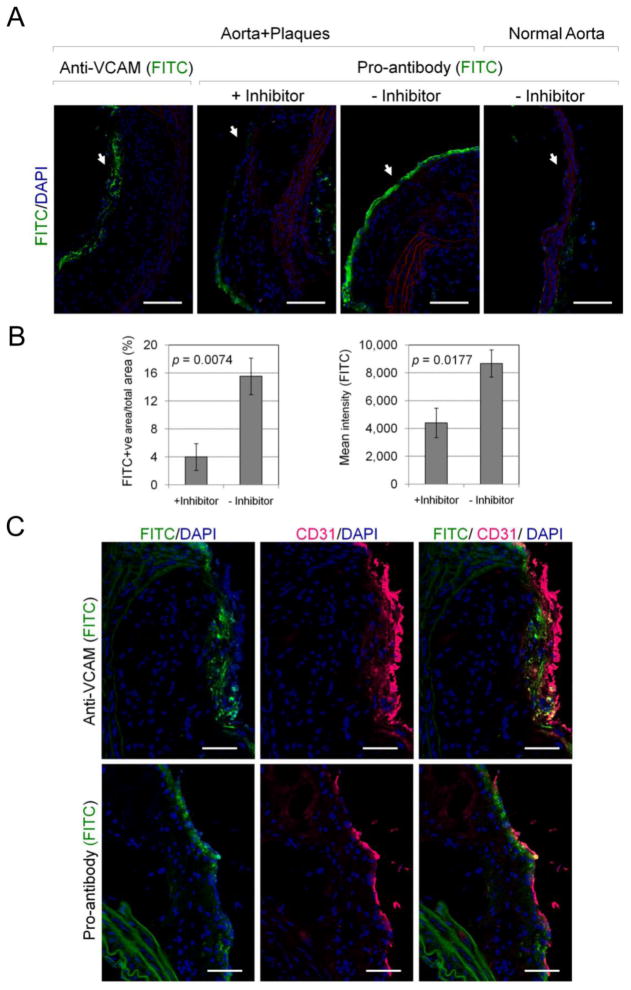
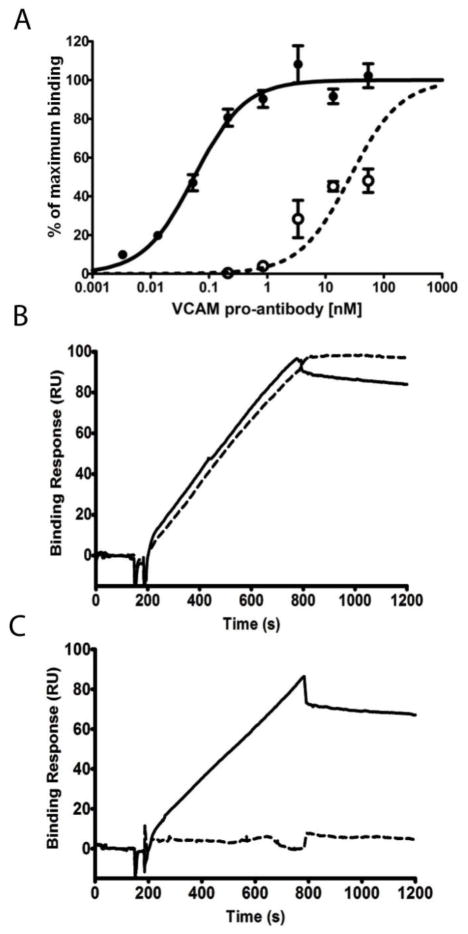
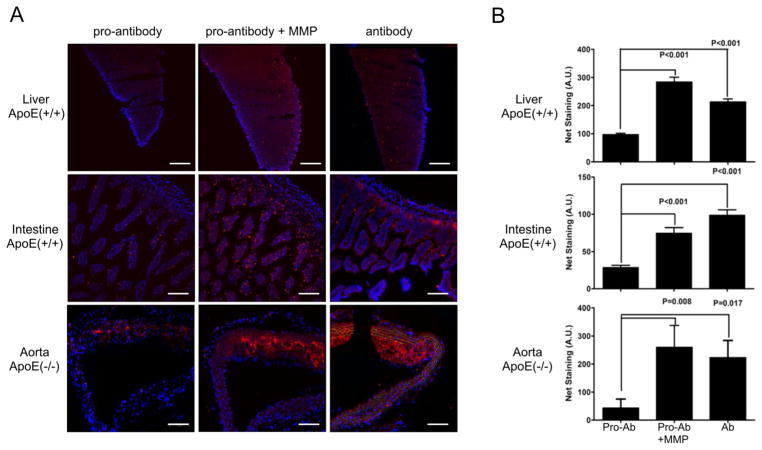
As a general strategy to selectively target antibody activity in vivo, a molecular architecture was designed to render binding activity dependent upon proteases in disease tissues. A protease-activated antibody (pro-antibody) targeting vascular cell adhesion molecule 1 (VCAM-1), a marker of atherosclerotic plaques, was constructed by tethering a binding site-masking peptide to the antibody via a matrix metalloprotease (MMP) susceptible linker. Pro-antibody activation in vitro by MMP-1 yielded a 200-fold increase in binding affinity and restored anti-VCAM-1 binding in tissue sections from ApoE⁻/⁻ mice ex vivo. The pro-antibody was efficiently activated by native proteases in aorta tissue extracts from ApoE⁻/⁻, but not from normal mice, and accumulated in aortic plaques in vivo with enhanced selectivity when compared to the unmodified antibody. Pro-antibody accumulation in aortic plaques was MMP-dependent, and significantly inhibited by a broad-spectrum MMP inhibitor. These results demonstrate that the activity of disease-associated proteases can be exploited to site-specifically target antibody activity in vivo.
作为一种选择性靶向体内抗体活性的一般策略,设计了一种分子结构,使结合活性依赖于疾病组织中的蛋白酶。通过将结合位点掩蔽肽通过基质金属蛋白酶(MMP)敏感连接子连接到抗体上,构建了一种靶向血管细胞粘附分子 1(VCAM-1)的蛋白酶激活抗体(pro-antibody),VCAM-1 是动脉粥样硬化斑块的标志物。MMP-1 在体外对 pro-antibody 的激活使结合亲和力提高了 200 倍,并恢复了 ApoE⁻/⁻小鼠离体组织切片中抗-VCAM-1 的结合。与未修饰的抗体相比,该 pro-antibody 可被源自 ApoE⁻/⁻的主动脉组织提取物中的天然蛋白酶有效激活,但不能被正常小鼠中的天然蛋白酶激活,并且在体内在主动脉斑块中积累具有增强的选择性。Pro-antibody 在主动脉斑块中的积累依赖于 MMP,并且可以被广谱 MMP 抑制剂显著抑制。这些结果表明,可以利用与疾病相关的蛋白酶的活性在体内特异性地靶向抗体活性。