Lawrence Berkeley National Laboratory, Physical Biosciences Division, Berkeley, CA 94720, USA.
Eur Biophys J. 2012 Oct;41(10):789-99. doi: 10.1007/s00249-012-0820-x. Epub 2012 May 26.
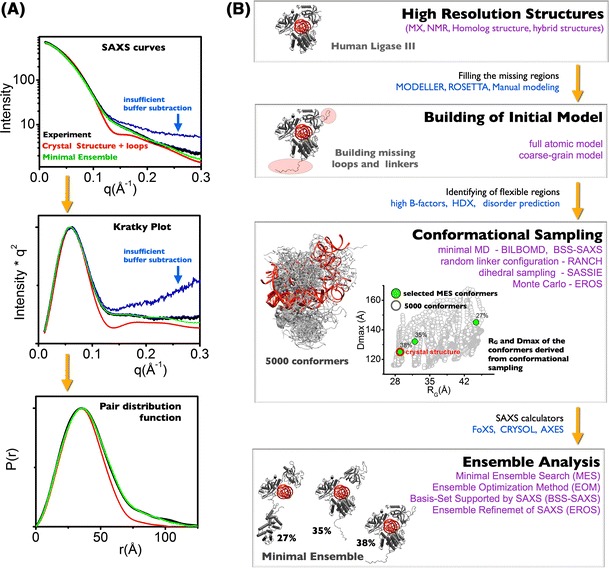
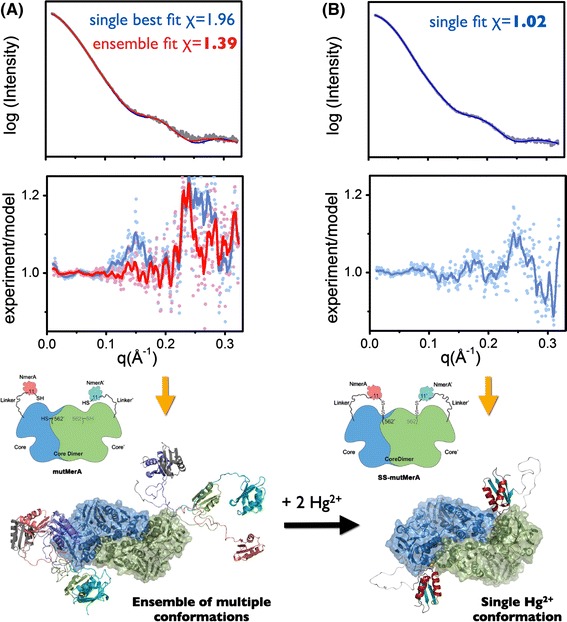
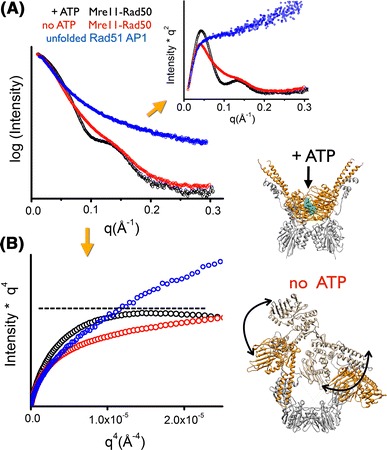
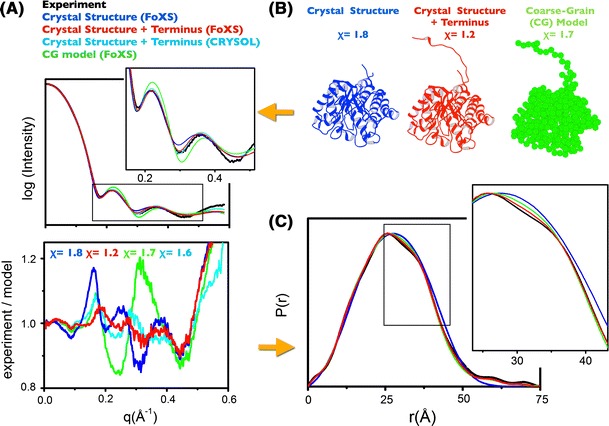
The dynamics of macromolecular conformations are critical to the action of cellular networks. Solution X-ray scattering studies, in combination with macromolecular X-ray crystallography (MX) and nuclear magnetic resonance (NMR), strive to determine complete and accurate states of macromolecules, providing novel insights describing allosteric mechanisms, supramolecular complexes, and dynamic molecular machines. This review addresses theoretical and practical concepts, concerns, and considerations for using these techniques in conjunction with computational methods to productively combine solution-scattering data with high-resolution structures. I discuss the principal means of direct identification of macromolecular flexibility from SAXS data followed by critical concerns about the methods used to calculate theoretical SAXS profiles from high-resolution structures. The SAXS profile is a direct interrogation of the thermodynamic ensemble and techniques such as, for example, minimal ensemble search (MES), enhance interpretation of SAXS experiments by describing the SAXS profiles as population-weighted thermodynamic ensembles. I discuss recent developments in computational techniques used for conformational sampling, and how these techniques provide a basis for assessing the level of the flexibility within a sample. Although these approaches sacrifice atomic detail, the knowledge gained from ensemble analysis is often appropriate for developing hypotheses and guiding biochemical experiments. Examples of the use of SAXS and combined approaches with X-ray crystallography, NMR, and computational methods to characterize dynamic assemblies are presented.
大分子构象的动力学对于细胞网络的功能至关重要。溶液 X 射线散射研究与大分子 X 射线晶体学(MX)和核磁共振(NMR)相结合,努力确定大分子的完整和准确状态,提供描述变构机制、超分子复合物和动态分子机器的新见解。本文综述了在结合使用计算方法时,使用这些技术的理论和实际概念、关注点和考虑因素,以有效地将溶液散射数据与高分辨率结构相结合。我讨论了从 SAXS 数据中直接识别大分子柔性的主要方法,然后对用于从高分辨率结构计算理论 SAXS 轮廓的方法进行了批判性的关注。SAXS 谱是对热力学集合体的直接询问,例如最小集合体搜索(MES)等技术通过将 SAXS 谱描述为群体加权热力学集合体,增强了对 SAXS 实验的解释。我讨论了用于构象采样的计算技术的最新进展,以及这些技术如何为评估样品内的灵活性水平提供基础。尽管这些方法牺牲了原子细节,但从集合体分析中获得的知识通常适合于提出假设和指导生化实验。介绍了使用 SAXS 和组合方法与 X 射线晶体学、NMR 和计算方法相结合来表征动态组装体的示例。