Department of Surgery, University of Auckland, Auckland, New Zealand; Auckland Bioengineering Institute, University of Auckland, Auckland, New Zealand.
Auckland Bioengineering Institute, University of Auckland, Auckland, New Zealand.
Gastroenterology. 2012 Sep;143(3):589-598.e3. doi: 10.1053/j.gastro.2012.05.036. Epub 2012 May 27.
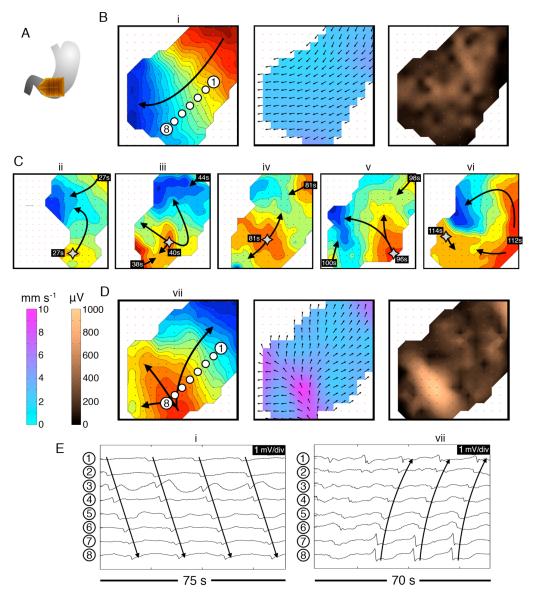
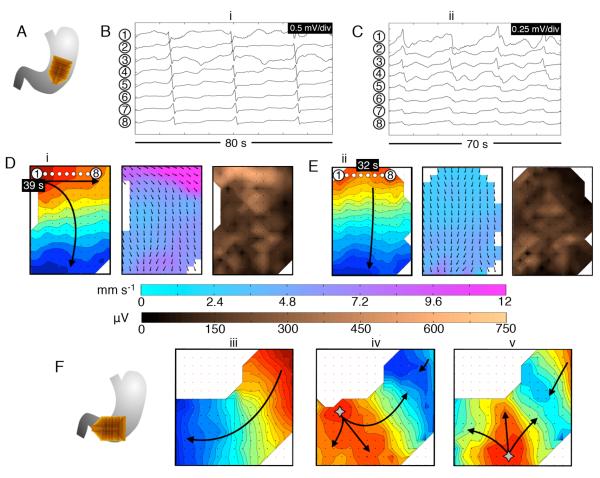
BACKGROUND & AIMS: Interstitial cells of Cajal (ICC) generate slow waves. Disrupted ICC networks and gastric dysrhythmias are each associated with gastroparesis. However, there are no data on the initiation and propagation of slow waves in gastroparesis because research tools have lacked spatial resolution. We applied high-resolution electrical mapping to quantify and classify gastroparesis slow-wave abnormalities in spatiotemporal detail.
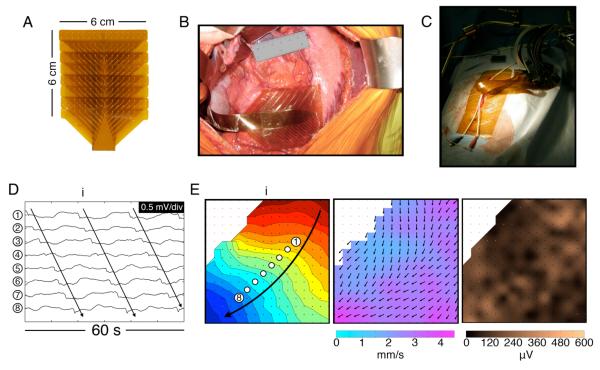
Serosal high-resolution mapping was performed using flexible arrays (256 electrodes; 36 cm(2)) at stimulator implantation in 12 patients with diabetic or idiopathic gastroparesis. Data were analyzed by isochronal mapping, velocity and amplitude field mapping, and propagation animation. ICC numbers were determined from gastric biopsy specimens.
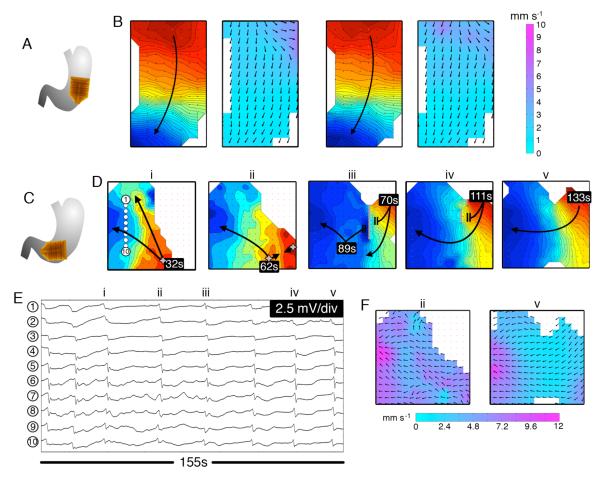
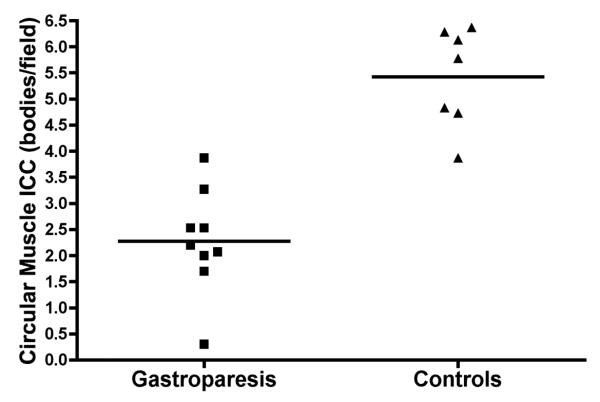
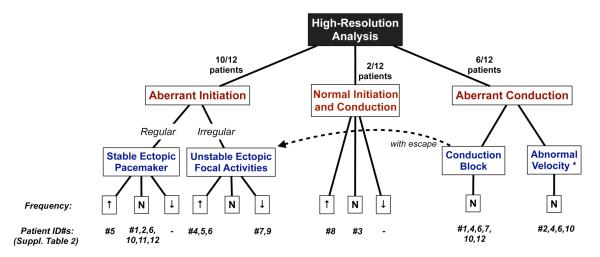
Mean ICC counts were reduced in patients with gastroparesis (2.3 vs 5.4 bodies/field; P < .001). Slow-wave abnormalities were detected by high-resolution mapping in 11 of 12 patients. Several new patterns were observed and classified as abnormal initiation (10/12; stable ectopic pacemakers or diffuse focal events; median, 3.3 cycles/min; range, 2.1-5.7 cycles/min) or abnormal conduction (7/10; reduced velocities or conduction blocks; median, 2.9 cycles/min; range, 2.1-3.6 cycles/min). Circumferential conduction emerged during aberrant initiation or incomplete block and was associated with velocity elevation (7.3 vs 2.9 mm s(-1); P = .002) and increased amplitudes beyond a low base value (415 vs 170 μV; P = .002).
High-resolution mapping revealed new categories of abnormal human slow-wave activity. Abnormalities of slow-wave initiation and conduction occur in gastroparesis, often at normal frequency, which could be missed by tests that lack spatial resolution. Irregular initiation, aberrant conduction, and low amplitude activity could contribute to the pathogenesis of gastroparesis.
Cajal 间质细胞(ICC)产生慢波。ICC 网络中断和胃节律紊乱均与胃轻瘫相关。然而,由于研究工具缺乏空间分辨率,因此尚无胃轻瘫慢波起始和传播的数据。我们应用高分辨率电描记法,以时空细节量化和分类胃轻瘫慢波异常。
在 12 例糖尿病或特发性胃轻瘫患者的刺激器植入部位进行浆膜高分辨率映射,使用柔性阵列(256 个电极;36 cm(2))。通过等时映射、速度和幅度场映射以及传播动画对数据进行分析。从胃活检标本中确定 ICC 数量。
胃轻瘫患者的 ICC 计数平均值降低(2.3 个体/视野与 5.4 个体/视野;P <.001)。高分辨率映射在 12 例患者中的 11 例中检测到慢波异常。观察到几种新的模式,并分类为异常起始(10/12;稳定的异位起搏点或弥漫性局灶事件;中位数为 3.3 个周期/分钟;范围为 2.1-5.7 个周期/分钟)或异常传导(7/10;速度降低或传导阻滞;中位数为 2.9 个周期/分钟;范围为 2.1-3.6 个周期/分钟)。在异常起始或不完全阻滞期间出现环形传导,并与速度升高(7.3 与 2.9 mm s(-1);P =.002)和高于低基础值的振幅增加(415 与 170 μV;P =.002)相关。
高分辨率映射揭示了人类新的异常慢波活动类别。胃轻瘫中存在慢波起始和传导异常,其频率通常正常,这可能会被缺乏空间分辨率的测试所遗漏。不规则起始、异常传导和低振幅活动可能导致胃轻瘫的发病机制。