Agroecology, Department of Crop Science, Georg-August-University, Grisebachstrasse 6, 37077, Göttingen, Germany.
Oecologia. 2012 Dec;170(4):1099-109. doi: 10.1007/s00442-012-2366-0. Epub 2012 May 30.
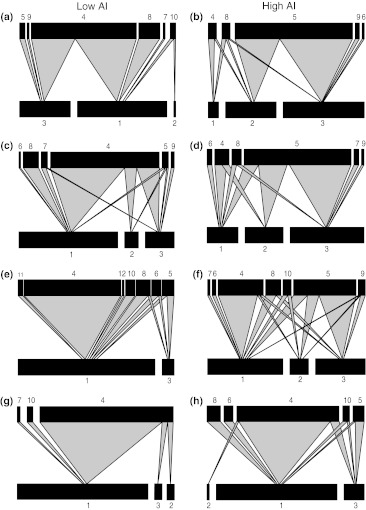
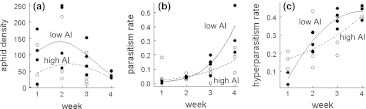
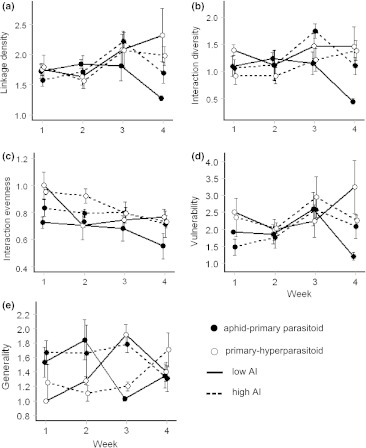
Agricultural intensification (AI) is currently a major driver of biodiversity loss and related ecosystem functioning decline. However, spatio-temporal changes in community structure induced by AI, and their relation to ecosystem functioning, remain largely unexplored. Here, we analysed 16 quantitative cereal aphid-parasitoid and parasitoid-hyperparasitoid food webs, replicated four times during the season, under contrasting AI regimes (organic farming in complex landscapes vs. conventional farming in simple landscapes). High AI increased food web complexity but also temporal variability in aphid-parasitoid food webs and in the dominant parasitoid species identity. Enhanced complexity and variability appeared to be controlled bottom-up by changes in aphid dominance structure and evenness. Contrary to the common expectations of positive biodiversity-ecosystem functioning relationships, community complexity (food-web complexity, species richness and evenness) was negatively related to primary parasitism rates. However, this relationship was positive for secondary parasitoids. Despite differences in community structures among different trophic levels, ecosystem services (parasitism rates) and disservices (aphid abundances and hyperparasitism rates) were always higher in fields with low AI. Hence, community structure and ecosystem functioning appear to be differently influenced by AI, and change differently over time and among trophic levels. In conclusion, intensified agriculture can support diverse albeit highly variable parasitoid-host communities, but ecosystem functioning might not be easy to predict from observed changes in community structure and composition.
农业集约化(AI)目前是生物多样性丧失和相关生态系统功能下降的主要驱动因素。然而,AI 引起的群落结构的时空变化及其与生态系统功能的关系在很大程度上仍未得到探索。在这里,我们分析了 16 个定量的谷类蚜虫-寄生蜂和寄生蜂-重寄生蜂食物网,在季节中重复了四次,在不同的 AI 制度下(复杂景观中的有机农业与简单景观中的常规农业)。高 AI 增加了食物网的复杂性,但也增加了蚜虫-寄生蜂食物网和优势寄生蜂物种身份的时间变异性。增强的复杂性和可变性似乎是由蚜虫优势结构和均匀性的变化引起的。与生物多样性与生态系统功能关系的常见预期相反,群落复杂性(食物网复杂性、物种丰富度和均匀度)与初级寄生率呈负相关。然而,这种关系对二级寄生者是积极的。尽管不同营养级之间的群落结构存在差异,但低 AI 农田的生态系统服务(寄生率)和生态失调(蚜虫丰度和重寄生率)总是更高。因此,群落结构和生态系统功能似乎受到 AI 的不同影响,并且随时间和营养级而变化不同。总之,集约化农业可以支持多样化但高度可变的寄生蜂-宿主群落,但生态系统功能可能不容易从观察到的群落结构和组成变化中预测。