Department of Botany and Plant Sciences, Center for Plant Cell Biology, University of California Riverside, CA, USA.
Front Plant Sci. 2012 Apr 5;3:66. doi: 10.3389/fpls.2012.00066. eCollection 2012.
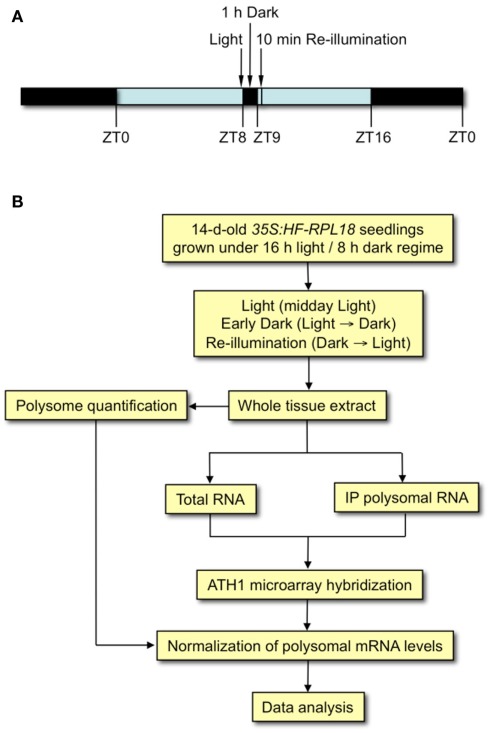
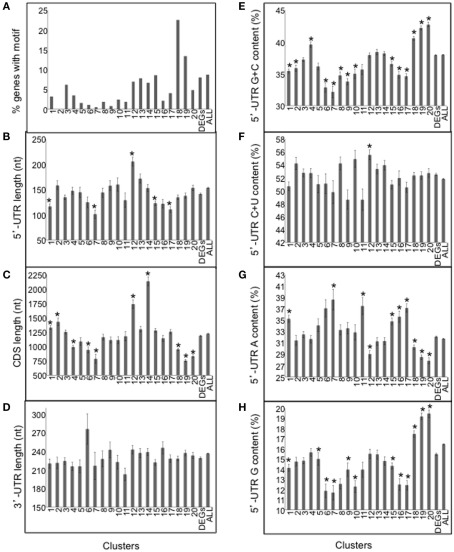
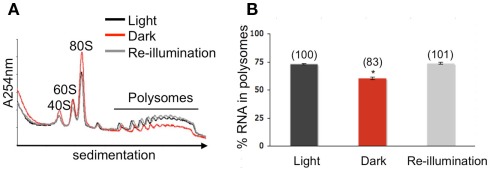
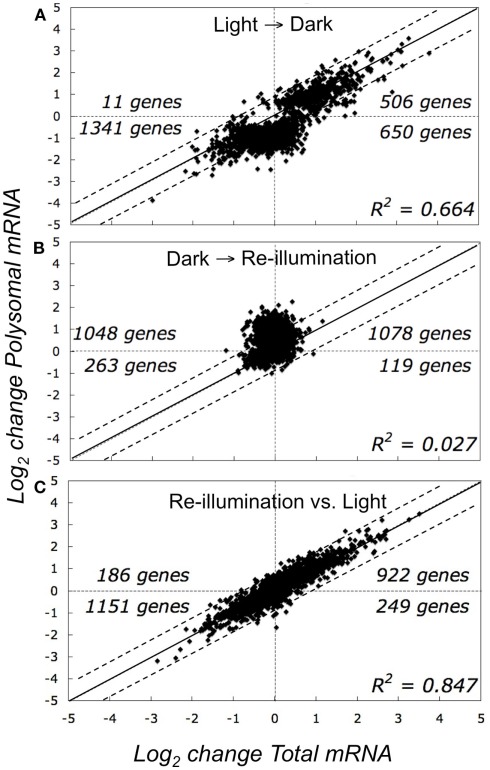
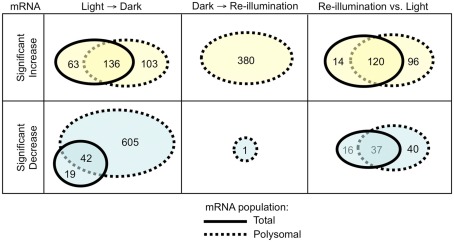
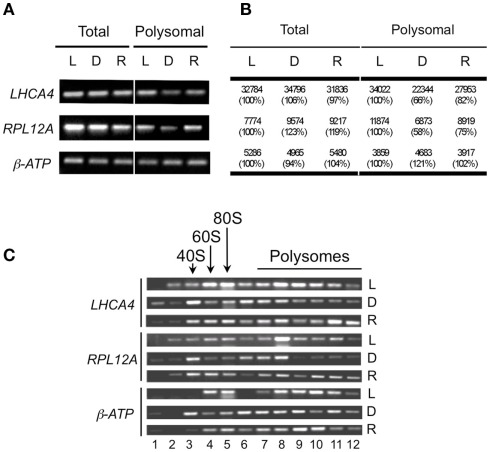
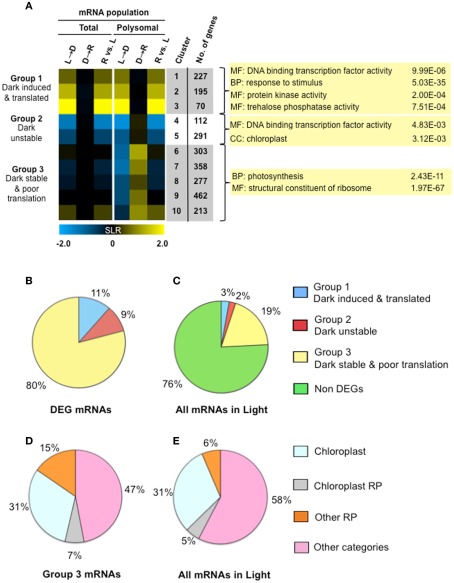
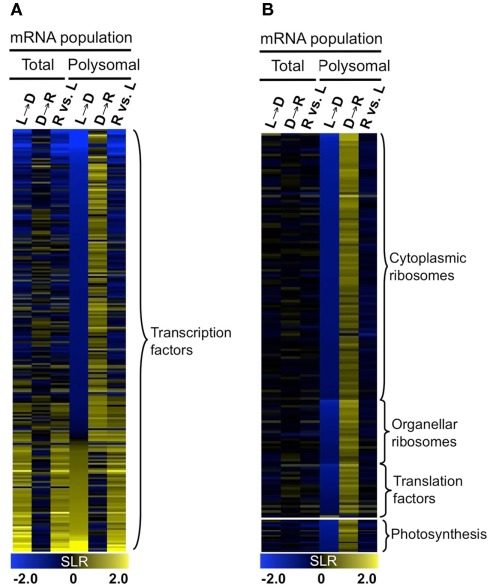
Light, a dynamic environmental parameter, is an essential regulator of plant growth and development. Light-regulated transcriptional networks are well documented, whereas light-regulated post-transcriptional regulation has received limited attention. In this study, dynamics in translation of cytosolic mRNAs were evaluated at the genome-level in Arabidopsis thaliana seedlings grown under a typical light/dark diurnal regime, shifted to darkness at midday, and then re-illuminated. One-hour of unanticipated darkness reduced levels of polysomes by 17% in a manner consistent with inhibition of initiation of translation. This down-regulation of translation was reversed within 10 min of re-illumination. Quantitative comparison of the total cellular population of transcripts (the transcriptome) to those associated with one or more 80S ribosome (the translatome) identified over 1600 mRNAs that were differentially translated in response to light availability. Unanticipated darkness limited both transcription and translation of mRNAs encoding components of the photosynthetic machinery. Many mRNAs encoding proteins associated with the energy demanding process of protein synthesis were stable but sequestered in the dark, in a rapidly reversible manner. A meta-analysis determined these same transcripts were similarly and coordinately regulated in response to changes in oxygen availability. The dark and hypoxia translationally repressed mRNAs lack highly supported candidate RNA-regulatory elements but are characterized by G + C-rich 5'-untranslated regions. We propose that modulation of translation of a subset of cellular mRNAs functions as an energy conservation mechanism.
光是一种动态的环境参数,是植物生长和发育的重要调节因子。光照调节的转录网络已经得到了很好的记录,而光照调节的转录后调节则受到了有限的关注。在这项研究中,我们在拟南芥幼苗中评估了在典型的光/暗昼夜节律下生长的细胞溶质 mRNA 的翻译动力学,这些幼苗在中午被转移到黑暗中,然后重新被照亮。出乎意料的一个小时的黑暗使多核糖体减少了 17%,这与翻译起始的抑制一致。这种翻译的下调在重新光照后的 10 分钟内得到逆转。对总细胞转录物群体(转录组)与一个或多个 80S 核糖体(翻译组)相关的转录物的定量比较,确定了 1600 多个对光照可用性有差异翻译的 mRNA。出乎意料的黑暗限制了光合作用机器组件的 mRNA 的转录和翻译。许多编码与蛋白质合成这一能量需求过程相关的蛋白的 mRNA 是稳定的,但在黑暗中以快速可逆的方式被隔离。一项荟萃分析确定,这些相同的转录物在应对氧气可用性的变化时也以类似的方式进行协调调节。黑暗和缺氧条件下翻译抑制的 mRNA 缺乏高度支持的候选 RNA 调节元件,但具有富含 G+C 的 5'非翻译区的特征。我们提出,一部分细胞 mRNA 的翻译调节作为一种能量节约机制发挥作用。