University of California, Irvine, CA, USA.
BMC Genomics. 2012 May 30;13:212. doi: 10.1186/1471-2164-13-212.
The contribution of a gene to the fitness of a bacterium can be assayed by whether and to what degree the bacterium tolerates transposon insertions in that gene. We use this fact to compare the fitness of syntenic homologous genes among related Salmonella strains and thereby reveal differences not apparent at the gene sequence level.
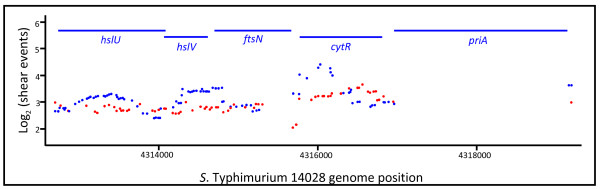
A transposon Tn5 derivative was used to construct mutants in Salmonella Typhimurium ATCC14028 (STM1) and Salmonella Typhi Ty2 (STY1), which were then grown in rich media. The locations of 234,152 and 53,556 integration sites, respectively, were mapped by sequencing. These data were compared to similar data available for a different Ty2 isolate (STY2) and essential genes identified in E. coli K-12 (ECO). Of 277 genes considered essential in ECO, all had syntenic homologs in STM1, STY1, and STY2, and all but nine genes were either devoid of transposon insertions or had very few. For three of these nine genes, part of the annotated gene lacked transposon integrations (yejM, ftsN and murB). At least one of the other six genes, trpS, had a potentially functionally redundant gene encoded elsewhere in Salmonella but not in ECO. An additional 165 genes were almost entirely devoid of transposon integrations in all three Salmonella strains examined, including many genes associated with protein and DNA synthesis. Four of these genes (STM14_1498, STM14_2872, STM14_3360, and STM14_5442) are not found in E. coli. Notable differences in the extent of gene selection were also observed among the three different Salmonella isolates. Mutations in hns, for example, were selected against in STM1 but not in the two STY strains, which have a defect in rpoS rendering hns nonessential.
Comparisons among transposon integration profiles from different members of a species and among related species, all grown in similar conditions, identify differences in gene contributions to fitness among syntenic homologs. Further differences in fitness profiles among shared genes can be expected in other selective environments, with potential relevance for comparative systems biology.
通过观察基因是否以及在何种程度上耐受转座子插入该基因,可以评估基因对细菌适应性的贡献。我们利用这一事实来比较相关沙门氏菌菌株中基因的适应性,从而揭示在基因序列水平上不明显的差异。
使用转座子 Tn5 衍生物构建了沙门氏菌 Typhimurium ATCC14028(STM1)和 Typhi Ty2(STY1)的突变体,然后在丰富的培养基中培养。通过测序定位了 234152 和 53556 个整合位点。将这些数据与 Ty2 分离株(STY2)的类似数据和大肠杆菌 K-12(ECO)中的必需基因进行比较。在 ECO 中被认为必需的 277 个基因中,所有基因在 STM1、STY1 和 STY2 中都有同源基因,除了 9 个基因外,所有基因都没有或只有很少的转座子插入。对于这 9 个基因中的 3 个,注释基因的一部分缺乏转座子整合(yejM、ftsN 和 murB)。这 9 个基因中的其他 6 个基因中的至少一个,trpS,在沙门氏菌中编码了一个潜在的功能冗余基因,但在 ECO 中没有。在所有 3 种沙门氏菌菌株中,几乎没有转座子整合的另外 165 个基因,包括许多与蛋白质和 DNA 合成相关的基因。这 4 个基因(STM14_1498、STM14_2872、STM14_3360 和 STM14_5442)在大肠杆菌中不存在。在三个不同的沙门氏菌分离株中,还观察到了基因选择程度的显著差异。例如,hns 的突变在 STM1 中被选择,但在两个 STY 菌株中没有被选择,因为 rpoS 的缺陷使 hns 变得非必需。
在同一物种的不同成员和相关物种之间,比较转座子整合图谱,并在相似条件下生长,可确定基因在适应性方面的差异。在其他选择环境中,共享基因的适应性谱可能会有进一步的差异,这可能对比较系统生物学有潜在的影响。