Department of Biological Sciences, Lehigh University Bethlehem, PA, USA.
Front Endocrinol (Lausanne). 2011 Dec 27;2:101. doi: 10.3389/fendo.2011.00101. eCollection 2011.
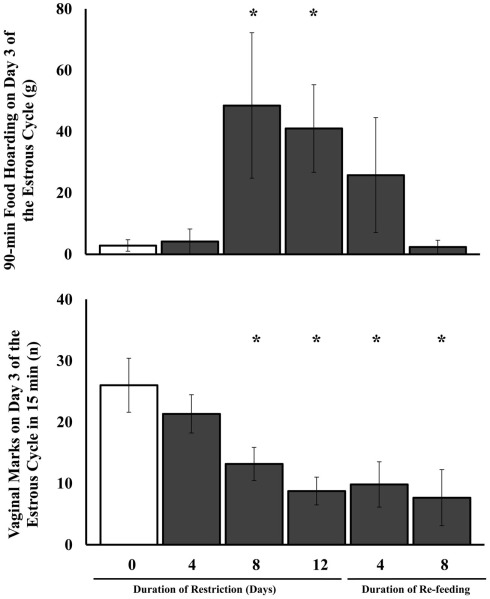
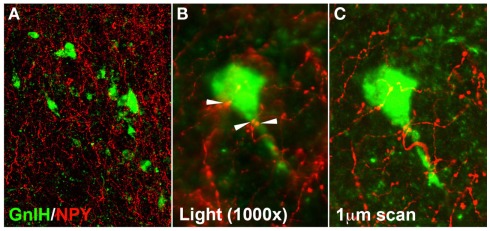
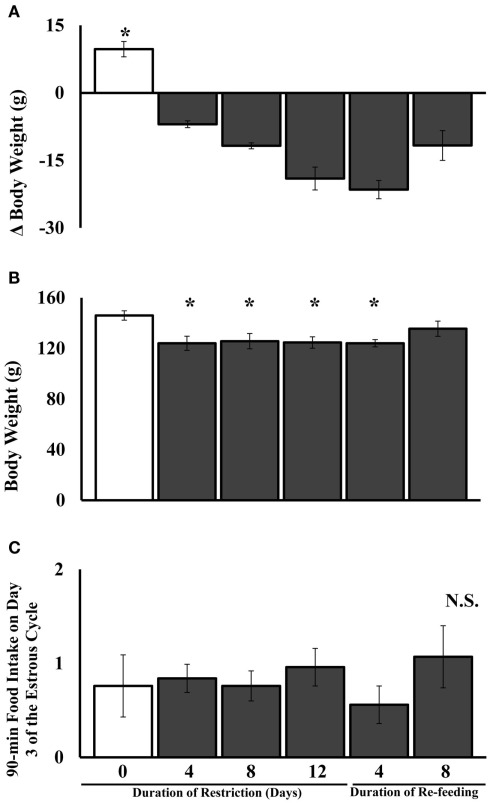
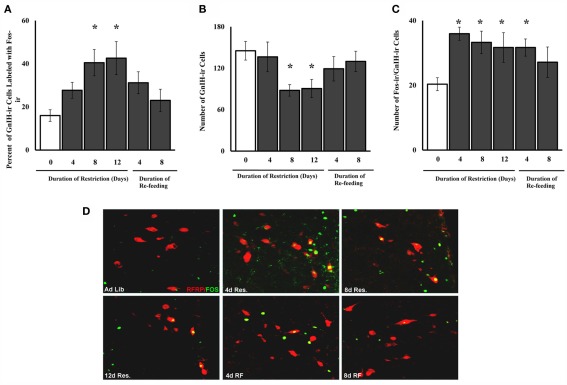
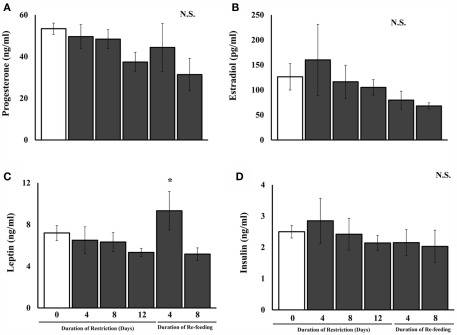
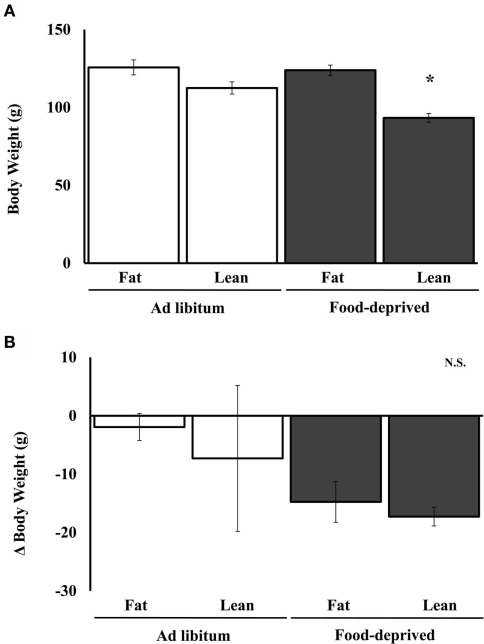
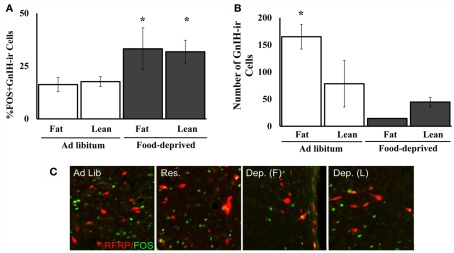
We hypothesized that putative anorectic and orexigenic peptides control the motivation to engage in either ingestive or sex behaviors, and these peptides function to optimize reproductive success in environments where energy fluctuates. Here, the putative orexigenic peptide, gonadotropin-inhibiting hormone (GnIH, also known as RFamide-related peptide-3), and the putative anorectic hormones leptin, insulin, and estradiol were examined during the course of food restriction. Groups of female Syrian hamsters were restricted to 75% of their ad libitum food intake or fed ad libitum for 4, 8, or 12 days. Two other groups were food-restricted for 12 days and then re-fed ad libitum for 4 or 8 days. After testing for sex and ingestive behavior, blood was sampled and assayed for peripheral hormones. Brains were immunohistochemically double-labeled for GnIH and the protein product of the immediate early gene, c-fos, a marker of cellular activation. Food hoarding, the number of double-labeled cells, and the percent of GnIH-Ir cells labeled with Fos-Ir were significantly increased at 8 and 12 days after the start of food restriction. Vaginal scent marking and GnIH-Ir cell number significantly decreased after the same duration of restriction. Food hoarding, but not food intake, was significantly positively correlated with cellular activation in GnIH-Ir cells. Vaginal scent marking was significantly negatively correlated with cellular activation in GnIH-Ir cells. There were no significant effects of food restriction on plasma insulin, leptin, estradiol, or progesterone concentrations. In the dorsomedial hypothalamus (DMH) of energetically challenged females, strong projections from NPY-Ir cells were found in close apposition to GnIH-Ir cells. Together these results are consistent with the idea that metabolic signals influence sexual and ingestive motivation via NPY fibers that project to GnIH cells in the DMH.
我们假设假定的厌食和食欲肽控制着进行摄入或性行为的动机,这些肽的功能是在能量波动的环境中优化生殖成功。在这里,研究了假定的食欲肽、促性腺激素抑制激素(GnIH,也称为 RFamide 相关肽-3)和假定的厌食激素瘦素、胰岛素和雌二醇在食物限制过程中的作用。将一组雌性叙利亚仓鼠限制在其自由进食量的 75%,或自由进食 4、8 或 12 天。另外两组仓鼠限制进食 12 天,然后恢复自由进食 4 或 8 天。在测试性行为和摄入性行为后,采集血液并检测外周激素。用 GnIH 和即时早期基因 c-fos 的蛋白质产物(细胞激活的标志物)对大脑进行免疫组织化学双重标记。在开始食物限制后的 8 和 12 天,食物囤积、双标记细胞的数量以及 Fos-Ir 标记的 GnIH-Ir 细胞的百分比显著增加。在同样的限制时间后,阴道气味标记和 GnIH-Ir 细胞数量显著减少。食物囤积,但不是食物摄入,与 GnIH-Ir 细胞中的细胞激活呈显著正相关。阴道气味标记与 GnIH-Ir 细胞中的细胞激活呈显著负相关。食物限制对血浆胰岛素、瘦素、雌二醇或孕酮浓度没有显著影响。在能量受到挑战的雌性的下丘脑背内侧核(DMH)中,发现 NPY-Ir 细胞的强投射与 GnIH-Ir 细胞紧密毗邻。这些结果共同表明,代谢信号通过投射到 DMH 中的 GnIH 细胞的 NPY 纤维影响性和摄入动机。