Barqawi Al B, Krughoff Kevin J, Eid Khadijah
Division of Urology, University of Colorado Denver, Aurora, CO 80045, USA.
Adv Urol. 2012;2012:862639. doi: 10.1155/2012/862639. Epub 2012 May 10.
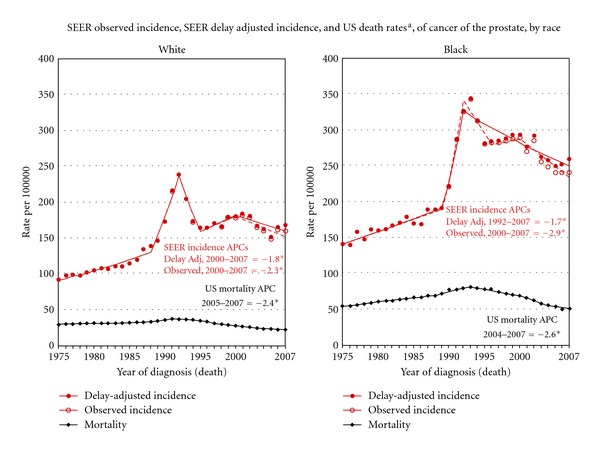
Among men, prostate cancer has a high prevalence, with relatively lower cancer-specific mortality risk compared to lung and colon cancer. Prostate-specific antigen (PSA) screening has increased prostate cancer awareness since its implementation as a screening tool almost 25 years ago, but, due to the largely indolent course of this disease and the unspecific nature of the PSA test, increased incidence has largely been associated with cancers that would not go on to cause death (clinically insignificant), leading to an overdiagnosis challenge and an ensuing overtreatment consequences. The overtreatment problem is exacerbated by the high risk of side effects that current treatment techniques have, putting patients' quality of life at risk with little or no survival benefit. The goals of this paper are to evaluate the rise, prevalence, and impact of the overdiagnosis and ensuing overtreatment problems, as well as highlight potential solutions. In this effort, a review of major epidemiological and screening studies, cancer statistics from the advent of prostate-specific antigen screening to the present, and reports on patient concerns and treatment outcomes was conducted to present the dominant factors that underlie current challenges in prostate cancer treatment and illuminate potential solutions.
在男性中,前列腺癌的患病率很高,与肺癌和结肠癌相比,其癌症特异性死亡风险相对较低。自近25年前作为一种筛查工具实施以来,前列腺特异性抗原(PSA)筛查提高了人们对前列腺癌的认识,但是,由于这种疾病在很大程度上发展缓慢,且PSA检测具有非特异性,发病率的增加在很大程度上与那些不会导致死亡的癌症(临床意义不显著)相关,从而引发了过度诊断的问题以及随之而来的过度治疗后果。当前治疗技术产生副作用的高风险加剧了过度治疗问题,使患者的生活质量面临风险,而生存获益甚微或没有生存获益。本文的目的是评估过度诊断及随之而来的过度治疗问题的出现、患病率和影响,并突出潜在的解决方案。为此,对主要的流行病学和筛查研究、从前列腺特异性抗原筛查出现到现在的癌症统计数据以及关于患者担忧和治疗结果的报告进行了综述,以呈现当前前列腺癌治疗挑战背后的主要因素,并阐明潜在的解决方案。