Computational Biomodeling (CoBi) Core and Department of Biomedical Engineering Lerner Research Institute, Cleveland Clinic, Cleveland, Ohio, United States of America.
PLoS One. 2012;7(5):e37538. doi: 10.1371/journal.pone.0037538. Epub 2012 May 23.
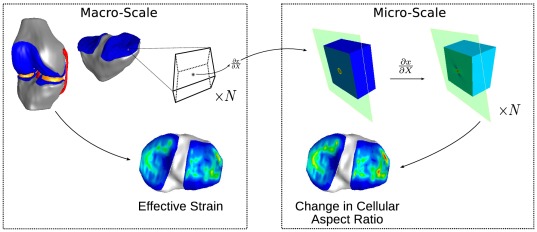
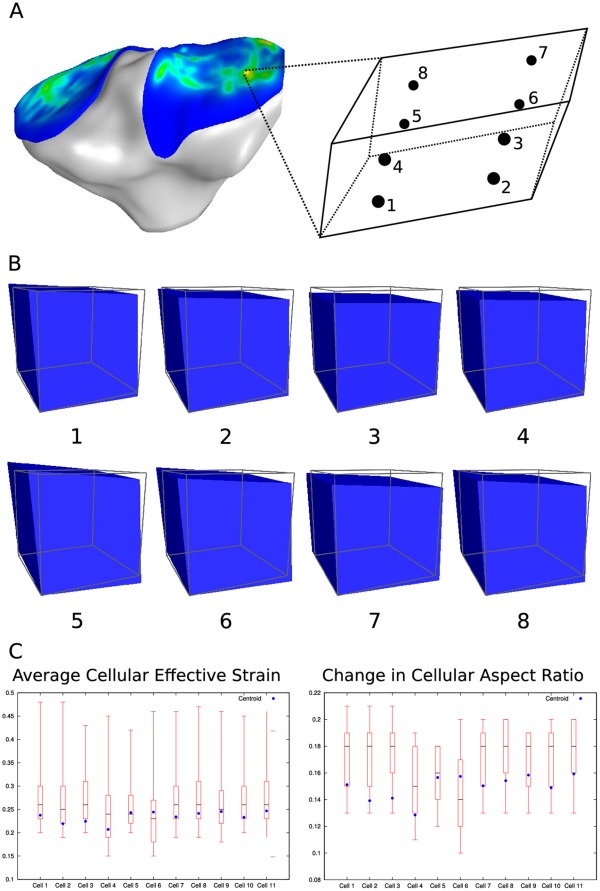
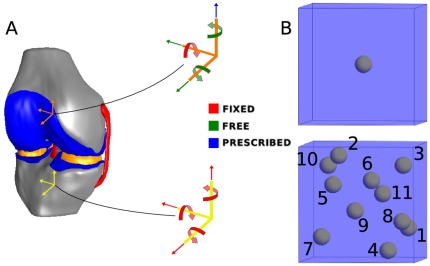
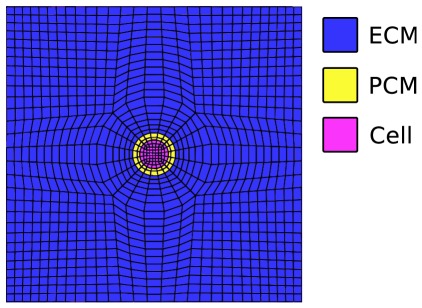
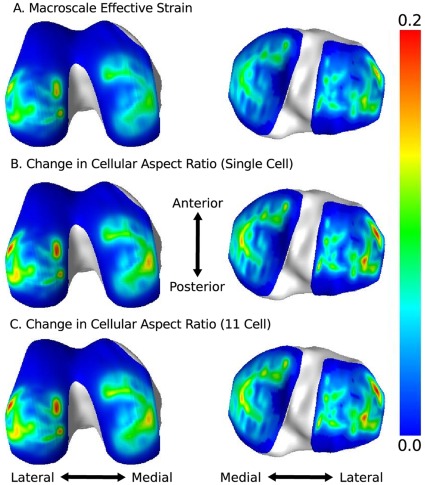
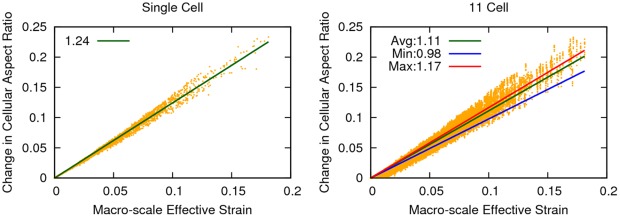
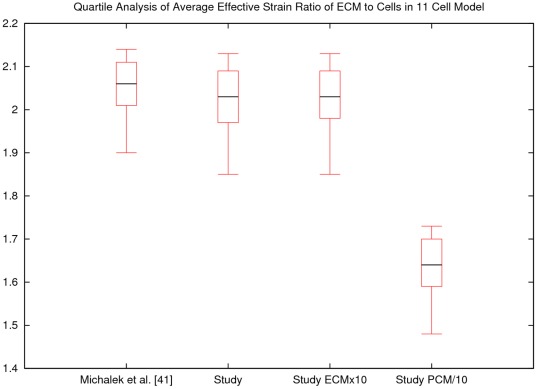
Cells of the musculoskeletal system are known to respond to mechanical loading and chondrocytes within the cartilage are not an exception. However, understanding how joint level loads relate to cell level deformations, e.g. in the cartilage, is not a straightforward task. In this study, a multi-scale analysis pipeline was implemented to post-process the results of a macro-scale finite element (FE) tibiofemoral joint model to provide joint mechanics based displacement boundary conditions to micro-scale cellular FE models of the cartilage, for the purpose of characterizing chondrocyte deformations in relation to tibiofemoral joint loading. It was possible to identify the load distribution within the knee among its tissue structures and ultimately within the cartilage among its extracellular matrix, pericellular environment and resident chondrocytes. Various cellular deformation metrics (aspect ratio change, volumetric strain, cellular effective strain and maximum shear strain) were calculated. To illustrate further utility of this multi-scale modeling pipeline, two micro-scale cartilage constructs were considered: an idealized single cell at the centroid of a 100×100×100 μm block commonly used in past research studies, and an anatomically based (11 cell model of the same volume) representation of the middle zone of tibiofemoral cartilage. In both cases, chondrocytes experienced amplified deformations compared to those at the macro-scale, predicted by simulating one body weight compressive loading on the tibiofemoral joint. In the 11 cell case, all cells experienced less deformation than the single cell case, and also exhibited a larger variance in deformation compared to other cells residing in the same block. The coupling method proved to be highly scalable due to micro-scale model independence that allowed for exploitation of distributed memory computing architecture. The method's generalized nature also allows for substitution of any macro-scale and/or micro-scale model providing application for other multi-scale continuum mechanics problems.
骨骼肌系统的细胞已知会对机械载荷作出响应,软骨内的软骨细胞也不例外。然而,了解关节水平的载荷如何与细胞水平的变形相关,例如在软骨中,并不是一项直接的任务。在这项研究中,实施了一种多尺度分析管道,以对宏观尺度有限元(FE)胫股关节模型的结果进行后处理,为软骨的微观尺度细胞 FE 模型提供基于关节力学的位移边界条件,目的是描述与胫股关节载荷相关的软骨细胞变形。可以在膝关节的组织结构中确定载荷分布,最终在软骨的细胞外基质、细胞周环境和驻留软骨细胞中确定载荷分布。计算了各种细胞变形度量(纵横比变化、体积应变、细胞有效应变和最大剪切应变)。为了进一步说明这种多尺度建模管道的实用性,考虑了两个微观软骨结构:一个是过去研究中常用的 100×100×100μm 块体心处的理想化单个细胞,另一个是解剖学上基于(相同体积的 11 个细胞模型)的胫股软骨中间区的代表。在这两种情况下,与模拟施加在胫股关节上的一个体重压缩载荷时在宏观尺度上预测的相比,软骨细胞经历了放大的变形。在 11 个细胞的情况下,所有细胞的变形都比单个细胞的变形小,而且与位于同一块体中的其他细胞相比,变形的方差也更大。由于微尺度模型的独立性,耦合方法具有高度可扩展性,允许利用分布式内存计算架构。该方法的通用性还允许替代任何宏观和/或微观模型,为其他多尺度连续力学问题提供应用。