Departamento de Fisiologia, Instituto de Biociências, Universidade de São Paulo, São Paulo, São Paulo, Brazil.
PLoS One. 2012;7(5):e37918. doi: 10.1371/journal.pone.0037918. Epub 2012 May 23.
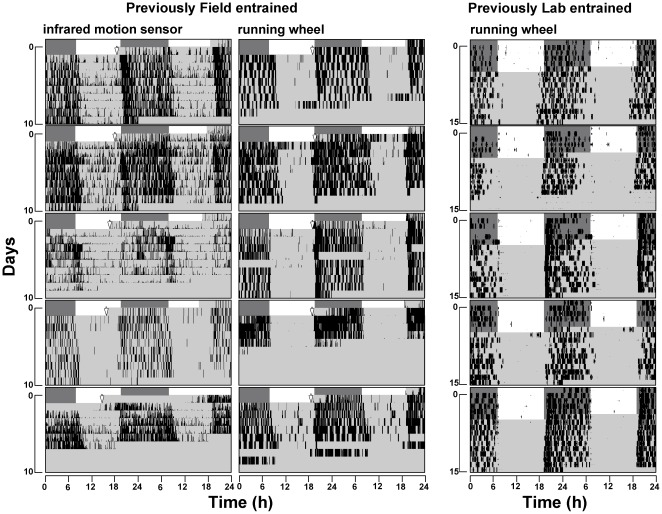
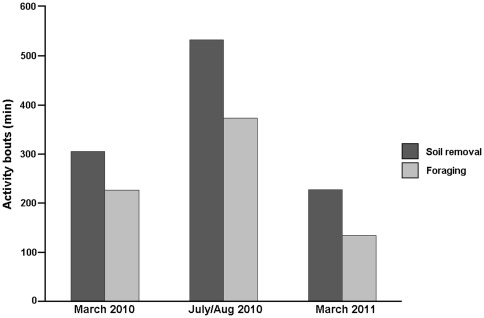
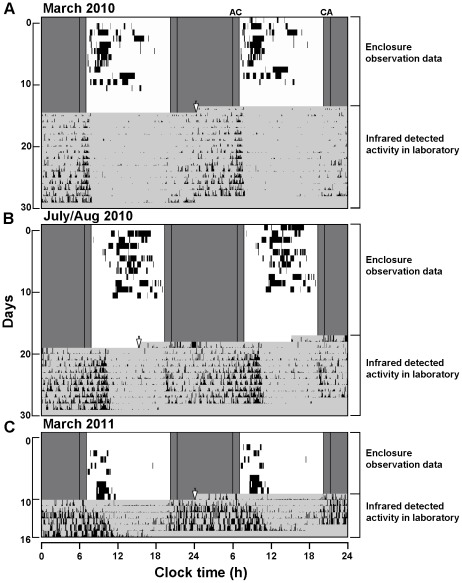
South American subterranean rodents (Ctenomys aff. knighti), commonly known as tuco-tucos, display nocturnal, wheel-running behavior under light-dark (LD) conditions, and free-running periods >24 h in constant darkness (DD). However, several reports in the field suggested that a substantial amount of activity occurs during daylight hours, leading us to question whether circadian entrainment in the laboratory accurately reflects behavior in natural conditions. We compared circadian patterns of locomotor activity in DD of animals previously entrained to full laboratory LD cycles (LD12:12) with those of animals that were trapped directly from the field. In both cases, activity onsets in DD immediately reflected the previous dark onset or sundown. Furthermore, freerunning periods upon release into DD were close to 24 h indicating aftereffects of prior entrainment, similarly in both conditions. No difference was detected in the phase of activity measured with and without access to a running wheel. However, when individuals were observed continuously during daylight hours in a semi-natural enclosure, they emerged above-ground on a daily basis. These day-time activities consisted of foraging and burrow maintenance, suggesting that the designation of this species as nocturnal might be inaccurate in the field. Our study of a solitary subterranean species suggests that the circadian clock is entrained similarly under field and laboratory conditions and that day-time activity expressed only in the field is required for foraging and may not be time-dictated by the circadian pacemaker.
南美穴居啮齿动物(Ctenomys aff. knighti),通常被称为 tuco-tucos,在光照-黑暗(LD)条件下表现出夜间、转轮行为,在持续黑暗(DD)中自由运行周期>24 小时。然而,野外的一些报告表明,大量的活动发生在白天,这使我们质疑实验室中的昼夜节律同步是否准确反映了自然条件下的行为。我们比较了先前在完全实验室 LD 周期(LD12:12)中同步的动物在 DD 中的昼夜节律活动模式与直接从野外捕获的动物的活动模式。在这两种情况下,DD 中的活动起始立即反映了先前的黑暗起始或日落后的时间。此外,释放到 DD 后自由运行的周期接近 24 小时,表明先前同步的后效,两种情况下都相似。在有和没有跑步轮的情况下测量的活动相位没有差异。然而,当个体在半自然围栏中连续观察到白天时,它们每天都会出现在地面上。这些白天的活动包括觅食和洞穴维护,这表明在野外,将该物种指定为夜间可能不准确。我们对独居地下物种的研究表明,昼夜节律时钟在野外和实验室条件下同步,并且仅在野外表达的白天活动是觅食所必需的,并且可能不受昼夜节律起搏器的时间控制。