Heat Shock Proteins and Cancer, INSERM, UMR 866 IFR 100, Faculty of Medicine Dijon, France.
Front Oncol. 2011 Nov 10;1:37. doi: 10.3389/fonc.2011.00037. eCollection 2011.
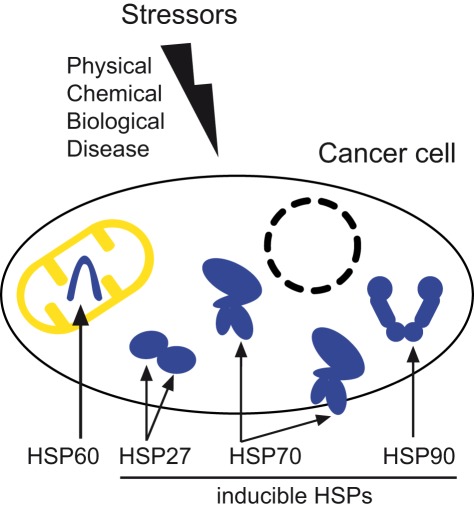
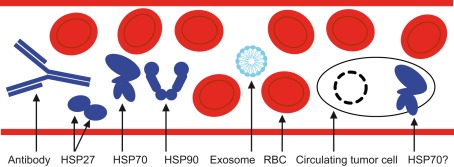
First discovered in 1962, heat shock proteins (HSPs) are highly studied with about 35,500 publications on the subject to date. HSPs are highly conserved, function as molecular chaperones for a large panel of "client" proteins and have strong cytoprotective properties. Induced by many different stress signals, they promote cell survival in adverse conditions. Therefore, their roles have been investigated in several conditions and pathologies where HSPs accumulate, such as in cancer. Among the diverse mammalian HSPs, some members share several features that may qualify them as cancer biomarkers. This review focuses mainly on three inducible HSPs: HSP27, HPS70, and HSP90. Our survey of recent literature highlights some recurring weaknesses in studies of the HSPs, but also identifies findings that indicate that some HSPs have potential as cancer biomarkers for successful clinical applications.
首次发现于 1962 年,热休克蛋白(HSPs)受到高度研究,目前已有约 35500 篇相关文献。HSPs 高度保守,作为“客户”蛋白的分子伴侣发挥作用,具有强大的细胞保护特性。它们受许多不同的应激信号诱导,在不利条件下促进细胞存活。因此,它们的作用已在 HSPs 积累的几种情况和病理学中得到研究,如癌症。在多种哺乳动物 HSPs 中,一些成员具有一些共同的特征,使它们有资格成为癌症生物标志物。本综述主要集中在三种诱导型 HSPs:HSP27、HSP70 和 HSP90。我们对最新文献的调查突出了 HSPs 研究中一些反复出现的弱点,但也确定了一些发现,表明一些 HSPs 具有作为癌症生物标志物的潜力,可成功应用于临床。