Unit of Cellular Signaling, Department of Biological Chemistry, The Alexander Silberman Institute of Life Sciences, The Hebrew University of Jerusalem Jerusalem, Israel.
Front Oncol. 2012 Feb 8;2:4. doi: 10.3389/fonc.2012.00004. eCollection 2012.
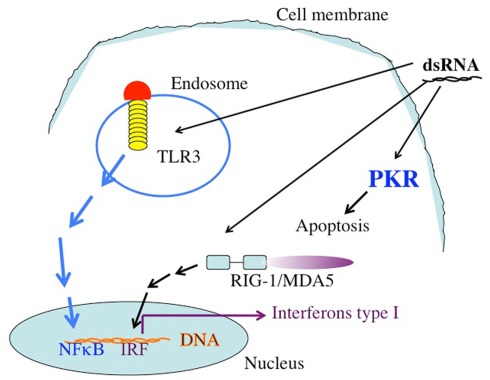
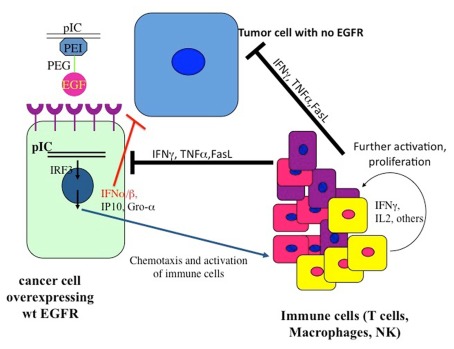
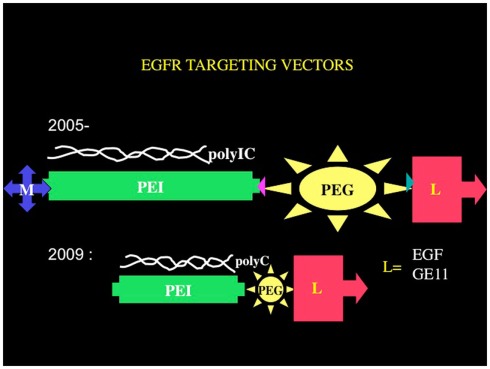
Cancer researchers have been looking for ways to harness the immune system and to reinstate immune surveillance, to kill cancer cells without collateral damage. Here we scan current approaches to targeting the immune system against cancer, and emphasize our own approach. We are using chemical vectors attached to a specific ligand, to introduce synthetic dsRNA, polyinosine/cytosine (polyIC), into tumors. The ligand binds to a receptor protein that is overexpressed on the surface of the tumor cells. Upon ligand binding, the receptor complex is internalized, introducing the polyIC into the cell. In this fashion a large amount of synthetic dsRNA can be internalized, leading to the activation of dsRNA-binding proteins, such as dsRNA dependent protein kinase (PKR), Toll-like receptor 3 (TLR3), retinoic acid-inducible gene I (RIG-1), and melanoma differentiation-associated gene 5 (MDA5). The simultaneous activation of these signaling proteins leads to the rapid demise of the targeted cell and to cytokine secretion. The cytokines lead to a strong bystander effect and to the recruitment of immune cells that converge upon the targeted cells. The bystander effects lead to the destruction of neighboring tumor cells not targeted themselves by the vector. Normal cells, being more robust than tumor cells, survive. This strategy has several advantages: (1) recruitment of the immune system is localized to the tumor. (2) The response is rapid, leading to fast tumor eradication. (3) The bystander effects lead to the eradication of tumor cells not harboring the target. (4) The multiplicity of pro-death signaling pathways elicited by PolyIC minimizes the likelihood of the emergence of resistance. In this chapter we focus on EGFR as the targeted receptor, which is overexpressed in many tumors. In principle, the strategy can be extended to other tumors that overexpress a protein that can be internalized by a ligand, which can be a small molecule, a single chain antibody, or an affibody.
癌症研究人员一直在寻找利用免疫系统并重新建立免疫监视的方法,以杀死癌细胞而不造成附带损伤。在这里,我们扫描了针对癌症的免疫系统的当前方法,并强调了我们自己的方法。我们使用附着在特定配体上的化学载体将合成双链 RNA(dsRNA)、聚肌苷酸/胞苷(polyIC)引入肿瘤。配体与肿瘤细胞表面过表达的受体蛋白结合。配体结合后,受体复合物被内化,将 polyIC 导入细胞。通过这种方式,可以摄取大量的合成 dsRNA,从而激活 dsRNA 结合蛋白,如 dsRNA 依赖性蛋白激酶(PKR)、Toll 样受体 3(TLR3)、维甲酸诱导基因 I(RIG-1)和黑色素瘤分化相关基因 5(MDA5)。这些信号蛋白的同时激活导致靶向细胞的迅速死亡和细胞因子的分泌。细胞因子导致强烈的旁观者效应,并招募聚集在靶向细胞上的免疫细胞。旁观者效应导致未被载体靶向的邻近肿瘤细胞的破坏。正常细胞比肿瘤细胞更健壮,因此能够存活。这种策略有几个优点:(1)免疫系统的募集仅限于肿瘤部位。(2)反应迅速,导致肿瘤迅速消除。(3)旁观者效应导致未携带靶标的肿瘤细胞的消除。(4)PolyIC 引发的多种促死亡信号通路最小化了出现耐药性的可能性。在本章中,我们重点介绍 EGFR 作为靶向受体,其在许多肿瘤中过表达。原则上,该策略可以扩展到其他过表达可被配体内化的蛋白质的肿瘤,配体可以是小分子、单链抗体或亲和体。