First Department of Medicine, Hokkaido University School of Medicine, and Division of Laboratory and Transfusion Medicine, Hokkaido University Hospital, Sapporo, Japan.
J Transl Med. 2012 Jul 11;10:111. doi: 10.1186/1479-5876-10-111.
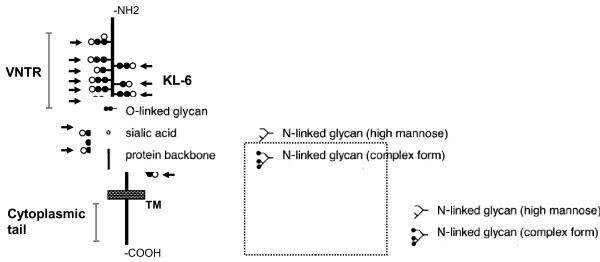
Serum Krebs von den Lungen-6 (KL-6), which is classified as human mucin-1 (MUC1), is used as a marker of sarcoidosis and other interstitial lung diseases. However, there remain some limitations due to a lack of information on the factors contributing to increased levels of serum KL-6. This study was designed to investigate the factors contributing to increased levels of serum KL-6 by molecular analysis.
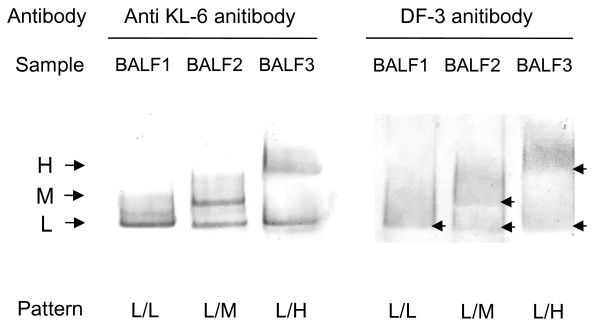
Western blot analysis using anti-KL-6 antibody was performed simultaneously on the bronchoalveolar lavage fluid (BALF) and serum obtained from 128 subjects with sarcoidosis.
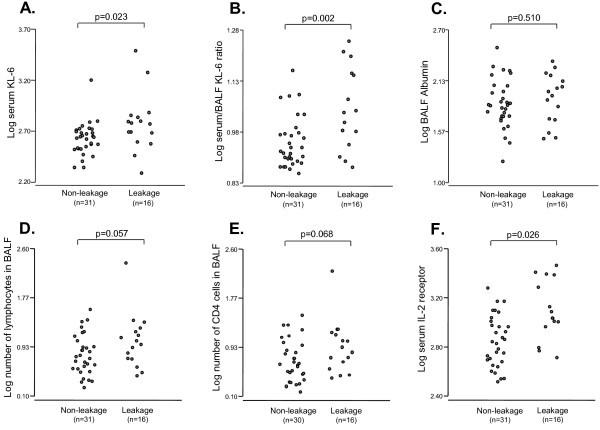
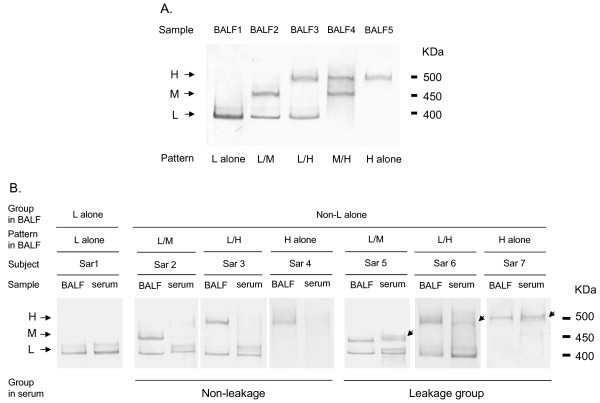
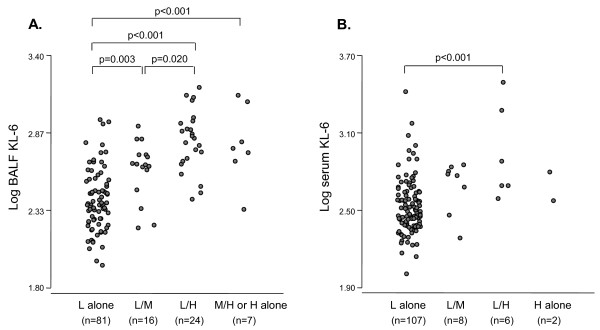
KL-6/MUC1 in BALF showed three bands and five band patterns. These band patterns were associated with the MUC1 genotype and the KL-6 levels. KL-6/MUC1 band patterns in serum were dependent on molecular size class in BALF. Significantly increased levels of serum KL-6, serum/BALF KL-6 ratio and serum soluble interleukin 2 receptor were observed in the subjects with influx of high molecular size KL-6/MUC1 from the alveoli to blood circulation. The multivariate linear regression analysis involving potentially relevant variables such as age, gender, smoking status, lung parenchymal involvement based on radiographical stage and molecular size of KL-6/MUC1 in serum showed that the molecular size of KL-6/MUC1 in serum was significant independent determinant of serum KL-6 levels.
The molecular structural variants of KL-6/MUC1 and its leakage behavior affect serum levels of KL-6 in sarcoidosis. This information may assist in the interpretation of serum KL-6 levels in sarcoidosis.
血清 Krebs von den Lungen-6(KL-6)被归类为人类粘蛋白-1(MUC1),被用作结节病和其他间质性肺疾病的标志物。然而,由于缺乏关于导致血清 KL-6 水平升高的因素的信息,因此仍然存在一些局限性。本研究旨在通过分子分析研究导致血清 KL-6 水平升高的因素。
使用抗 KL-6 抗体对 128 例结节病患者的支气管肺泡灌洗液(BALF)和血清同时进行 Western blot 分析。
BALF 中的 KL-6/MUC1 显示出三条带和五条带模式。这些带型与 MUC1 基因型和 KL-6 水平有关。血清中的 KL-6/MUC1 带型取决于 BALF 中的分子大小类别。在肺泡到血液循环中高相对分子质量 KL-6/MUC1 流入的患者中,观察到血清 KL-6 水平、血清/BALF KL-6 比值和血清可溶性白细胞介素 2 受体显著升高。涉及年龄、性别、吸烟状况、基于影像学分期的肺实质受累以及血清中 KL-6/MUC1 分子大小等潜在相关变量的多元线性回归分析显示,血清中 KL-6/MUC1 的分子大小是血清 KL-6 水平的重要独立决定因素。
KL-6/MUC1 的分子结构变异及其渗漏行为影响结节病患者的血清 KL-6 水平。这些信息可能有助于解释结节病患者的血清 KL-6 水平。