Valenti Marco, Vinciguerra Maria Giulia, Masedu Francesco, Tiberti Sergio, Sconci Vittorio
Department of Medicine and Public Health, University of L'Aquila, L'Aquila, Italy.
BMJ Open. 2012 May 31;2(3). doi: 10.1136/bmjopen-2012-000824. Print 2012.
To assess and estimate the personality changes that occurred before and after the 2009 earthquake in L'Aquila and to model the ways that the earthquake affected adolescents according to gender and sport practice. The consequences of earthquakes on psychological health are long lasting for portions of the population, depending on age, gender, social conditions and individual experiences. Sports activities are considered a factor with which to test the overall earthquake impact on individual and social psychological changes in adolescents.
Before and after design.
Population-based study conducted in L'Aquila, Italy, before and after the 2009 earthquake.
Before the earthquake, a random sample of 179 adolescent subjects who either practised or did not practise sports (71 vs 108, respectively). After the earthquake, of the original 179 subjects, 149 were assessed a second time.
Minnesota Multiphasic Personality Inventory-Adolescents (MMPI-A) questionnaire scores, in a supervised environment.
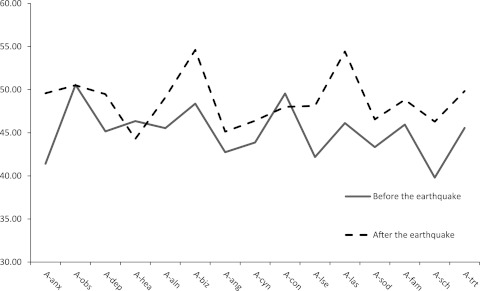
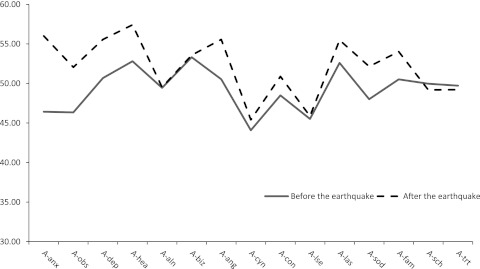
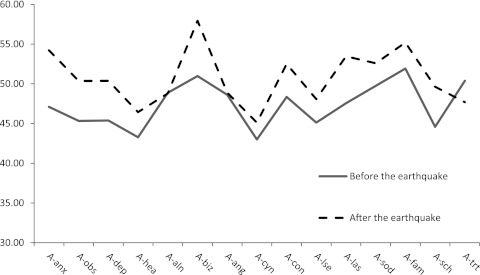
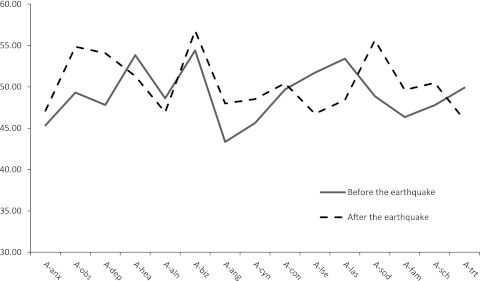
An unbalanced split plot design, at a 0.05 significance level, was carried out using a linear mixed model with quake, sex and sports practice as predictive factors. Although the overall scores indicated no deviant behaviours in the adolescents tested, changes were detected in many individual content scale scores, including depression (A-dep score mean ± SEM: before quake =47.54±0.73; after quake =52.67±0.86) and social discomfort (A-sod score mean ± SEM: before quake =49.91±0.65; after quake =51.72±0.81). The MMPI-A profiles show different impacts of the earthquake on adolescents according to gender and sport practice.
The differences detected in MMPI-A scores raise issues about social policies required to address the psychological changes in adolescents. The current study supports the idea that sport should be considered part of a coping strategy to assist adolescents in dealing with the psychological effects of the earthquakes on their personalities.
评估并估计2009年拉奎拉地震前后发生的人格变化,并根据性别和体育活动习惯模拟地震对青少年的影响方式。地震对部分人群心理健康的影响是持久的,这取决于年龄、性别、社会状况和个人经历。体育活动被视为检验地震对青少年个人和社会心理变化总体影响的一个因素。
前后对照设计。
在意大利拉奎拉进行的基于人群的研究,于2009年地震前后开展。
地震前,从179名青少年受试者中随机抽取样本,这些受试者有的进行体育活动,有的不进行体育活动(分别为71名和108名)。地震后,对最初的179名受试者中的149名进行了第二次评估。
在有监督的环境下,明尼苏达多相人格调查表青少年版(MMPI-A)问卷得分。
采用以地震、性别和体育活动习惯作为预测因素的线性混合模型,在0.05的显著性水平下进行了不平衡裂区设计。尽管总体得分表明接受测试的青少年没有异常行为,但在许多单项内容量表得分中发现了变化,包括抑郁(A-dep得分均值±标准误:地震前=47.54±0.73;地震后=52.67±0.86)和社交不适(A-sod得分均值±标准误:地震前=49.91±0.65;地震后=51.72±0.81)。MMPI-A剖面图显示,根据性别和体育活动习惯,地震对青少年有不同的影响。
MMPI-A得分中检测到的差异引发了有关应对青少年心理变化所需社会政策的问题。当前研究支持以下观点,即应将体育活动视为应对策略的一部分,以帮助青少年应对地震对其人格产生的心理影响。