Department of Applied Clinical Sciences and Biotechnology, Section of Clinical Epidemiology and Environmental Medicine, University of L'Aquila, Via Vetoio, Coppito 2, 67100 L'Aquila, Italy.
BMC Public Health. 2013 Dec 7;13:1143. doi: 10.1186/1471-2458-13-1143.
People's well-being after loss resulting from an earthquake is a concern in countries prone to natural disasters. Most studies on post-earthquake subjective quality of life (QOL) have focused on the effects of psychological impairment and post-traumatic stress disorder (PTSD) on the psychological dimension of QOL. However, there is a need for studies focusing on QOL in populations not affected by PTSD or psychological impairment. The aim of this study was to estimate QOL changes over an 18-month period in an adult population sample after the L'Aquila 2009 earthquake.
The study was designed as a longitudinal survey with four repeated measurements performed at six monthly intervals. The setting was the general population of an urban environment after a disruptive earthquake. Participants included 397 healthy adult subjects. Exclusion criteria were comorbidities such as physical, psychological, psychiatric or neurodegenerative diseases at the beginning of the study. The primary outcome measure was QOL, as assessed by the WHOQOL-BREF instrument. A generalised estimating equation model was run for each WHOQOL-BREF domain.
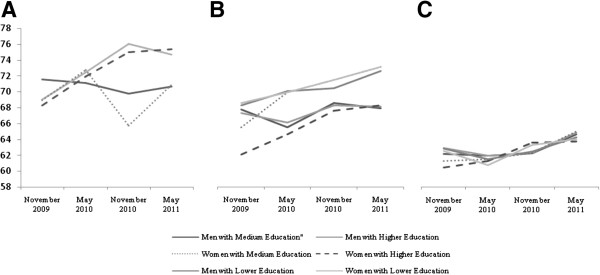
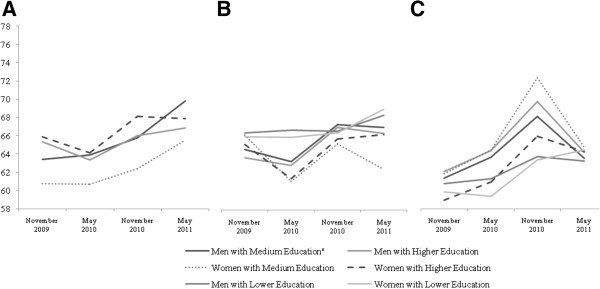
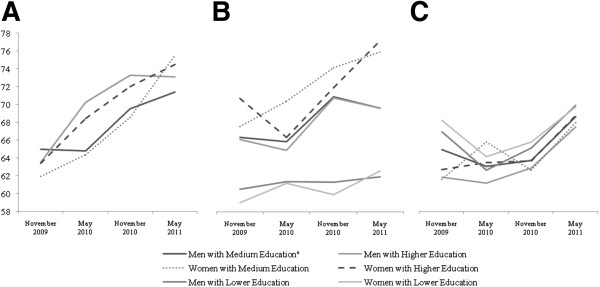
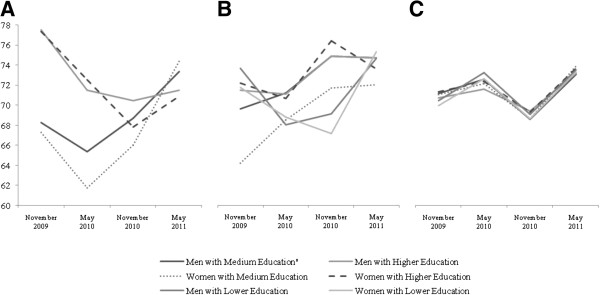
Overall, QOL scores were observed to be significantly higher 18 months after the earthquake in all WHOQOL-BREF domains. The model detected an average increase in the physical QOL scores (from 66.6 ± 5.2 to 69.3 ± 4.7), indicating a better overall physical QOL for men. Psychological domain scores (from 64.9 ± 5.1 to 71.5 ± 6.5) were observed to be worse in men than in women. Levels at the WHOQOL domain for psychological health increased from the second assessment onwards in women, indicating higher resiliency. Men averaged higher scores than women in terms of social relationships and the environmental domain. Regarding the physical, psychological and social domains of QOL, scores in the elderly group (age > 60) were observed to be similar to each other regardless of the significant covariates used.
WHOQOL-BREF scores of the psychological domain displayed trends conditioned by age and education: older subjects experienced less satisfaction with psychological health on average. Less-educated subjects always demonstrated the worst QOL scores. Gender, age and education impacted the variability of QOL in the environmental dimension in the elderly.
在易发生自然灾害的国家,人们在地震中失去亲人后的幸福感是一个关注点。大多数关于震后主观生活质量(QOL)的研究都集中在心理损伤和创伤后应激障碍(PTSD)对 QOL 的心理维度的影响上。然而,需要对未受 PTSD 或心理损伤影响的人群进行 QOL 研究。本研究的目的是评估 2009 年拉奎拉地震后 18 个月内成年人样本的 QOL 变化。
本研究设计为一项纵向调查,在六个月的时间间隔内进行四次重复测量。研究地点为破坏性地震后城市环境中的一般人群。参与者包括 397 名健康的成年受试者。在研究开始时,排除了患有躯体、心理、精神或神经退行性疾病等合并症的患者。主要观察指标为 WHOQOL-BREF 量表评估的 QOL。对每个 WHOQOL-BREF 领域进行了广义估计方程模型分析。
总体而言,在所有 WHOQOL-BREF 领域,震后 18 个月时 QOL 评分明显升高。该模型检测到身体 QOL 评分平均升高(从 66.6 ± 5.2 增加到 69.3 ± 4.7),表明男性的整体身体 QOL 更好。男性的心理领域评分(从 64.9 ± 5.1 增加到 71.5 ± 6.5)较女性差。女性从第二次评估开始,心理健康领域的水平增加,表明其具有更高的适应力。男性在人际关系和环境领域的平均得分均高于女性。关于身体、心理和社会领域的 QOL,年龄>60 岁的老年组无论使用何种重要协变量,其得分彼此相似。
WHOQOL-BREF 量表的心理领域评分呈现出受年龄和教育程度影响的趋势:年龄较大的受试者平均来说对心理健康的满意度较低。受教育程度较低的受试者始终表现出最差的 QOL 评分。性别、年龄和教育程度影响了老年人群环境维度 QOL 的可变性。