Department of Chemistry, The University of Memphis, Memphis, Tennessee, United States of America.
PLoS Comput Biol. 2012;8(5):e1002530. doi: 10.1371/journal.pcbi.1002530. Epub 2012 May 24.
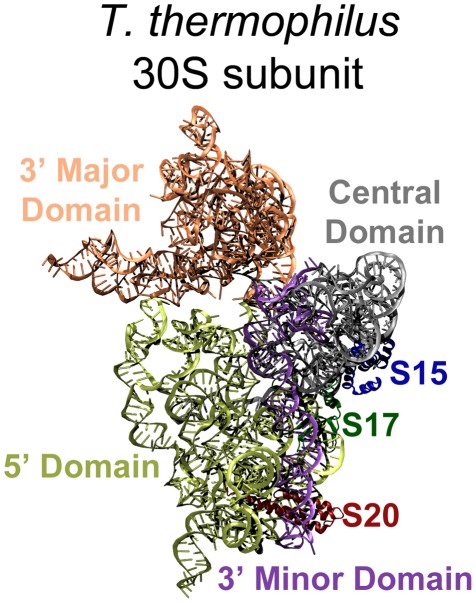
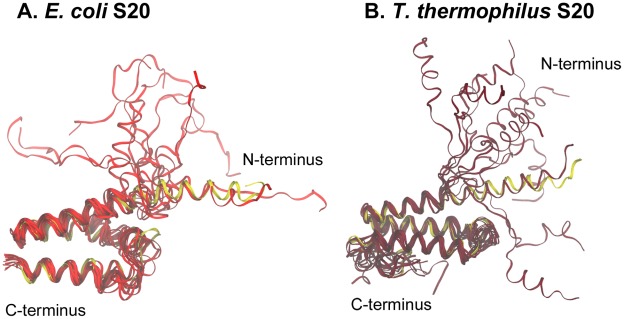
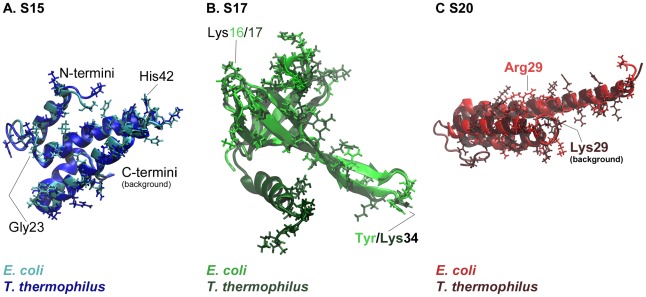
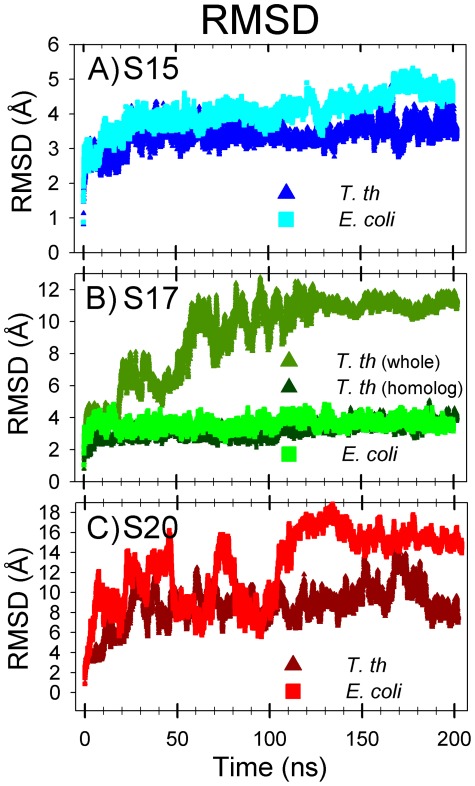
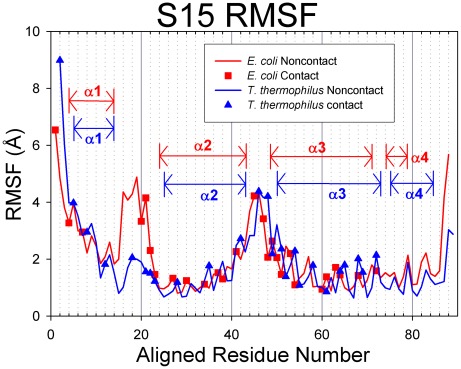
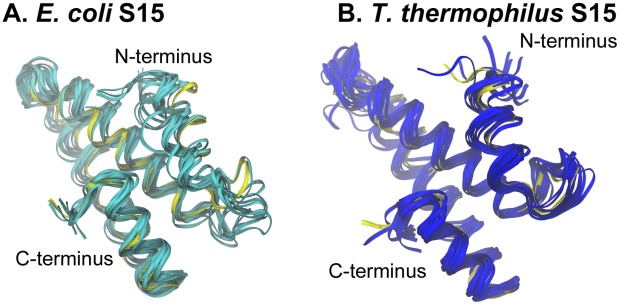
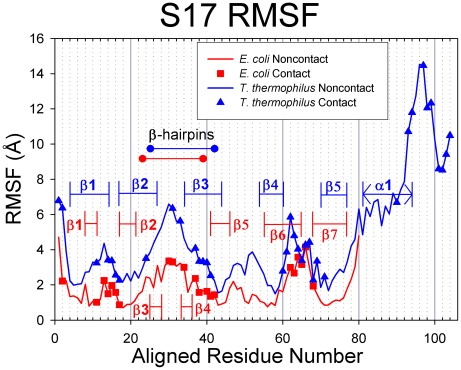
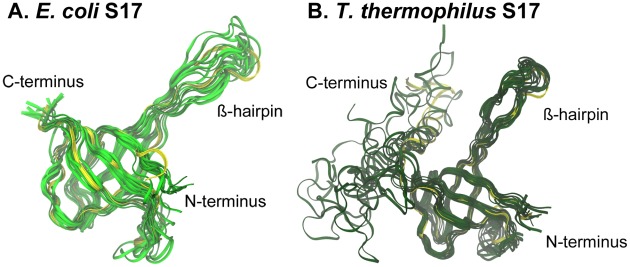
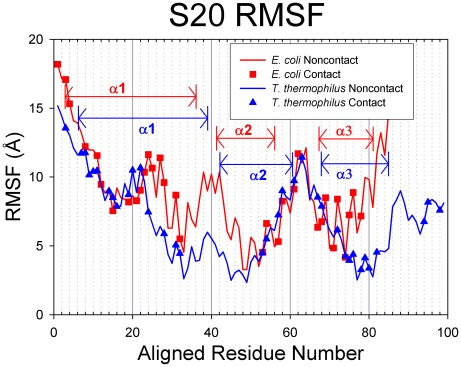
Assembly of the ribosome from its protein and RNA constituents has been studied extensively over the past 50 years, and experimental evidence suggests that prokaryotic ribosomal proteins undergo conformational changes during assembly. However, to date, no studies have attempted to elucidate these conformational changes. The present work utilizes computational methods to analyze protein dynamics and to investigate the linkage between dynamics and binding of these proteins during the assembly of the ribosome. Ribosomal proteins are known to be positively charged and we find the percentage of positive residues in r-proteins to be about twice that of the average protein: Lys+Arg is 18.7% for E. coli and 21.2% for T. thermophilus. Also, positive residues constitute a large proportion of RNA contacting residues: 39% for E. coli and 46% for T. thermophilus. This affirms the known importance of charge-charge interactions in the assembly of the ribosome. We studied the dynamics of three primary proteins from E. coli and T. thermophilus 30S subunits that bind early in the assembly (S15, S17, and S20) with atomic molecular dynamic simulations, followed by a study of all r-proteins using elastic network models. Molecular dynamics simulations show that solvent-exposed proteins (S15 and S17) tend to adopt more stable solution conformations than an RNA-embedded protein (S20). We also find protein residues that contact the 16S rRNA are generally more mobile in comparison with the other residues. This is because there is a larger proportion of contacting residues located in flexible loop regions. By the use of elastic network models, which are computationally more efficient, we show that this trend holds for most of the 30S r-proteins.
核糖体由其蛋白质和 RNA 成分组成,在过去的 50 年中得到了广泛的研究,实验证据表明原核核糖体蛋白在组装过程中会发生构象变化。然而,迄今为止,尚无研究试图阐明这些构象变化。本工作利用计算方法分析蛋白质动力学,并研究这些蛋白质在核糖体组装过程中的动力学与结合之间的联系。核糖体蛋白已知带正电荷,我们发现 r 蛋白中的正电荷残基百分比是平均蛋白的两倍:大肠杆菌的 Lys+Arg 为 18.7%,嗜热栖热菌的 Lys+Arg 为 21.2%。此外,正电荷残基构成了与 RNA 接触残基的很大一部分:大肠杆菌的为 39%,嗜热栖热菌的为 46%。这证实了电荷-电荷相互作用在核糖体组装中的重要性。我们使用原子分子动力学模拟研究了在组装早期结合的大肠杆菌和嗜热栖热菌 30S 亚基的三种主要蛋白质(S15、S17 和 S20)的动力学,然后使用弹性网络模型研究所有 r 蛋白。分子动力学模拟表明,暴露于溶剂中的蛋白质(S15 和 S17)比 RNA 嵌入的蛋白质(S20)更容易采取更稳定的溶液构象。我们还发现与 16S rRNA 接触的蛋白质残基通常比其他残基更具移动性。这是因为接触残基的比例较大,位于柔性环区域。通过使用计算效率更高的弹性网络模型,我们表明这种趋势适用于大多数 30S r 蛋白。