Zhang Ying, Cai Qinghua, Luo Yuxiang, Zhang Yu, Li Huilin
School of Pharmaceutical Sciences, Sun Yat-sen University, Guangzhou, 510006, China.
Henan Engineering Laboratory for Mammary Bioreactor, School of Life Sciences, Henan University, Kaifeng, Henan, 475004, China.
J Pharm Anal. 2023 Jan;13(1):63-72. doi: 10.1016/j.jpha.2022.11.003. Epub 2022 Nov 14.
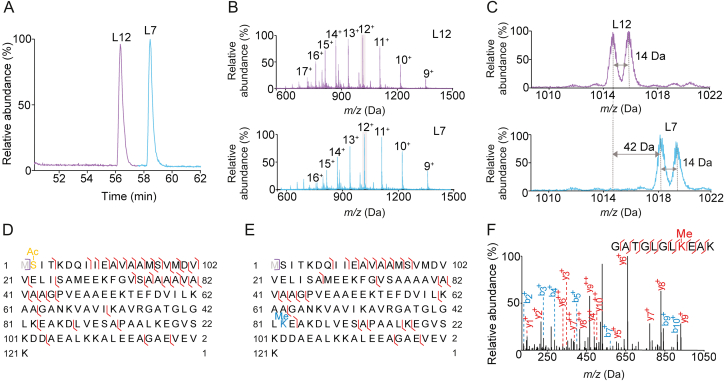
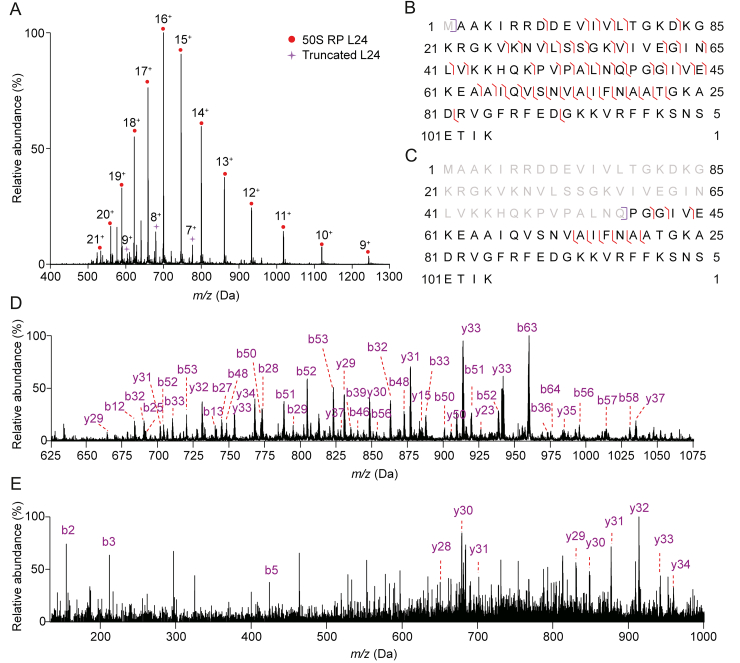
Ribosomes are abundant, large RNA-protein complexes that are the sites of all protein synthesis in cells. Defects in ribosomal proteins (RPs), including proteoforms arising from genetic variations, alternative splicing of RNA transcripts, post-translational modifications and alterations of protein expression level, have been linked to a diverse range of diseases, including cancer and aging. Comprehensive characterization of ribosomal proteoforms is challenging but important for the discovery of potential disease biomarkers or protein targets. In the present work, using 70S RPs as an example, we first developed a top-down proteomics approach on a Waters Synapt G2 Si mass spectrometry (MS) system, and then applied it to the HeLa 80S ribosome. The results were complemented by a bottom-up approach. In total, 50 out of 55 RPs were identified using the top-down approach. Among these, more than 30 RPs were found to have their N-terminal methionine removed. Additional modifications such as methylation, acetylation, and hydroxylation were also observed, and the modification sites were identified by bottom-up MS. In a HeLa 80S ribosomal sample, we identified 98 ribosomal proteoforms, among which multiple truncated 80S ribosomal proteoforms were observed, the type of information which is often overlooked by bottom-up experiments. Although their relevance to diseases is not yet known, the integration of top-down and bottom-up proteomics approaches paves the way for the discovery of proteoform-specific disease biomarkers or targets.
核糖体是丰富的大型RNA-蛋白质复合物,是细胞内所有蛋白质合成的场所。核糖体蛋白(RPs)的缺陷,包括由基因变异、RNA转录本的可变剪接、翻译后修饰以及蛋白质表达水平改变产生的蛋白异构体,与包括癌症和衰老在内的多种疾病相关。核糖体蛋白异构体的全面表征具有挑战性,但对于发现潜在的疾病生物标志物或蛋白质靶点很重要。在本研究中,以70S核糖体蛋白为例,我们首先在沃特世Synapt G2 Si质谱(MS)系统上开发了一种自上而下的蛋白质组学方法,然后将其应用于HeLa 80S核糖体。结果通过自下而上的方法得到补充。使用自上而下的方法总共鉴定出了55种核糖体蛋白中的50种。其中,发现超过30种核糖体蛋白的N端甲硫氨酸被去除。还观察到了甲基化、乙酰化和羟基化等其他修饰,并通过自下而上的质谱鉴定了修饰位点。在一个HeLa 80S核糖体样本中,我们鉴定出了98种核糖体蛋白异构体,其中观察到了多种截短的80S核糖体蛋白异构体,这类信息在自下而上的实验中常常被忽视。尽管它们与疾病的相关性尚不清楚,但自上而下和自下而上蛋白质组学方法的整合为发现蛋白异构体特异性疾病生物标志物或靶点铺平了道路。