Repovš Grega, Barch Deanna M
Department of Psychology, University of Ljubljana Ljubljana, Slovenia.
Front Hum Neurosci. 2012 May 23;6:137. doi: 10.3389/fnhum.2012.00137. eCollection 2012.
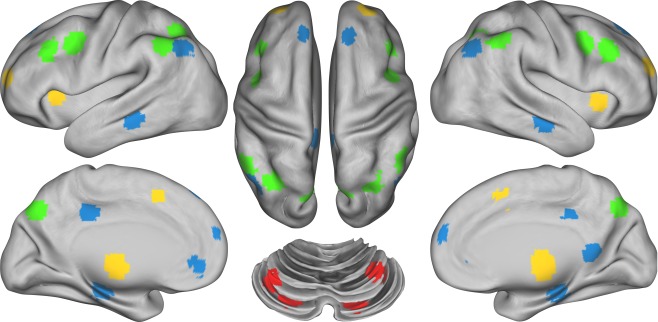
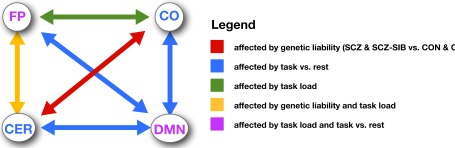
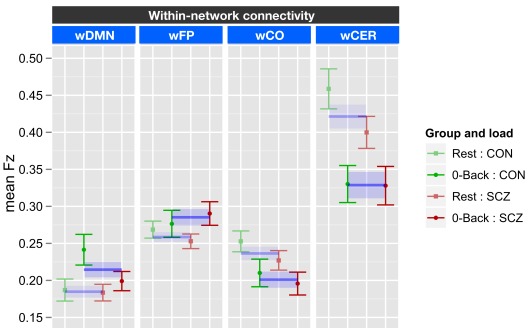
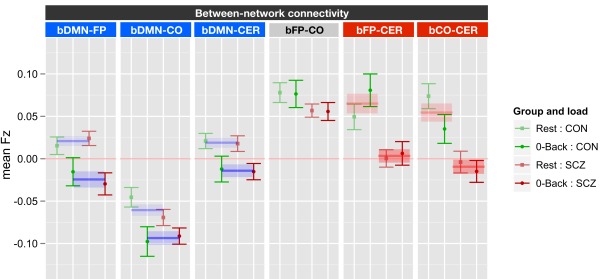
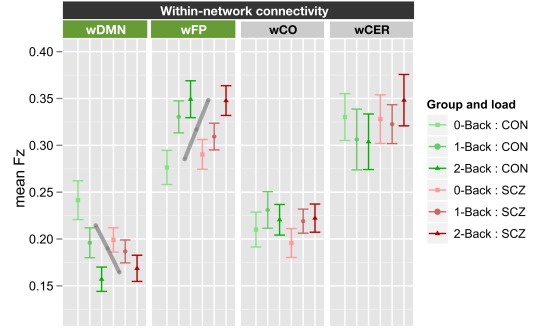
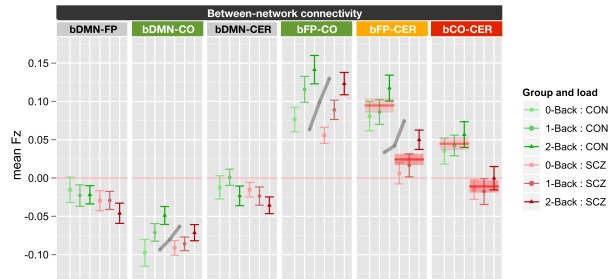
A growing number of studies have reported altered functional connectivity in schizophrenia during putatively "task-free" states and during the performance of cognitive tasks. However, there have been few systematic examinations of functional connectivity in schizophrenia across rest and different task states to assess the degree to which altered functional connectivity reflects a stable characteristic or whether connectivity changes vary as a function of task demands. We assessed functional connectivity during rest and during three working memory loads of an N-back task (0-back, 1-back, 2-back) among: (1) individuals with schizophrenia (N = 19); (2) the siblings of individuals with schizophrenia (N = 28); (3) healthy controls (N = 10); and (4) the siblings of healthy controls (N = 17). We examined connectivity within and between four brain networks: (1) frontal-parietal (FP); (2) cingulo-opercular (CO); (3) cerebellar (CER); and (4) default mode (DMN). In terms of within-network connectivity, we found that connectivity within the DMN and FP increased significantly between resting state and 0-back, while connectivity within the CO and CER decreased significantly between resting state and 0-back. Additionally, we found that connectivity within both the DMN and FP was further modulated by memory load. In terms of between network connectivity, we found that the DMN became significantly more "anti-correlated" with the FP, CO, and CER networks during 0-back as compared to rest, and that connectivity between the FP and both CO and CER networks increased with memory load. Individuals with schizophrenia and their siblings showed consistent reductions in connectivity between both the FP and CO networks with the CER network, a finding that was similar in magnitude across rest and all levels of working memory load. These findings are consistent with the hypothesis that altered functional connectivity in schizophrenia reflects a stable characteristic that is present across cognitive states.
越来越多的研究报告称,精神分裂症患者在假定的“无任务”状态以及认知任务执行过程中,其功能连接发生了改变。然而,很少有系统的研究来考察精神分裂症患者在静息状态和不同任务状态下的功能连接,以评估功能连接改变在多大程度上反映了一种稳定的特征,或者连接变化是否随任务需求而变化。我们评估了精神分裂症患者(N = 19)、精神分裂症患者的兄弟姐妹(N = 28)、健康对照者(N = 10)以及健康对照者的兄弟姐妹(N = 17)在静息状态和N-back任务的三种工作记忆负荷(0-back、1-back、2-back)下的功能连接。我们考察了四个脑网络内部以及之间的连接:(1)额顶叶(FP);(2)扣带回-脑岛(CO);(3)小脑(CER);以及(4)默认模式网络(DMN)。在网络内部连接方面,我们发现,在静息状态和0-back之间,DMN和FP内部的连接显著增加,而CO和CER内部的连接在静息状态和0-back之间显著减少。此外,我们发现DMN和FP内部的连接都进一步受到记忆负荷的调节。在网络之间的连接方面,我们发现,与静息状态相比,在0-back期间,DMN与FP、CO和CER网络之间的“反相关”程度显著增加,并且FP与CO和CER网络之间的连接随着记忆负荷的增加而增加。精神分裂症患者及其兄弟姐妹在FP和CO网络与CER网络之间的连接上均表现出一致的减少,这一发现在静息状态和所有工作记忆负荷水平上的程度相似。这些发现与以下假设一致,即精神分裂症患者功能连接的改变反映了一种在认知状态中都存在的稳定特征。