Division of Cellular and Molecular Therapy, Department of Pediatrics, University of Florida, Gainesville, Florida, United States of America.
PLoS One. 2012;7(5):e37671. doi: 10.1371/journal.pone.0037671. Epub 2012 May 24.
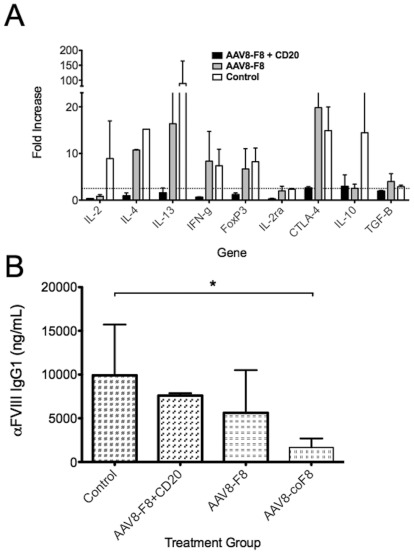
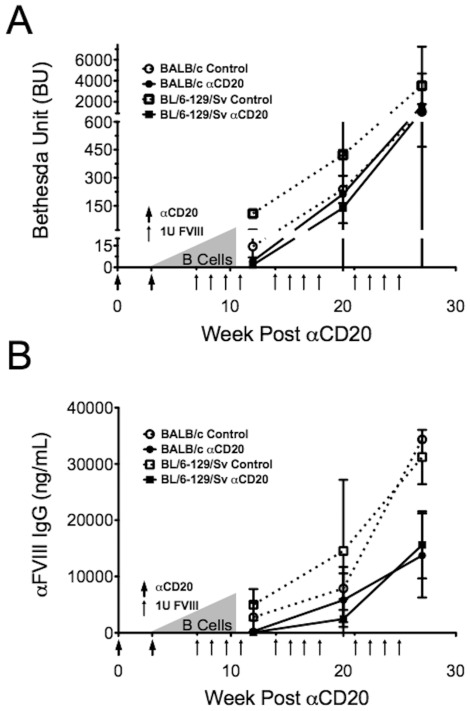
The major complication in the treatment of hemophilia A is the development of neutralizing antibodies (inhibitors) against factor VIII (FVIII). The current method for eradicating inhibitors, termed immune tolerance induction (ITI), is costly and protracted. Clinical protocols that prevent rather than treat inhibitors are not yet established. Liver-directed gene therapy hopes to achieve long-term correction of the disease while also inducing immune tolerance. We sought to investigate the use of adeno-associated viral (serotype 8) gene transfer to induce tolerance to human B domain deleted FVIII in hemophilia A mice. We administered an AAV8 vector with either human B domain deleted FVIII or a codon-optimized transgene, both under a liver-specific promoter to two strains of hemophilia A mice. Protein therapy or gene therapy was given either alone or in conjunction with anti-CD20 antibody-mediated B cell depletion. Gene therapy with a low-expressing vector resulted in sustained near-therapeutic expression. However, supplementary protein therapy revealed that gene transfer had sensitized mice to hFVIII in a high-responder strain but not in mice of a low-responding strain. This heightened response was ameliorated when gene therapy was delivered with anti-murine CD20 treatment. Transient B cell depletion prevented inhibitor formation in protein therapy, but failed to achieve a sustained hypo-responsiveness. Importantly, use of a codon-optimized hFVIII transgene resulted in sustained therapeutic expression and tolerance without a need for B cell depletion. Therefore, anti-CD20 may be beneficial in preventing vector-induced immune priming to FVIII, but higher levels of liver-restricted expression are preferred for tolerance.
治疗 A 型血友病的主要并发症是针对凝血因子 VIII(FVIII)产生中和抗体(抑制剂)。目前消除抑制剂的方法称为免疫耐受诱导(ITI),既昂贵又耗时。尚未建立预防而非治疗抑制剂的临床方案。肝靶向基因治疗希望在实现长期疾病矫正的同时诱导免疫耐受。我们试图研究使用腺相关病毒(血清型 8)基因转移来诱导 A 型血友病小鼠对人 B 结构域缺失 FVIII 的耐受。我们用载有人 B 结构域缺失 FVIII 或密码子优化转基因的 AAV8 载体,均在肝脏特异性启动子下,对两种 A 型血友病小鼠进行了处理。蛋白治疗或基因治疗单独或与抗 CD20 抗体介导的 B 细胞耗竭联合使用。低表达载体的基因治疗导致持续的近治疗表达。然而,补充蛋白治疗表明,基因转移使高反应性品系的小鼠对 hFVIII 产生了敏感性,但对低反应性品系的小鼠没有。当与抗鼠 CD20 治疗一起给予基因治疗时,这种高反应性得到了改善。短暂的 B 细胞耗竭可预防蛋白治疗中的抑制剂形成,但未能实现持续的低反应性。重要的是,使用密码子优化的 hFVIII 转基因可实现持续的治疗表达和耐受,而无需 B 细胞耗竭。因此,抗 CD20 可能有益于预防载体诱导的 FVIII 免疫启动,但更倾向于肝脏受限表达水平更高。