Department of Orthopaedic Surgery, The 2nd Affiliated Hospital of Medical College, Xi'an Jiaotong University, Xi'an, Shaanxi Province, People's Republic of China.
PLoS One. 2012;7(5):e37947. doi: 10.1371/journal.pone.0037947. Epub 2012 May 24.
Minimally invasive total hip arthroplasty (MITHA) remains considerably controversial. Limited visibility and prosthesis malposition increase the risk of post-surgical complications compared to those of the traditional method.
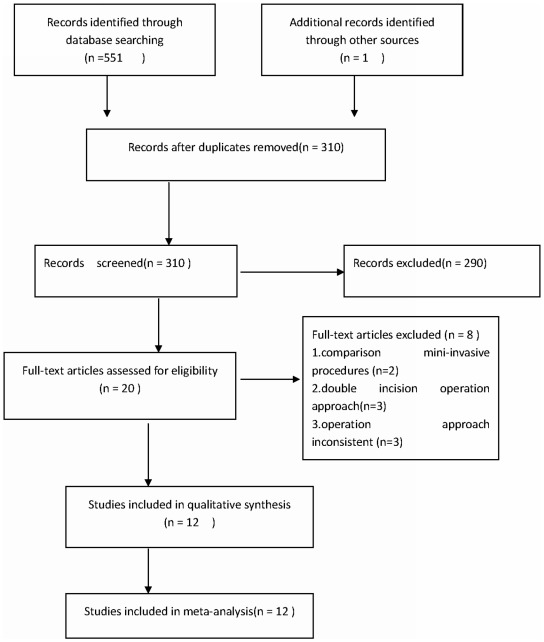
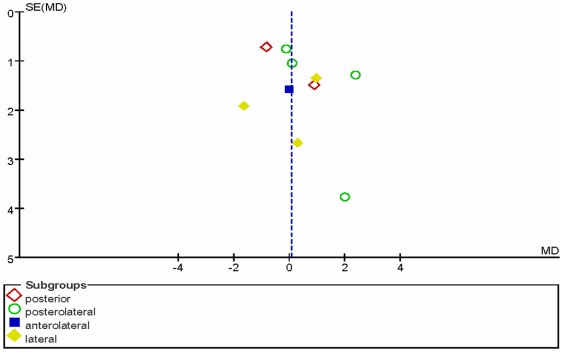
A meta-analysis was undertaken of all published databases up to May 2011. The studies were divided into four subgroups according to the surgical approach taken. The radiological outcomes and complications of minimally invasive surgery were compared to traditional total hip arthroplasty (TTHA) using risk ratio, mean difference, and standardized mean difference statistics.
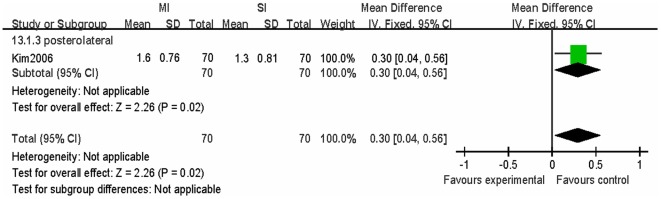
In five studies involving the posterolateral approach, no significant differences were found between the MITHA groups and the TTHA groups in the acetabular cup abduction angle (p = 0.41), acetabular anteversion (p = 0.96), and femoral prosthesis position (p = 0.83). However, the femoral offset was significantly increased (WMD = 3.00; 95% CI, 0.40-5.60; p = 0.02). Additionally, there were no significant differences among the complications in both the groups (dislocations, nerve injury, infection, deep vein thrombosis, proximal femoral fracture) and revision rate (p>0.05). In three studies involving the posterior approach, there were no significant differences in radiological outcomes or all other complications between MITHA or TTHA groups (p>0.05). Three studies involved anterolateral approach, while 2 studies used the lateral approach. However, the information from imaging and complications was not adequate for statistical analysis.
Posterior MITHA seems to be a safe surgical procedure, without the increased risk of post-operative complication rates and component malposition rates. The posterolateral approach THA may lead to increased femoral offset. The current data are not enough to reach a positive conclusion that lateral and anterolateral approaches will result in increased risks of adverse effects and complications at the prosthesis site.
微创全髋关节置换术(MITHA)仍然存在很大争议。与传统方法相比,微创全髋关节置换术(MITHA)由于视野有限和假体位置不当,增加了术后并发症的风险。
对截至 2011 年 5 月所有已发表数据库进行了荟萃分析。根据手术方法将研究分为四个亚组。使用风险比、均数差和标准化均数差统计学比较微创外科的放射学结果和并发症与传统全髋关节置换术(TTHA)。
在五项涉及后外侧入路的研究中,MITHA 组与 TTHA 组在髋臼杯外展角(p=0.41)、髋臼前倾角(p=0.96)和股骨假体位置(p=0.83)方面无显著差异。然而,股骨偏心距显著增加(WMD=3.00;95%CI,0.40-5.60;p=0.02)。此外,两组并发症(脱位、神经损伤、感染、深静脉血栓形成、股骨近端骨折)和翻修率均无显著差异(p>0.05)。在涉及后入路的三项研究中,MITHA 或 TTHA 组在放射学结果或所有其他并发症方面无显著差异(p>0.05)。三项研究涉及前外侧入路,两项研究采用外侧入路。然而,影像学和并发症信息不足以进行统计分析。
后外侧 MITHA 似乎是一种安全的手术方法,不会增加术后并发症发生率和假体位置不当的风险。后外侧入路 THA 可能导致股骨偏心距增加。目前的数据还不足以得出积极的结论,即外侧和前外侧入路会导致假体部位不良影响和并发症的风险增加。