Department of Radiology, Gangnam Severance Hospital, Yonsei University College of Medicine, Seoul, Korea.
Yonsei Med J. 2012 Jul 1;53(4):825-33. doi: 10.3349/ymj.2012.53.4.825.
The purpose of our study was to validate diffusion-weighted MRI (DWI) before and after superparamagnetic iron oxide (SPIO) injection for assessment of hepatic metastases.
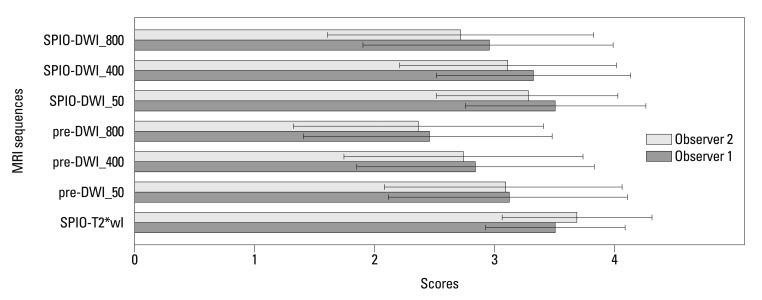
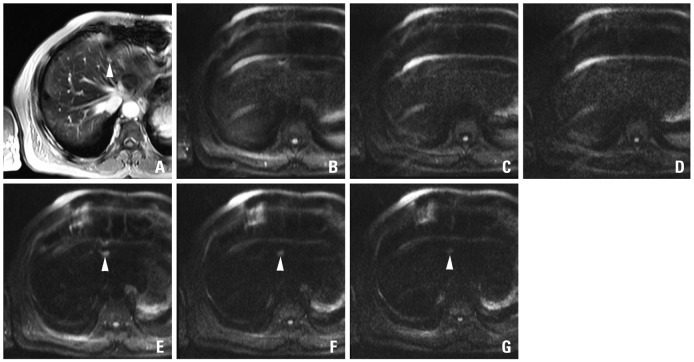
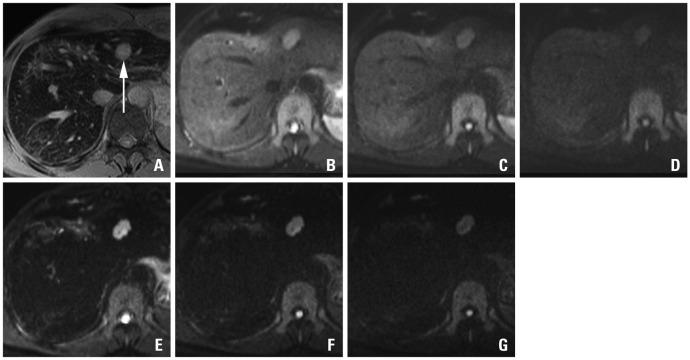
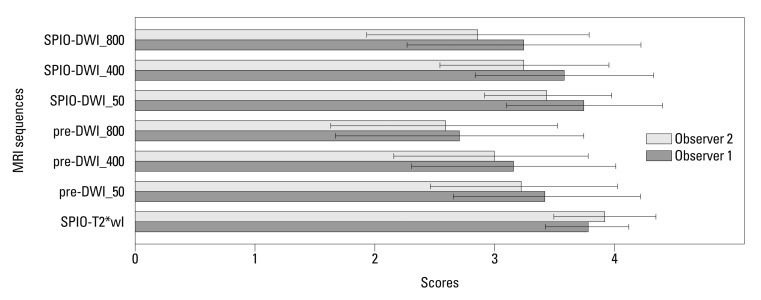
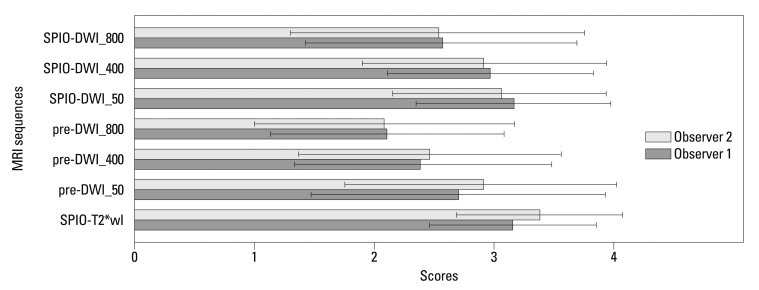
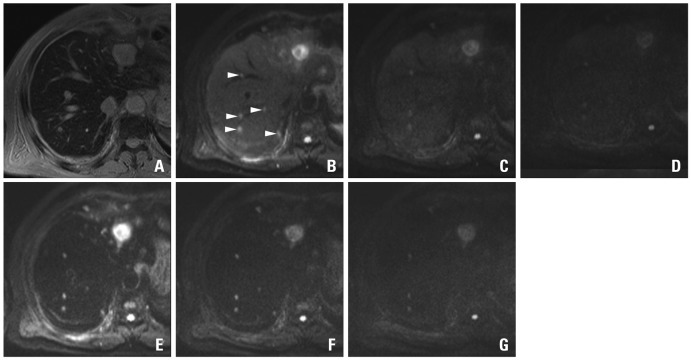
Eighty-six hepatic metastases (size range, 0.3-4.7 cm; mean, 1.5 cm) verified pathologically or by follow-up imaging studies in 22 consecutive patients (17 men and 5 women; 44-83 years; mean age, 60 years) during a 13-month period were enrolled. Hepatic MRI, including DWI (b-factors=50, 400, 800 s/mm²) with breath-holding technique of single-shot spin-echo echo-planar imaging (TR/TE=1000/69 ms, average=2) before and after SPIO administration, were retrospectively reviewed by two independent radiologists with a 5-point scale confidence score for each hepatic lesion on pre-contrast DWI (pre-DWI), SPIO-enhanced DWI (SPIO-DWI), and SPIO-enhanced T2*-weighted imaging (SPIO-T2*wI).
For all lesions, SPIO-T2wI showed significantly higher confidence score in the diagnosis of hepatic metastases than pre-contrast or SPIO-DWI regardless of the size of b-factors (p<0.05) with only one exception; using b-factor=50 s/mm², the score of SPIO-T2*wI was still higher than SPIO-DWI but there was no statistical significance given by observer 1 (p=0.730). For the subcentimeter lesions (n=37), SPIO-T2*wI showed the highest score, and using b-factor= 50 or 400 s/mm² SPIO-DWI showed similar confidence scores to SPIO-T2*wI by both observers (p>0.05). Pre-DWI using b-factor=50 sec/mm² was also comparable with SPIO-T2wI by observer 1 (p=0.060).
Pre-DWI has a limited value for the assessment of hepatic metastases, however, the repetition of DWI after SPIO injection using small b-factors could complement SPIO-T2*wI, especially for subcentimeter lesions.
本研究的目的是验证超顺磁性氧化铁(SPIO)注射前后扩散加权 MRI(DWI)在评估肝转移中的作用。
连续 22 例(男 17 例,女 5 例;年龄 44-83 岁,平均 60 岁)患者的 86 个经病理或随访影像学检查证实的肝转移瘤(大小范围 0.3-4.7cm,平均 1.5cm)纳入研究。采用单次激发自旋回波平面成像呼吸门控技术进行肝脏 MRI 检查,包括 DWI(b 值=50、400、800s/mm²),并在 SPIO 给药前后进行(TR/TE=1000/69ms,平均 2 次)。两名独立的放射科医生对每个肝病变的平扫 DWI(pre-DWI)、SPIO 增强 DWI(SPIO-DWI)和 SPIO 增强 T2加权成像(SPIO-T2wI)的诊断信心进行五分制评分。
所有病变中,SPIO-T2wI 在诊断肝转移瘤时的置信评分均显著高于平扫或 SPIO-DWI,与 b 值的大小无关(p<0.05),只有一个例外;使用 b 值=50s/mm² 时,SPIO-T2*wI 的评分仍高于 SPIO-DWI,但观察者 1 认为没有统计学意义(p=0.730)。对于亚厘米病变(n=37),SPIO-T2*wI 的评分最高,而观察者 1 认为使用 b 值=50 或 400s/mm² 的 SPIO-DWI 的置信评分与 SPIO-T2*wI 相似(p>0.05)。b 值=50sec/mm² 的平扫 DWI 与观察者 1 的 SPIO-T2wI 也相当(p=0.060)。
平扫 DWI 对评估肝转移瘤的价值有限,然而,使用小 b 值重复 SPIO 注射后的 DWI 可以补充 SPIO-T2*wI,特别是对于亚厘米病变。