Melton E D, Schmidt C, Kappler A
Geomicrobiology, Centre for Applied Geosciences, University of Tübingen Tübingen, Germany.
Front Microbiol. 2012 May 31;3:197. doi: 10.3389/fmicb.2012.00197. eCollection 2012.
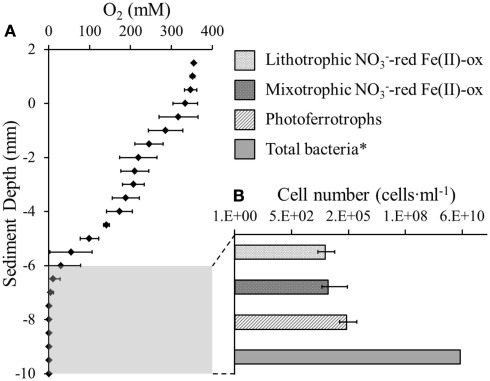
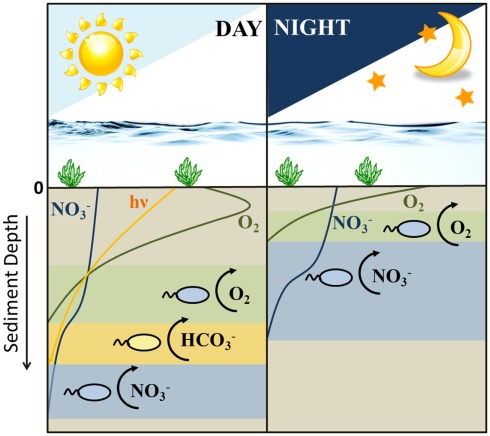
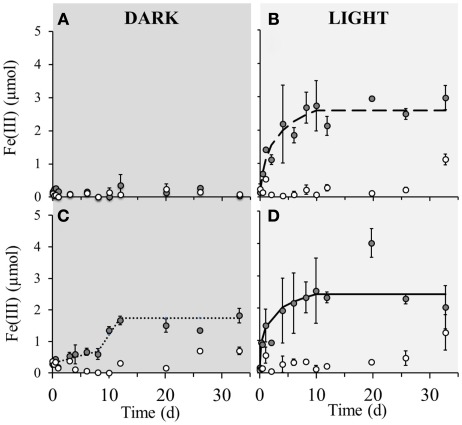
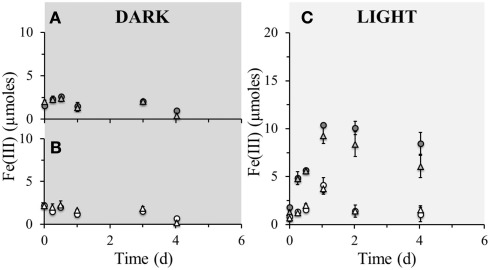
The distribution of neutrophilic microbial iron oxidation is mainly determined by local gradients of oxygen, light, nitrate and ferrous iron. In the anoxic top part of littoral freshwater lake sediment, nitrate-reducing and phototrophic Fe(II)-oxidizers compete for the same e(-) donor; reduced iron. It is not yet understood how these microbes co-exist in the sediment and what role they play in the Fe cycle. We show that both metabolic types of anaerobic Fe(II)-oxidizing microorganisms are present in the same sediment layer directly beneath the oxic-anoxic sediment interface. The photoferrotrophic most probable number counted 3.4·10(5) cells·g(-1) and the autotrophic and mixotrophic nitrate-reducing Fe(II)-oxidizers totaled 1.8·10(4) and 4.5·10(4) cells·g(-1) dry weight sediment, respectively. To distinguish between the two microbial Fe(II) oxidation processes and assess their individual contribution to the sedimentary Fe cycle, littoral lake sediment was incubated in microcosm experiments. Nitrate-reducing Fe(II)-oxidizing bacteria exhibited a higher maximum Fe(II) oxidation rate per cell, in both pure cultures and microcosms, than photoferrotrophs. In microcosms, photoferrotrophs instantly started oxidizing Fe(II), whilst nitrate-reducing Fe(II)-oxidizers showed a significant lag-phase during which they probably use organics as e(-) donor before initiating Fe(II) oxidation. This suggests that they will be outcompeted by phototrophic Fe(II)-oxidizers during optimal light conditions; as phototrophs deplete Fe(II) before nitrate-reducing Fe(II)-oxidizers start Fe(II) oxidation. Thus, the co-existence of the two anaerobic Fe(II)-oxidizers may be possible due to a niche space separation in time by the day-night cycle, where nitrate-reducing Fe(II)-oxidizers oxidize Fe(II) during darkness and phototrophs play a dominant role in Fe(II) oxidation during daylight. Furthermore, metabolic flexibility of Fe(II)-oxidizing microbes may play a paramount role in the conservation of the sedimentary Fe cycle.
嗜中性微生物铁氧化的分布主要由氧气、光照、硝酸盐和亚铁的局部梯度决定。在滨海淡水湖沉积物的缺氧顶层,硝酸盐还原菌和光养铁(II)氧化菌竞争同一电子供体——还原态铁。目前尚不清楚这些微生物如何在沉积物中共存以及它们在铁循环中发挥何种作用。我们发现,两种代谢类型的厌氧铁(II)氧化微生物都存在于有氧 - 缺氧沉积物界面正下方的同一沉积层中。光养铁还原菌的最可能数为3.4·10⁵个细胞·克⁻¹,自养和兼养硝酸盐还原铁(II)氧化菌分别总计为1.8·10⁴和4.5·10⁴个细胞·克⁻¹干重沉积物。为区分两种微生物铁(II)氧化过程并评估它们对沉积铁循环的各自贡献,在微观实验中对滨海湖沉积物进行了培养。在纯培养物和微观实验中,硝酸盐还原铁(II)氧化菌每细胞的最大铁(II)氧化速率均高于光养铁还原菌。在微观实验中,光养铁还原菌立即开始氧化铁(II),而硝酸盐还原铁(II)氧化菌则表现出显著的滞后期,在此期间它们可能在开始铁(II)氧化之前利用有机物作为电子供体。这表明在最佳光照条件下,它们将被光养铁(II)氧化菌竞争淘汰;因为光养菌在硝酸盐还原铁(II)氧化菌开始铁(II)氧化之前就耗尽了铁(II)。因此,两种厌氧铁(II)氧化菌的共存可能是由于昼夜循环导致的时间生态位空间分离,其中硝酸盐还原铁(II)氧化菌在黑暗中氧化铁(II),而光养菌在白天的铁(II)氧化中起主导作用。此外,铁(II)氧化微生物的代谢灵活性可能在沉积铁循环的守恒中起至关重要的作用。