Human Genomics Laboratory, Pennington Biomedical Research Center, Baton Rouge, Louisiana, United States of America.
PLoS One. 2012;7(5):e37887. doi: 10.1371/journal.pone.0037887. Epub 2012 May 30.
Individuals differ in the response to regular exercise. Whether there are people who experience adverse changes in cardiovascular and diabetes risk factors has never been addressed.
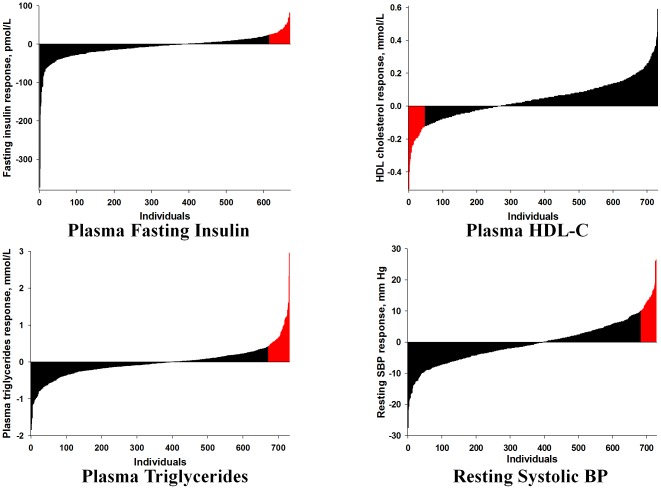
METHODOLOGY/PRINCIPAL FINDINGS: An adverse response is defined as an exercise-induced change that worsens a risk factor beyond measurement error and expected day-to-day variation. Sixty subjects were measured three times over a period of three weeks, and variation in resting systolic blood pressure (SBP) and in fasting plasma HDL-cholesterol (HDL-C), triglycerides (TG), and insulin (FI) was quantified. The technical error (TE) defined as the within-subject standard deviation derived from these measurements was computed. An adverse response for a given risk factor was defined as a change that was at least two TEs away from no change but in an adverse direction. Thus an adverse response was recorded if an increase reached 10 mm Hg or more for SBP, 0.42 mmol/L or more for TG, or 24 pmol/L or more for FI or if a decrease reached 0.12 mmol/L or more for HDL-C. Completers from six exercise studies were used in the present analysis: Whites (N = 473) and Blacks (N = 250) from the HERITAGE Family Study; Whites and Blacks from DREW (N = 326), from INFLAME (N = 70), and from STRRIDE (N = 303); and Whites from a University of Maryland cohort (N = 160) and from a University of Jyvaskyla study (N = 105), for a total of 1,687 men and women. Using the above definitions, 126 subjects (8.4%) had an adverse change in FI. Numbers of adverse responders reached 12.2% for SBP, 10.4% for TG, and 13.3% for HDL-C. About 7% of participants experienced adverse responses in two or more risk factors.
CONCLUSIONS/SIGNIFICANCE: Adverse responses to regular exercise in cardiovascular and diabetes risk factors occur. Identifying the predictors of such unwarranted responses and how to prevent them will provide the foundation for personalized exercise prescription.
个体对规律运动的反应存在差异。是否存在心血管和糖尿病风险因素发生不良变化的人群,目前尚未可知。
方法/主要发现:不良反应定义为,在超出测量误差和预期日常变化的情况下,运动引起的风险因素恶化。60 名受试者在三周内接受了三次测量,定量评估静息收缩压(SBP)、空腹血浆高密度脂蛋白胆固醇(HDL-C)、甘油三酯(TG)和胰岛素(FI)的变化。根据这些测量值计算出个体内标准差(即技术误差,TE)。如果某一风险因素的变化至少为两个 TE,且为不利方向,则定义为不良反应。因此,如果 SBP 升高达到 10mmHg 或以上、TG 升高达到 0.42mmol/L 或以上、FI 升高达到 24pmol/L 或以上,或如果 HDL-C 降低达到 0.12mmol/L 或以上,则记录为不良反应。本分析使用了六项运动研究的完成者数据:HERITAGE 家族研究中的白种人(N=473)和黑种人(N=250);DREW 研究中的白种人和黑种人(N=326)、INFLAME 研究中的白种人和黑种人(N=70)、STRIDE 研究中的白种人和黑种人(N=303);马里兰大学队列中的白种人(N=160)和于韦斯屈莱大学研究中的白种人(N=105),共 1687 名男性和女性。根据上述定义,126 名受试者(8.4%)的 FI 出现不良变化。SBP、TG 和 HDL-C 的不良反应者比例分别达到 12.2%、10.4%和 13.3%。约 7%的参与者有两个或更多风险因素出现不良反应。
结论/意义:规律运动可引起心血管和糖尿病风险因素的不良变化。识别这种不必要的反应的预测因素以及如何预防这些反应,将为个性化运动处方提供基础。