Department of Radiation Oncology, Albert Einstein College of Medicine and Montefiore Medical Center, Bronx, New York, United States of America.
PLoS One. 2012;7(5):e38111. doi: 10.1371/journal.pone.0038111. Epub 2012 May 30.
Recent studies have shown that a new generation of synthetic agonist of Toll-like receptor (TLR) 9 consisting a 3'-3'-attached structure and a dCp7-deaza-dG dinucultodie shows more potent immunostimulatory effects in both mouse and human than conventional CpG oligonucleotides. Radiation therapy (RT) provides a source of tumor antigens that are released from dying, irradiated, tumor cells without causing systemic immunosuppression. We, therefore, examined effect of combining RT with a designer synthetic agonist of TLR9 on anti-tumoral immunity, primary tumor growth retardation and metastases in a murine model of lung cancer.
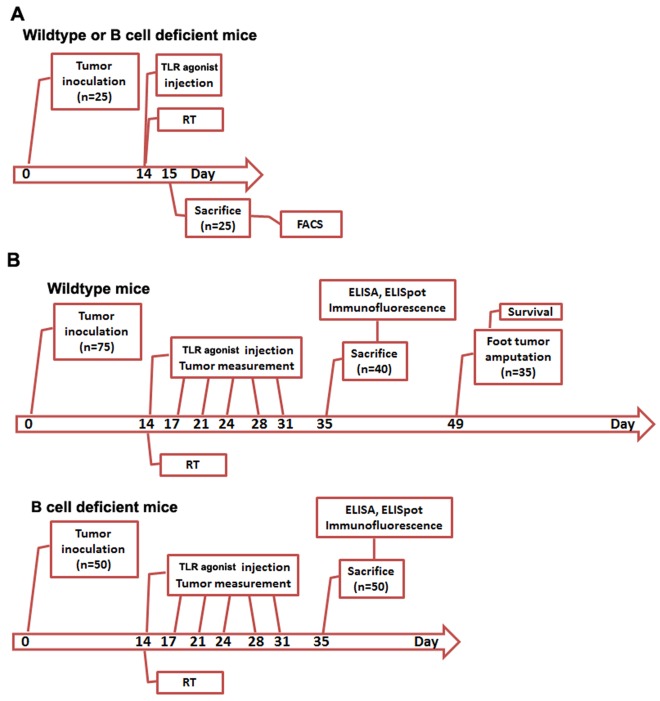
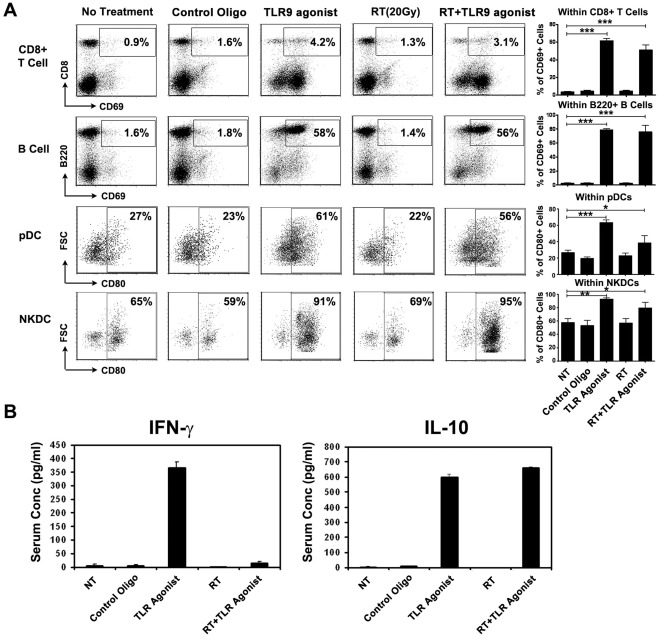
Grouped C57BL/6 and congenic B cell deficient mice (B(-/-)) bearing footpad 3LL tumors were treated with PBS, TLR9 agonist, control oligonucelotide, RT or the combination of RT and TLR9 agonist. Immune phenotype of splenocytes and serum IFN-γ and IL-10 levels were analyzed by FACS and ELISA, 24 h after treatment. Tumor growth, lung metastases and survival rate were monitored and tumor specific antibodies in serum and deposition in tumor tissue were measured by ELISA and immunofluorescence.
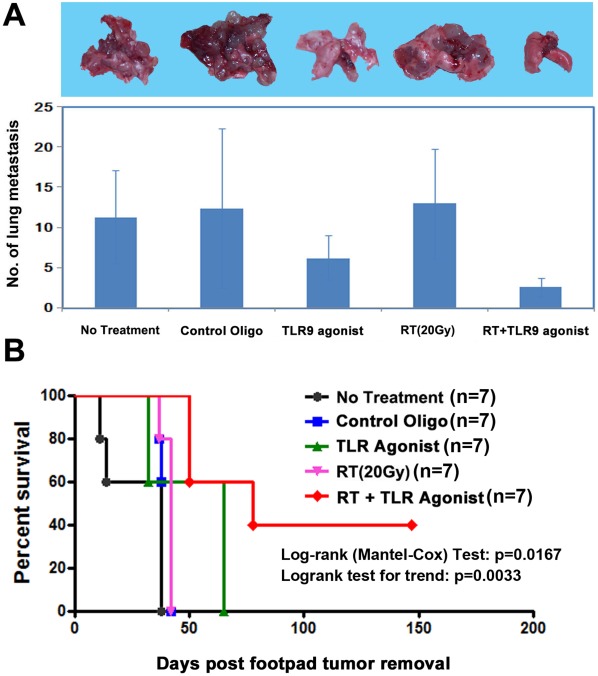
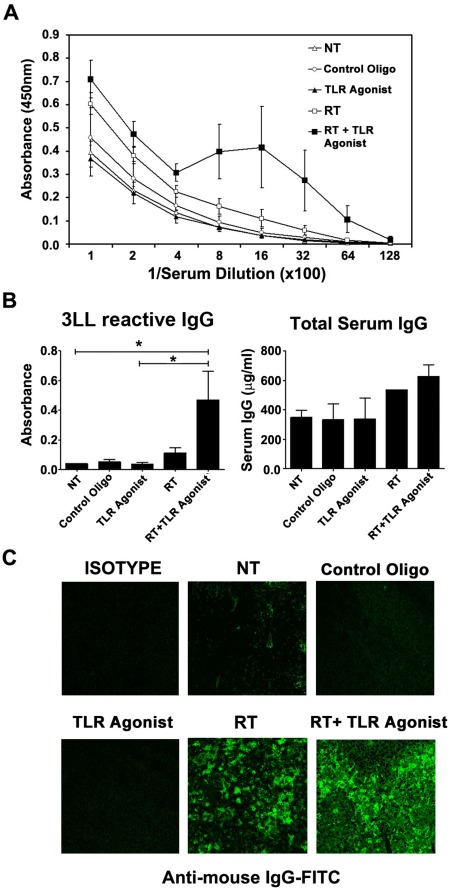
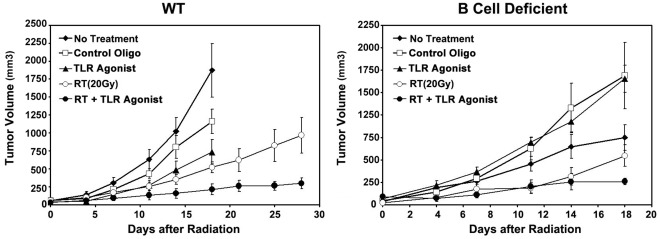
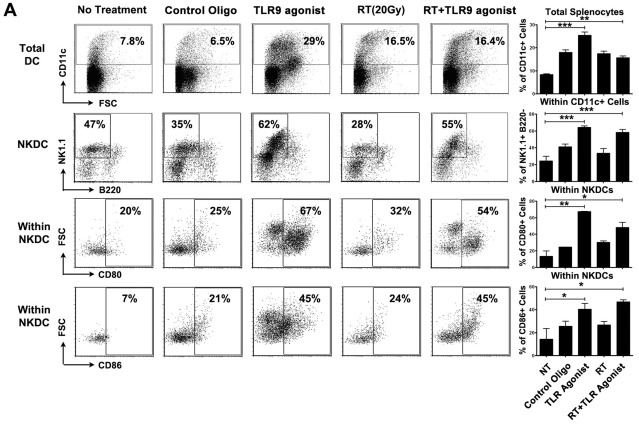
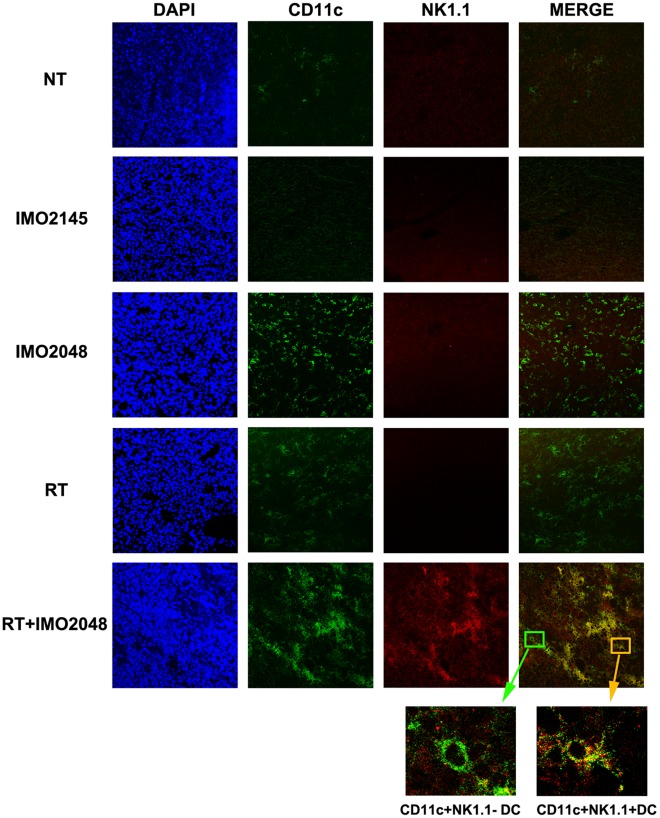
TLR9 agonist expanded and activated B cells and plasmacytoid dendritic cells in wild-type mice and natural killer DCs (NKDCs) in B cell-deficient (B(-/-)) mice bearing ectopic Lewis lung adenocarcinoma (3LL). Combined RT with TLR9 agonist treatment inhibited 3LL tumor growth in both wild type and B(-/-) mice. A strong tumor-specific humoral immune response (titer: 1/3200) with deposition of mouse IgG auto-antibodies in tumor tissue were found in wildtype mice, whereas the number of tumor infiltrating NKDCs increased in B(-/-) mice following RT+ TLR9 agonist therapy. Furthermore, mice receiving combination therapy had fewer lung metastases and a higher survival than single treatment cohorts.
Combination therapy with TLR9 agonist and RT induces systemic anti-tumoral humoral response, augments tumoral infiltration of NKDCs, reduces pulmonary metastases and improves survival in a murine model of 3LL cancer.
最近的研究表明,一种新型的 Toll 样受体(TLR)9 合成激动剂,由 3'-3'-连接结构和 dCp7-脱氮-dG 二核苷酸组成,在小鼠和人类中比传统的 CpG 寡核苷酸具有更强的免疫刺激作用。放射治疗(RT)提供了肿瘤抗原的来源,这些抗原是从死亡、照射的肿瘤细胞中释放出来的,而不会引起全身免疫抑制。因此,我们研究了将 RT 与设计合成的 TLR9 激动剂联合应用于肺癌小鼠模型中的抗肿瘤免疫、原发肿瘤生长抑制和转移的效果。
将携带足底 3LL 肿瘤的 C57BL/6 和同基因 B 细胞缺陷型(B(-/-)) 小鼠分组,用 PBS、TLR9 激动剂、对照寡核苷酸、RT 或 RT 和 TLR9 激动剂联合治疗。治疗后 24 小时,通过 FACS 和 ELISA 分析脾细胞的免疫表型和血清 IFN-γ 和 IL-10 水平。监测肿瘤生长、肺转移和存活率,并通过 ELISA 和免疫荧光测量血清中的肿瘤特异性抗体和肿瘤组织中的沉积。
TLR9 激动剂在携带异位 Lewis 肺腺癌(3LL)的野生型小鼠中扩增和激活 B 细胞和浆细胞样树突状细胞,在 B 细胞缺陷型(B(-/-)) 小鼠中扩增和激活自然杀伤 DC(NKDC)。RT 联合 TLR9 激动剂治疗抑制了野生型和 B(-/-)) 小鼠的 3LL 肿瘤生长。在野生型小鼠中发现了强烈的肿瘤特异性体液免疫反应(效价:1/3200),并在肿瘤组织中沉积了小鼠 IgG 自身抗体,而在接受 RT+TLR9 激动剂治疗的 B(-/-)小鼠中,肿瘤浸润性 NKDC 的数量增加。此外,接受联合治疗的小鼠的肺转移数量较少,存活率高于单一治疗组。
TLR9 激动剂和 RT 的联合治疗可诱导全身性抗肿瘤体液反应,增强 NKDC 对肿瘤的浸润,减少肺转移,并提高 3LL 癌症小鼠模型的存活率。