Ledoux Tracey A, Mama Scherezade K, O'Connor Daniel P, Adamus Heather, Fraser Margaret L, Lee Rebecca E
Department of Health and Human Performance, Texas Obesity Research Center, University of Houston, 3855 Holman Street Garrison Room 104, Houston, TX 77204-6015, USA.
J Obes. 2012;2012:737891. doi: 10.1155/2012/737891. Epub 2012 May 14.
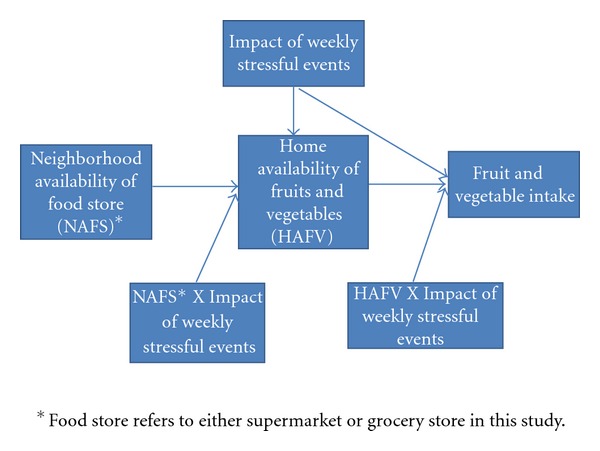
Background. Mediating and moderating variables may interfere with the association between neighborhood availability of grocery stores (NAG) and supermarkets (NAS) and fruit and vegetable (FV) intake. Objective. The purpose of this study was to test mediation of home availability of FV (HAFV) and moderation of impact of weekly stressful events (IWSE) on the association between NAG and NAS with FV consumption among African American (AA) and Hispanic/Latina (HL) women. Methods. Three hundred nine AA and HL, 25-60 year old women in the Health Is Power (HIP) randomized controlled trial completed validated measures of HAFV, IWSE, and FV intake at baseline. Trained field assessors coded NAG and NAS. Institutional Review Board approval was obtained. Results. NAG and NAS were not associated with FV intake or HAFV, so HAFV was not a mediator. HAFV (std. Beta = .29, P < 0.001) and IWSE (std. Beta = .17; P < 0.05) were related to FV intake (R(2) = 0.17; P < 0.001), but IWSE was not a moderator. Conclusion. Increasing HAFV and decreasing the IWSE should increase FV consumption. The extent to which the neighborhood environment is related to the home food environment and diet, and the mechanisms for the association between IWSE and diet should be examined in future research.
背景。中介变量和调节变量可能会干扰杂货店(NAG)和超市(NAS)的社区可及性与水果和蔬菜(FV)摄入量之间的关联。目的。本研究的目的是检验非洲裔美国(AA)和西班牙裔/拉丁裔(HL)女性中,家庭水果和蔬菜可及性(HAFV)的中介作用以及每周应激事件(IWSE)对NAG和NAS与FV消费之间关联的调节作用。方法。在“健康就是力量”(HIP)随机对照试验中,309名年龄在25至60岁之间的AA和HL女性在基线时完成了关于HAFV、IWSE和FV摄入量的有效测量。经过培训的现场评估人员对NAG和NAS进行了编码。获得了机构审查委员会的批准。结果。NAG和NAS与FV摄入量或HAFV均无关联,因此HAFV不是中介变量。HAFV(标准化β = 0.29,P < 0.001)和IWSE(标准化β = 0.17;P < 0.05)与FV摄入量相关(R² = 0.17;P < 0.001),但IWSE不是调节变量。结论。增加HAFV和减少IWSE应能增加FV消费量。未来的研究应考察社区环境与家庭食物环境及饮食之间的关联程度,以及IWSE与饮食之间关联的机制。