The UKK Institute for Health Promotion Research, P,O, Box 30, FI-33501, Tampere, Finland.
BMC Public Health. 2012 Jun 6;12:403. doi: 10.1186/1471-2458-12-403.
The purpose of the study was to evaluate a 6-month intervention to promote office-employees' walking with pedometers and e-mail messages.
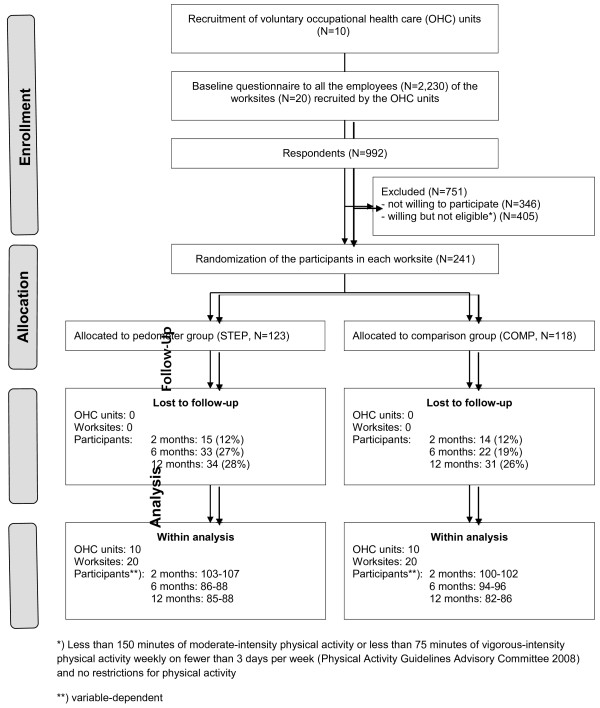
Participants were recruited by 10 occupational health care units (OHC) from 20 worksites with 2,230 employees. Voluntary and insufficiently physically active employees (N = 241) were randomized to a pedometer (STEP, N = 123) and a comparison group (COMP, N = 118). STEP included one group meeting, log-monitored pedometer-use and six e-mail messages from OHC. COMP participated in data collection. Reach, effectiveness, adoption, implementation, maintenance (RE-AIM) and costs were assessed with questionnaires (0, 2, 6, 12 months), process evaluation and interviews (12 months).
The intervention reached 29% (N = 646) of employees in terms of participation willingness. Logistic regression showed that the proportion of walkers tended to increase more in STEP than in COMP at 2 months in "walking for transportation" (Odds ratio 2.12, 95%CI 0.94 to 4.81) and at 6 months in "walking for leisure" (1.86, 95%CI 0.94 to 3.69). Linear model revealed a modest increase in the mean duration of "walking stairs" at 2 and 6 months (Geometric mean ratio 1.26, 95%CI 0.98 to 1.61; 1.27, 0.98 to 1.64). Adoption and implementation succeeded as intended. At 12 months, some traces of the intervention were sustained in 15 worksites, and a slightly higher number of walkers in STEP in comparison with COMP was observed in "walking stairs" (OR 2.24, 95%CI 0.94 to 5.31) and in "walking for leisure" (2.07, 95%CI 0.99 to 4.34). The direct costs of the intervention were 43 Euros per participant.
The findings indicate only modest impact on some indicators of walking. Future studies should invest in reaching the employees, minimizing attrition rate and using objective walking assessment. TRIAL REGISTERATION: ISRCTN79432107.
本研究旨在评估一项为期 6 个月的干预措施,该措施通过计步器和电子邮件消息来促进办公室员工的步行活动。
参与者通过 10 个职业保健单位(OHC)从 20 个工作场所招募,共有 2230 名员工。招募了自愿但身体活动不足的员工(N=241),并将其随机分为计步器组(STEP,N=123)和对照组(COMP,N=118)。STEP 组包括一次小组会议、日志监测计步器使用情况和 OHC 发送的六封电子邮件。COMP 组则参与数据收集。使用问卷(0、2、6、12 个月)、过程评估和访谈(12 个月)评估了可达性、有效性、采用率、实施情况、维持率(RE-AIM)和成本。
就参与意愿而言,该干预措施覆盖了 29%(N=646)的员工。逻辑回归显示,在“步行通勤”方面,2 个月时 STEP 组的步行者比例较 COMP 组更倾向于增加(优势比 2.12,95%CI 0.94 至 4.81),而在“休闲步行”方面,6 个月时 STEP 组更倾向于增加(1.86,95%CI 0.94 至 3.69)。线性模型显示,在 2 个月和 6 个月时,“走楼梯”的平均时长略有增加(几何平均比 1.26,95%CI 0.98 至 1.61;1.27,0.98 至 1.64)。采用率和实施情况符合预期。在 12 个月时,15 个工作场所仍能观察到干预措施的一些痕迹,并且在“走楼梯”(OR 2.24,95%CI 0.94 至 5.31)和“休闲步行”(2.07,95%CI 0.99 至 4.34)方面,STEP 组的步行者数量略多于 COMP 组。干预措施的直接成本为每个参与者 43 欧元。
研究结果表明,该干预措施仅对一些步行指标产生了适度的影响。未来的研究应致力于覆盖员工,尽量减少流失率,并使用客观的步行评估方法。
ISRCTN79432107。