US Department of Agriculture, Floral and Nursery Plants Research Unit, Beltsville, MD 20705-2350, USA.
BMC Plant Biol. 2012 Jun 6;12:79. doi: 10.1186/1471-2229-12-79.
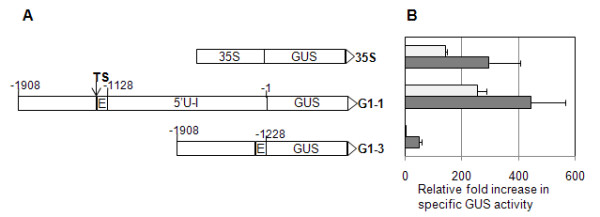
There are many non-cereal monocots of agronomic, horticultural, and biofuel importance. Successful transformation of these species requires an understanding of factors controlling expression of their genes. Introns have been known to affect both the level and tissue-specific expression of genes in dicots and cereal monocots, but there have been no studies on an intron isolated from a non-cereal monocot. This study characterizes the levels of GUS expression and levels of uidA mRNA that code for β-glucuronidase (GUS) expression in leaves of Gladiolus and Arabidopsis using GUBQ1, a polyubiquitin promoter with a 1.234 kb intron, isolated from the non-cereal monocot Gladiolus, and an intronless version of this promoter.
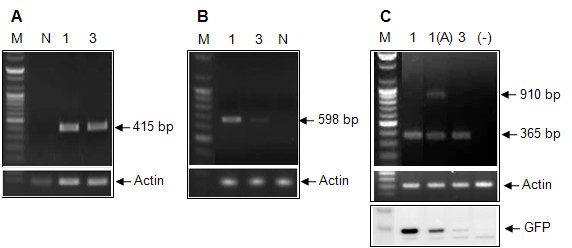
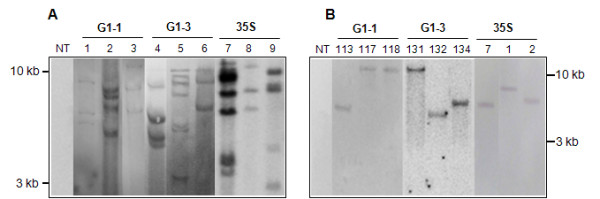
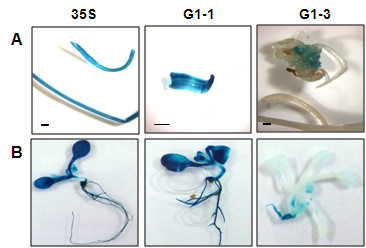
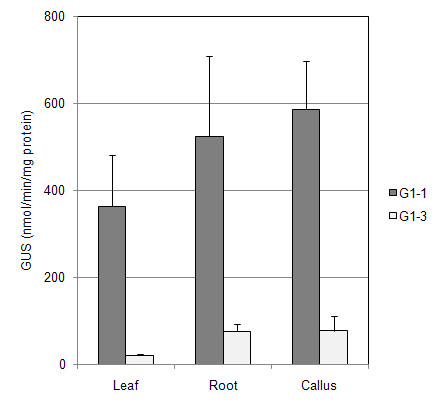
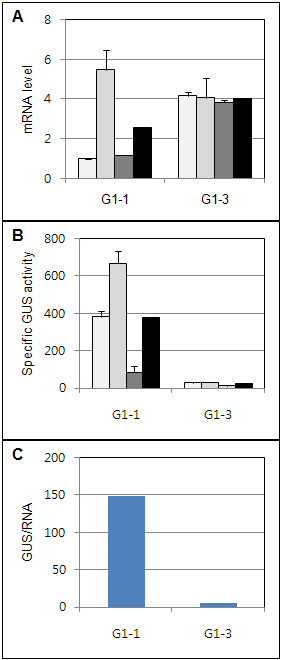
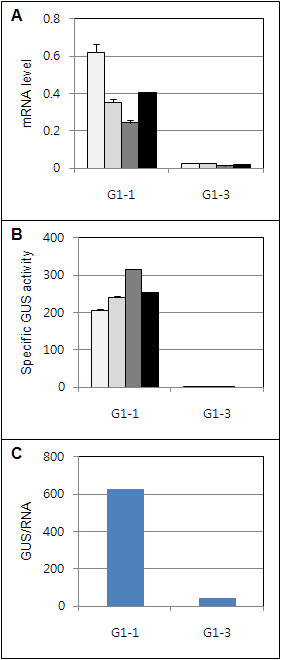
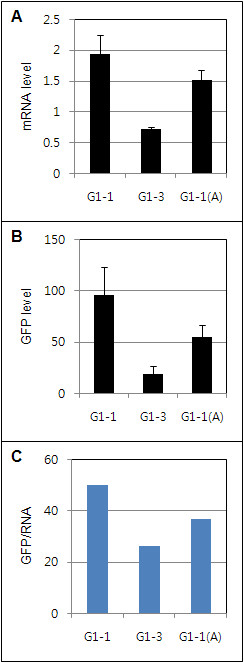
Gladiolus and Arabidopsis were verified by Southern hybridization to be transformed with the uidA gene that was under control of either the GUBQ1 promoter (1.9 kb), a 5' GUBQ1 promoter missing its 1.234 kb intron (0.68 kb), or the CaMV 35 S promoter. Histochemical staining showed that GUS was expressed throughout leaves and roots of Gladiolus and Arabidopsis with the 1.9 kb GUBQ1 promoter. GUS expression was significantly decreased in Gladiolus and abolished in Arabidopsis when the 5'UTR-intron was absent. In Arabidopsis and Gladiolus, the presence of uidA mRNA was independent of the presence of the 5'UTR-intron. The 5'-UTR intron enhanced translation efficiency for both Gladiolus and Arabidopsis.
The GUBQ1 promoter directs high levels of GUS expression in young leaves of both Gladiolus and Arabidopsis. The 5'UTR-intron from GUBQ1 resulted in a similar pattern of β-glucuronidase translation efficiency for both species even though the intron resulted in different patterns of uidA mRNA accumulation for each species.
有许多具有农业、园艺和生物燃料重要性的非谷类单子叶植物。这些物种的成功转化需要了解控制其基因表达的因素。内含子已被证明会影响双子叶植物和谷类单子叶植物中基因的水平和组织特异性表达,但尚未有研究涉及非谷类单子叶植物的内含子。本研究使用从小麦叶分离的多泛素启动子 GUBQ1 及其无内含子的版本,研究了从小麦叶分离的非谷类单子叶植物唐菖蒲的一个内含子对其基因表达的影响,该内含子长 1.234kb。
通过 Southern 杂交验证,拟南芥和唐菖蒲均转化了 uidA 基因,该基因受 GUBQ1 启动子(1.9kb)、缺少其 1.234kb 内含子的 5'GUBQ1 启动子(0.68kb)或 CaMV 35S 启动子的控制。组织化学染色表明,GUS 在唐菖蒲和拟南芥的叶片和根部均有表达,而 1.9kb 的 GUBQ1 启动子则表达 GUS。当 5'UTR-内含子时不存在时,GUS 在唐菖蒲中的表达显著降低,在拟南芥中则被消除。在拟南芥和唐菖蒲中,uidA mRNA 的存在与 5'UTR-内含子的存在无关。5'UTR 内含子增强了唐菖蒲和拟南芥的翻译效率。
GUBQ1 启动子在唐菖蒲和拟南芥的幼叶中均能高水平表达 GUS。即使内含子导致每个物种的 uidA mRNA 积累模式不同,GUBQ1 的 5'UTR-内含子也导致了两种物种的β-葡萄糖醛酸酶翻译效率相似的模式。