Department of Nutrition, Harvard School of Public Health, Boston, MA, USA.
Paediatr Perinat Epidemiol. 2012 Jul;26(4):361-72. doi: 10.1111/j.1365-3016.2012.01294.x.
An increasing number of women are utilizing fertility treatments, but little is known about their relation to autism spectrum disorders (ASD).
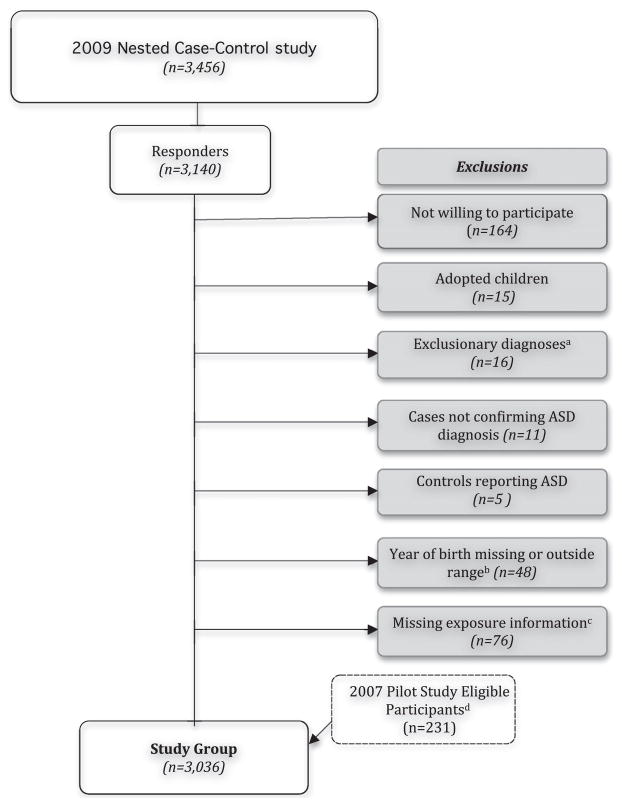
To determine the association between maternal fertility therapy use and risk of having a child with ASD, we conducted a nested case-control study within the Nurses' Health Study II (n = 116,430). Maternally reported diagnoses of ASD were confirmed through a supplementary questionnaire and, in a subgroup, the Autism Diagnostic Interview-Revised. Controls were randomly selected by frequency matching to case children's year of birth. Associations were examined by self-reported infertility and type of therapy using conditional logistic regression.
In all, 9% of the 507 cases and 7% of 2,529 controls indicated fertility therapy use for the index pregnancy. No significant associations with self-reported fertility therapies or history of infertility were seen in primary analyses. In subgroup analyses of women with maternal age ≥ 35 years (n = 1,020), artificial insemination was significantly associated with ASD; ovulation inducing drug (OID) use was significantly associated in crude but not adjusted analyses (odds ratio 1.81, 95% CI 0.96-3.42). Results were similar by diagnostic subgroup, though within the advanced maternal age group, OID and artificial insemination were significantly associated with Asperger syndrome and pervasive developmental disorder not-otherwise specified, but not autistic disorder.
[corrected] Assisted reproductive therapy and history of infertility did not increase risk of having a child with ASD in this study. However, the associations observed with OID and artificial insemination among older mothers, for whom these exposures are more common, warrant further investigation.
越来越多的女性正在接受生育治疗,但人们对生育治疗与自闭症谱系障碍(ASD)之间的关系知之甚少。
为了确定母体生育治疗的使用与 ASD 患儿发生风险之间的关系,我们在护士健康研究 II (NHS II)(n = 116430)中进行了一项巢式病例对照研究。通过补充问卷,在一个亚组中通过自闭症诊断访谈修订版,对 ASD 的母体报告诊断进行了确认。通过与病例儿童出生年份的频率匹配,随机选择对照。使用条件逻辑回归检查通过自我报告的不孕和治疗类型的关联。
在所有病例中,9%的 507 例和 7%的 2529 例对照者表示在索引妊娠中使用了生育治疗。在主要分析中,未发现与自我报告的生育治疗或不孕史有显著关联。在母体年龄≥35 岁的女性亚组分析中(n = 1020),人工授精与 ASD 显著相关;促排卵药物(OID)的使用在粗分析中显著相关,但在调整分析中不显著(优势比 1.81,95%CI 0.96-3.42)。在诊断亚组中,结果相似,但在高龄产妇组中,OID 和人工授精与 Asperger 综合征和特定未分类的广泛发育障碍显著相关,但与自闭症障碍无关。
在这项研究中,辅助生殖治疗和不孕史并未增加 ASD 患儿的患病风险。然而,在年龄较大的母亲中观察到的 OID 和人工授精与这些暴露更常见的关联,值得进一步研究。