Lyall Kristen, Rando Juliette, Wang Siwen, Hamra Ghassan B, Chavarro Jorge, Weisskopf Marc G, Croen Lisa A, Fallin M Daniele, Hertz-Picciotto Irva, Volk Heather E, Schmidt Rebecca J, Newschaffer Craig J
AJ Drexel Autism Institute, Drexel University, Philadelphia, PA, United States.
Department of Nutrition, Harvard T.H. Chan School of Public Health, Boston, MA, United States.
Curr Dev Nutr. 2023 Jul 25;7(8):101978. doi: 10.1016/j.cdnut.2023.101978. eCollection 2023 Aug.
Prior work has suggested relationships between prenatal intake of certain nutrients and autism.
We examined a broad set of prenatal nutrients and foods using a Bayesian modeling approach.
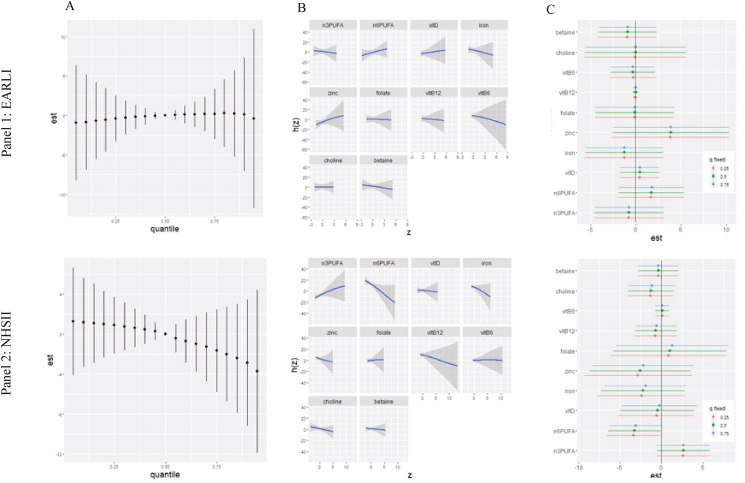
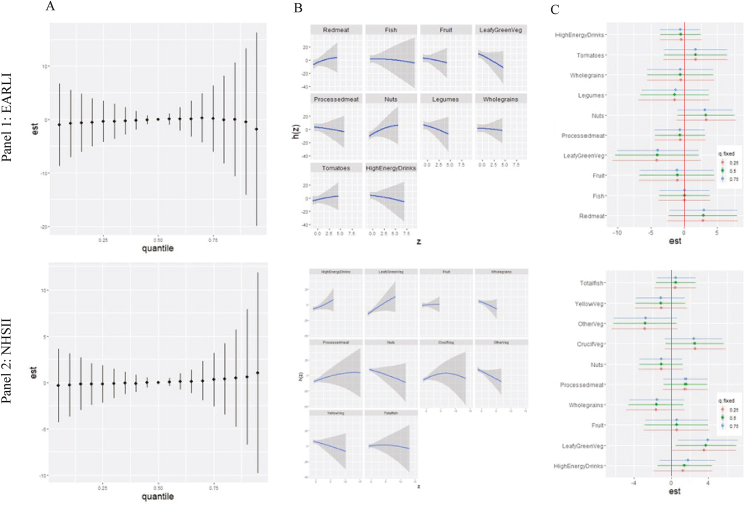
Participants were drawn from the Early Autism Risks Longitudinal Investigation ( = 127), a cohort following women with a child with autism through a subsequent pregnancy. Participants were also drawn from the Nurses' Health Study II (NHSII, = 713), a cohort of United States female nurses, for comparison analyses. In both studies, information on prospectively reported prenatal diet was drawn from food frequency questionnaires, and child autism-related traits were measured by the Social Responsiveness Scale (SRS). Bayesian kernel machine regression was used to examine the combined effects of several nutrients with neurodevelopmental relevance, including polyunsaturated fatty acids (PUFAs), iron, zinc, vitamin D, folate, and other methyl donors, and separately, key food sources of these, in association with child SRS scores in crude and adjusted models.
In adjusted analyses, the overall mixture effects of nutrients in Early Autism Risks Longitudinal Investigation and foods in both cohorts on SRS scores were not observed, though there was some suggestion of decreasing SRS scores with increasing overall nutrient mixture in NHSII. No associations were observed with folate within the context of this mixture, but holding other nutrients fixed, n-6 PUFAs were associated with lower SRS scores in NHSII. In both cohorts, lower SRS scores were observed with higher intake of some groupings of vegetables, though for differing types of vegetables across cohorts, and some vegetable groups were associated with higher SRS scores in NHSII.
Our work extends prior research and suggests the need to further consider prenatal dietary factors from a combined effects perspective. In addition, findings here point to potential differences in nutrient associations based on a family history of autism, which suggests the need to consider gene interactions in future work.
先前的研究表明某些营养素的产前摄入量与自闭症之间存在关联。
我们使用贝叶斯建模方法研究了一系列广泛的产前营养素和食物。
参与者来自早期自闭症风险纵向调查(n = 127),这是一个追踪有自闭症孩子的女性随后怀孕情况的队列。参与者还来自护士健康研究II(NHSII,n = 713),这是一组美国女护士队列,用于比较分析。在这两项研究中,前瞻性报告的产前饮食信息来自食物频率问卷,儿童自闭症相关特征通过社会反应量表(SRS)进行测量。贝叶斯核机器回归用于研究几种与神经发育相关的营养素的综合作用,包括多不饱和脂肪酸(PUFA)、铁、锌、维生素D、叶酸和其他甲基供体,以及分别研究这些营养素的关键食物来源,在粗模型和调整模型中与儿童SRS评分的关联。
在调整分析中,未观察到早期自闭症风险纵向调查中的营养素总体混合效应以及两个队列中的食物对SRS评分的影响,尽管在NHSII中有一些迹象表明随着总体营养素混合量增加SRS评分降低。在这种混合情况下未观察到与叶酸的关联,但在其他营养素固定的情况下,n - 6多不饱和脂肪酸与NHSII中较低的SRS评分相关。在两个队列中,某些蔬菜组摄入量较高时观察到较低的SRS评分,尽管不同队列中蔬菜类型不同,并且某些蔬菜组与NHSII中较高的SRS评分相关。
我们的工作扩展了先前的研究,并表明需要从综合效应的角度进一步考虑产前饮食因素。此外,这里的研究结果指出了基于自闭症家族史的营养素关联的潜在差异,这表明在未来的工作中需要考虑基因相互作用。