Russell H. Morgan Department of Radiology and Radiological Science, Johns Hopkins University School of Medicine, Baltimore, Maryland 21287, USA.
Magn Reson Med. 2013 May;69(5):1217-25. doi: 10.1002/mrm.24357. Epub 2012 Jun 12.
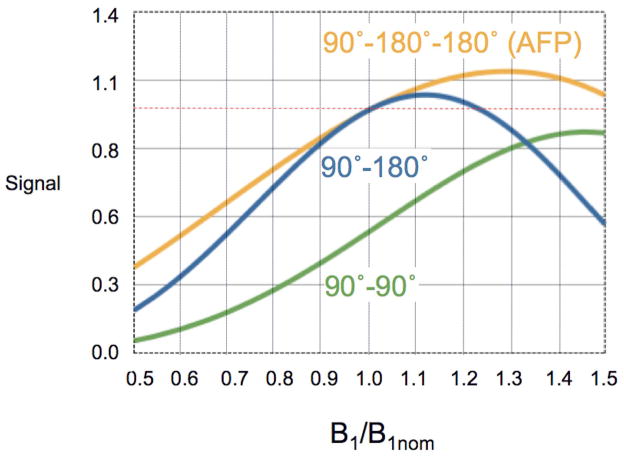
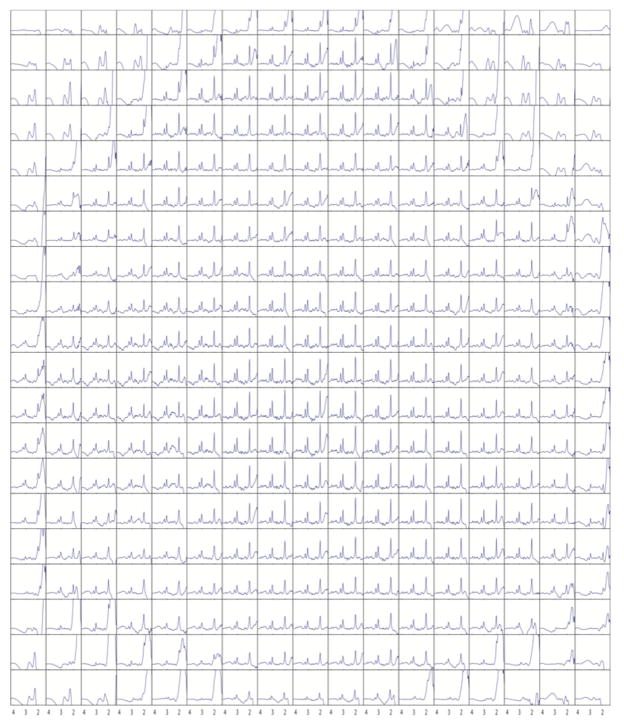
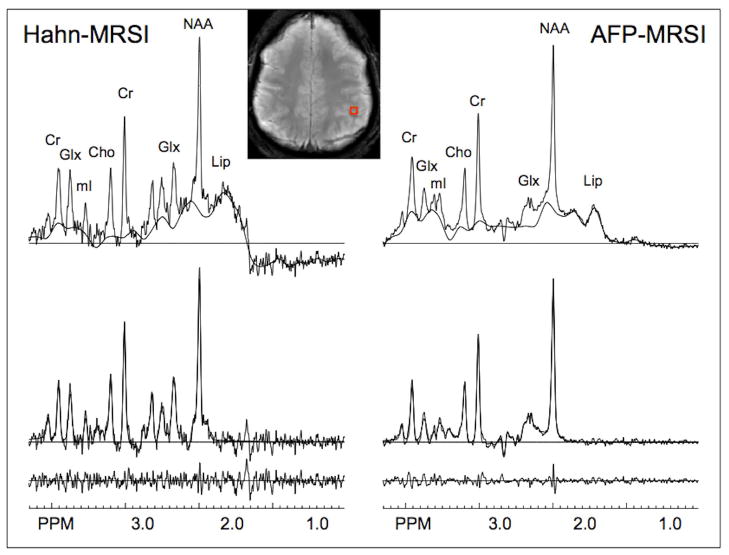
Two approaches to high-resolution SENSE-encoded magnetic resonance spectroscopic imaging (MRSI) of the human brain at 7 Tesla (T) with whole-slice coverage are described. Both sequences use high-bandwidth radiofrequency pulses to reduce chemical shift displacement artifacts, SENSE-encoding to reduce scan time, and dual-band water and lipid suppression optimized for 7 T. Simultaneous B0 and transmit B1 mapping was also used for both sequences to optimize field homogeneity using high-order shimming and determine optimum radiofrequency transmit level, respectively. One sequence ("Hahn-MRSI") used reduced flip angle (90°) refocusing pulses for lower radiofrequency power deposition, while the other sequence used adiabatic fast passage refocusing pulses for improved sensitivity and reduced signal dependence on the transmit-B1 level. In four normal subjects, adiabatic fast passage-MRSI showed a signal-to-noise ratio improvement of 3.2±0.5 compared to Hahn-MRSI at the same spatial resolution, pulse repetition time, echo time, and SENSE-acceleration factor. An interleaved two-slice Hahn-MRSI sequence is also demonstrated to be experimentally feasible.
介绍了两种在 7 特斯拉(T)下对人脑进行高分辨率 SENSE 编码磁共振波谱成像(MRSI)的方法。这两个序列都使用了高带宽射频脉冲来减少化学位移位移伪影,SENSE 编码来减少扫描时间,并使用针对 7 T 优化的双带水和脂质抑制。两个序列都使用了同时的 B0 和发射 B1 映射,以分别使用高阶匀场和确定最佳射频发射水平来优化场均匀性。一个序列(“Hahn-MRSI”)使用降低的翻转角(90°)重聚焦脉冲以降低射频功率沉积,而另一个序列使用绝热快速通过重聚焦脉冲以提高灵敏度并降低信号对发射-B1 水平的依赖性。在四个正常受试者中,与在相同空间分辨率、脉冲重复时间、回波时间和 SENSE 加速因子下的 Hahn-MRSI 相比,绝热快速通过-MRSI 的信噪比提高了 3.2±0.5。还演示了一种交错的双切片 Hahn-MRSI 序列在实验上是可行的。