Boise State University, Boise, Idaho, United States of America.
PLoS Comput Biol. 2012 May;8(5):e1002499. doi: 10.1371/journal.pcbi.1002499. Epub 2012 May 31.
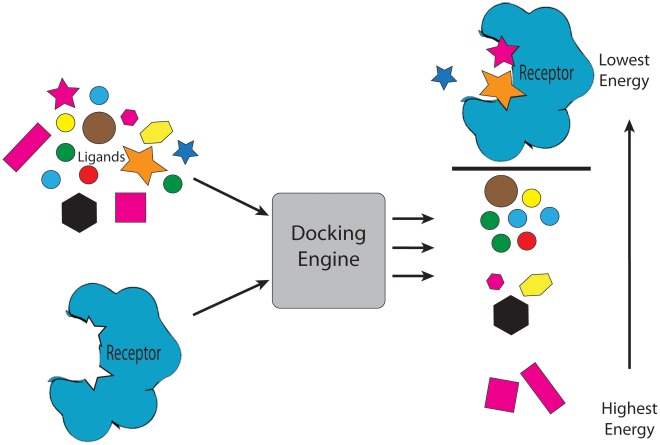
We survey low cost high-throughput virtual screening (HTVS) computer programs for instructors who wish to demonstrate molecular docking in their courses. Since HTVS programs are a useful adjunct to the time consuming and expensive wet bench experiments necessary to discover new drug therapies, the topic of molecular docking is core to the instruction of biochemistry and molecular biology. The availability of HTVS programs coupled with decreasing costs and advances in computer hardware have made computational approaches to drug discovery possible at institutional and non-profit budgets. This paper focuses on HTVS programs with graphical user interfaces (GUIs) that use either DOCK or AutoDock for the prediction of DockoMatic, PyRx, DockingServer, and MOLA since their utility has been proven by the research community, they are free or affordable, and the programs operate on a range of computer platforms.
我们调查了低成本高通量虚拟筛选 (HTVS) 计算机程序,供希望在课程中演示分子对接的教师使用。由于 HTVS 程序是发现新药物疗法所需的耗时且昂贵的湿实验室实验的有益补充,因此分子对接是生物化学和分子生物学教学的核心。HTVS 程序的可用性,加上计算机硬件成本的降低和技术的进步,使得在机构和非营利预算下进行药物发现的计算方法成为可能。本文重点介绍了具有图形用户界面 (GUI) 的 HTVS 程序,这些程序使用 DOCK 或 AutoDock 进行预测,包括 DockoMatic、PyRx、DockingServer 和 MOLA,因为它们的实用性已得到研究界的证明,而且它们是免费或负担得起的,并且这些程序可在多种计算机平台上运行。