Department of Agronomy, Iowa State University, Ames, IA 50011, USA.
BMC Plant Biol. 2012 Jun 13;12:87. doi: 10.1186/1471-2229-12-87.
Nonhost resistance (NHR) provides immunity to all members of a plant species against all isolates of a microorganism that is pathogenic to other plant species. Three Arabidopsis thaliana PEN (penetration deficient) genes, PEN1, 2 and 3 have been shown to provide NHR against the barley pathogen Blumeria graminis f. sp. hordei at the prehaustorial level. Arabidopsis pen1-1 mutant lacking the PEN1 gene is penetrated by the hemibiotrophic oomycete pathogen Phytophthora sojae, the causal organism of the root and stem rot disease in soybean. We investigated if there is any novel nonhost resistance mechanism in Arabidopsis against the soybean pathogen, P. sojae.
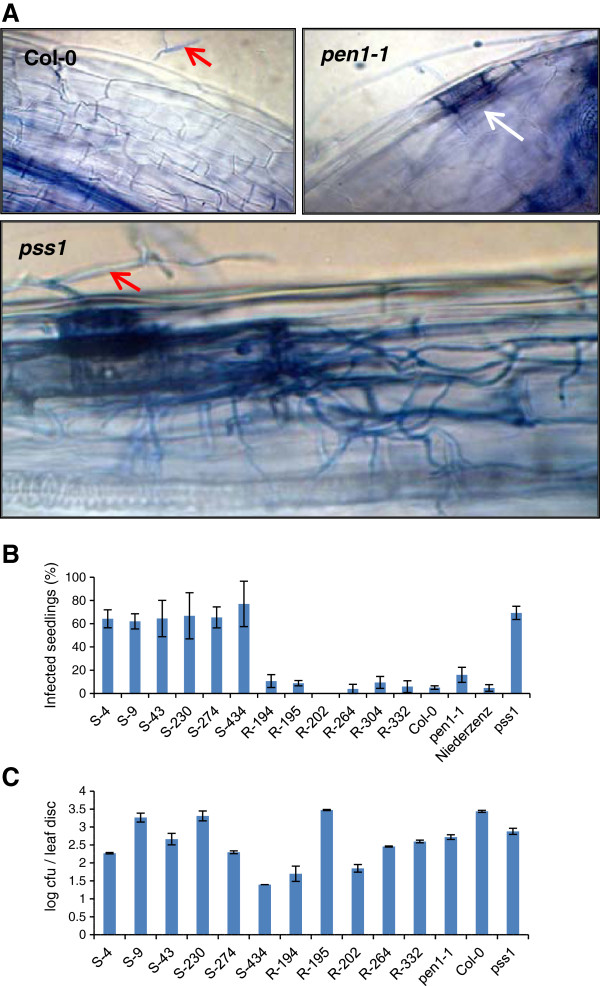
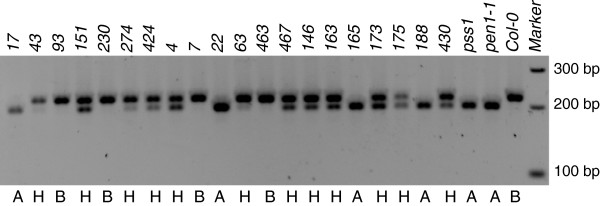
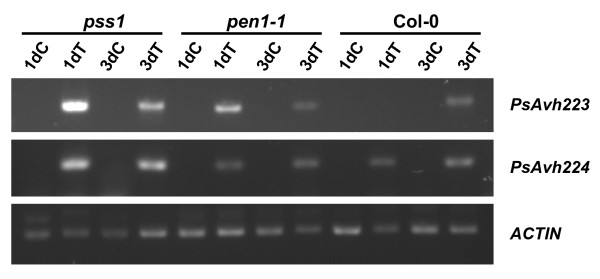
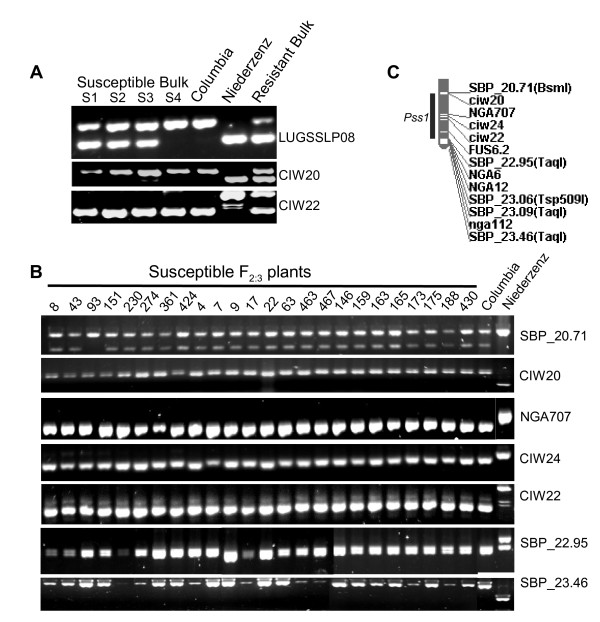
The P.sojaesusceptible (pss) 1 mutant was identified by screening a mutant population created in the Arabidopsis pen1-1 mutant that lacks penetration resistance against the non adapted barley biotrophic fungal pathogen, Blumeria graminis f. sp. hordei. Segregation data suggested that PEN1 is not epistatic to PSS1. Responses of pss1 and pen1-1 to P. sojae invasion were distinct and suggest that PSS1 may act at both pre- and post-haustorial levels, while PEN1 acts at the pre-haustorial level against this soybean pathogen. Therefore, PSS1 encodes a new form of nonhost resistance. The pss1 mutant is also infected by the necrotrophic fungal pathogen, Fusarium virguliforme, which causes sudden death syndrome in soybean. Thus, a common NHR mechanism is operative in Arabidopsis against both hemibiotrophic oomycetes and necrotrophic fungal pathogens that are pathogenic to soybean. However, PSS1 does not play any role in immunity against the bacterial pathogen, Pseudomonas syringae pv. glycinea, that causes bacterial blight in soybean. We mapped PSS1 to a region very close to the southern telomere of chromosome 3 that carries no known disease resistance genes.
The study revealed that Arabidopsis PSS1 is a novel nonhost resistance gene that confers a new form of nonhost resistance against both a hemibiotrophic oomycete pathogen, P. sojae and a necrotrophic fungal pathogen, F. virguliforme that cause diseases in soybean. However, this gene does not play any role in the immunity of Arabidopsis to the bacterial pathogen, P. syringae pv. glycinea, which causes bacterial blight in soybean. Identification and further characterization of the PSS1 gene would provide further insights into a new form of nonhost resistance in Arabidopsis, which could be utilized in improving resistance of soybean to two serious pathogens.
非寄主抗性(NHR)赋予植物物种的所有成员对所有致病微生物的分离株的免疫力,这些微生物对其他植物物种具有致病性。已经表明,拟南芥中的三个 PEN(穿透缺陷)基因 PEN1、2 和 3 在haustorial 前水平提供了对大麦病原体禾谷布氏白粉菌 f. sp. hordei 的 NHR。缺乏 PEN1 基因的拟南芥 pen1-1 突变体被半生物营养性卵菌病原体大豆疫霉,大豆根和茎腐烂病的致病生物体穿透。我们研究了拟南芥中是否存在针对大豆病原体大豆疫霉的新型非寄主抗性机制。
通过筛选缺乏对非适应大麦生物性真菌病原体禾谷布氏白粉菌 f. sp. hordei 的穿透抗性的拟南芥 pen1-1 突变体中的突变体群体,鉴定出 P.sojaesusceptible (pss) 1 突变体。分离数据表明 PEN1 与 PSS1 不是上位性的。pss1 和 pen1-1 对 P. sojae 入侵的反应明显不同,表明 PSS1 可能在前haustorial 和 post-haustorial 水平起作用,而 PEN1 在前haustorial 水平对此大豆病原体起作用。因此,PSS1 编码一种新形式的非寄主抗性。pss1 突变体也被坏死性真菌病原体尖孢镰刀菌感染,该病原体导致大豆猝倒病。因此,一种常见的 NHR 机制在拟南芥中对大豆致病的半生物营养性卵菌和坏死性真菌病原体均起作用。然而,PSS1 在对大豆细菌性斑点病的细菌病原体丁香假单胞菌 pv. glycinea 的免疫中不起任何作用。我们将 PSS1 定位到染色体 3 的南部端粒附近的一个区域,该区域没有携带已知的抗病基因。
该研究表明,拟南芥 PSS1 是一种新的非寄主抗性基因,赋予了一种新形式的非寄主抗性,可抵抗大豆致病的半生物营养性卵菌病原体大豆疫霉和坏死性真菌病原体尖孢镰刀菌。然而,该基因在拟南芥对细菌性斑点病的细菌病原体丁香假单胞菌 pv. glycinea 的免疫中不起任何作用,细菌性斑点病在大豆中引起细菌性斑点病。PSS1 基因的鉴定和进一步表征将进一步深入了解拟南芥中的一种新形式的非寄主抗性,这可能有助于提高大豆对两种严重病原体的抗性。