Diabetes Research Unit, Department Cell Biology, King Faisal Specialist Hospital & Research Centre, PO BOX 3354, Riyadh, 11211, Saudi Arabia.
Nutr Metab (Lond). 2012 Jun 14;9(1):58. doi: 10.1186/1743-7075-9-58.
Recent evidence suggests that the effects of certain food additives may be synergistic or additive. Aspartame (ASP) and Monosodium Glutamate (MSG) are ubiquitous food additives with a common moiety: both contain acidic amino acids which can act as neurotransmitters, interacting with NMDA receptors concentrated in areas of the Central Nervous System regulating energy expenditure and conservation. MSG has been shown to promote a neuroendocrine dysfunction when large quantities are administered to mammals during the neonatal period. ASP is a low-calorie dipeptide sweetener found in a wide variety of diet beverages and foods. However, recent reports suggest that ASP may promote weight gain and hyperglycemia in a zebrafish nutritional model.
We investigated the effects of ASP, MSG or a combination of both on glucose and insulin homeostasis, weight change and adiposity, in C57BL/6 J mice chronically exposed to these food additives commencing in-utero, compared to an additive-free diet. Pearson correlation analysis was used to investigate the associations between body characteristics and variables in glucose and insulin homeostasis.
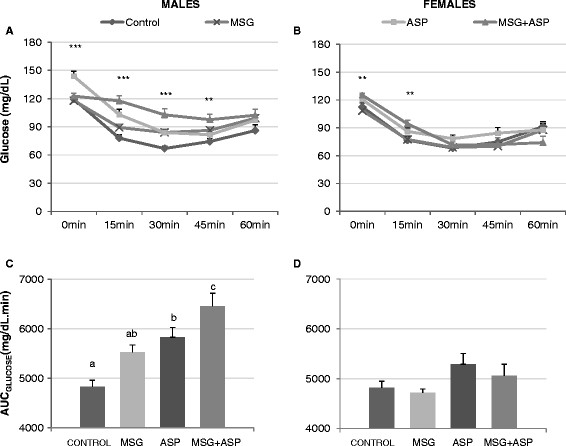
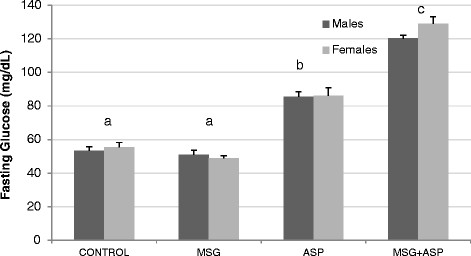
ASP alone (50 mg/Kgbw/day) caused an increase in fasting blood glucose of 1.6-fold, together with reduced insulin sensitivity during an Insulin Tolerance Test (ITT) P < 0.05. Conversely MSG alone decreased blood triglyceride and total cholesterol (T-CHOL) levels. The combination of MSG (120 mg/Kgbw/day) and ASP elevated body weight, and caused a further increase in fasting blood glucose of 2.3-fold compared to Controls (prediabetic levels); together with evidence of insulin resistance during the ITT (P < 0.05). T-CHOL levels were reduced in both ASP-containing diets in both genders. Further analysis showed a strong correlation between body weight at 6 weeks, and body weight and fasting blood glucose levels at 17 weeks, suggesting that early body weight may be a predictor of glucose homeostasis in later life.
Aspartame exposure may promote hyperglycemia and insulin intolerance. MSG may interact with aspartame to further impair glucose homeostasis. This is the first study to ascertain the hyperglycemic effects of chronic exposure to a combination of these commonly consumed food additives; however these observations are limited to a C57BL/6 J mouse model. Caution should be applied in extrapolating these findings to other species.
最近的证据表明,某些食品添加剂的影响可能是协同或累加的。阿斯巴甜(ASP)和谷氨酸单钠(MSG)是无处不在的食品添加剂,它们有一个共同的部分:都含有酸性氨基酸,可作为神经递质,与中枢神经系统中调节能量消耗和储存的 NMDA 受体相互作用。当大量的 MSG 在哺乳动物的新生儿期给予时,已经证明它会促进神经内分泌功能障碍。ASP 是一种低热量二肽甜味剂,存在于各种饮食饮料和食品中。然而,最近的报告表明,ASP 可能会在斑马鱼营养模型中促进体重增加和高血糖。
我们研究了 ASP、MSG 或两者组合对从宫内开始长期暴露于这些食品添加剂的 C57BL/6J 小鼠的葡萄糖和胰岛素稳态、体重变化和肥胖的影响,与不含添加剂的饮食进行比较。Pearson 相关分析用于研究体重特征与葡萄糖和胰岛素稳态变量之间的相关性。
ASP 单独(50mg/Kgbw/天)导致空腹血糖增加 1.6 倍,同时胰岛素耐量试验(ITT)时胰岛素敏感性降低(P<0.05)。相反,MSG 单独降低了血液甘油三酯和总胆固醇(T-CHOL)水平。MSG(120mg/Kgbw/天)和 ASP 的组合增加了体重,并导致空腹血糖进一步增加 2.3 倍,与对照组(糖尿病前期水平)相比;同时在 ITT 期间存在胰岛素抵抗的证据(P<0.05)。两种 ASP 饮食都降低了 T-CHOL 水平。进一步分析表明,6 周时的体重与 17 周时的体重和空腹血糖水平之间存在很强的相关性,表明早期体重可能是以后生活中葡萄糖稳态的预测因素。
暴露于 ASP 可能会导致高血糖和胰岛素耐受。MSG 可能与 ASP 相互作用,进一步损害葡萄糖稳态。这是第一项确定长期暴露于这些常用食品添加剂组合后高血糖影响的研究;然而,这些观察结果仅限于 C57BL/6J 小鼠模型。在将这些发现外推到其他物种时应谨慎。