Institute of Health and Care Sciences, Sahlgrenska Academy, University of Gothenburg, Gothenburg, Sweden.
BMC Nurs. 2012 Jun 14;11:8. doi: 10.1186/1472-6955-11-8.
Standardized patient surveys are widely used for assessing quality of healthcare from the patient perspective. An important purpose of such surveys is to identify disparities in care among different patient groups. The purpose of this study was to 1.) evaluate aspects of the validity of the adapted Swedish version of the Picker Patient Care Experience -15 (PPE-15) survey and 2.) examine the explanatory value of various socio-demographic and health characteristics in predicting patients' care experiences.
A retrospective cross-sectional study design was used. Patients discharged from internal medicine wards at regional and university hospitals in different parts of Sweden during 2010 were invited to participate in the regularly administered national care-experience survey for hospital care. The internal validity of the PPE-15 was assessed with Cronbach's alpha and item-scale correlations. Pearson product-moment correlation coefficients were used to compare PPE-15 total scores with overall care satisfaction ratings and Spearman correlation coefficients were used to compare PPE-15 total scores with various patient characteristics. Multiple linear regression analysis was performed to examine the influence of various patient characteristics on PPE-15 scores.
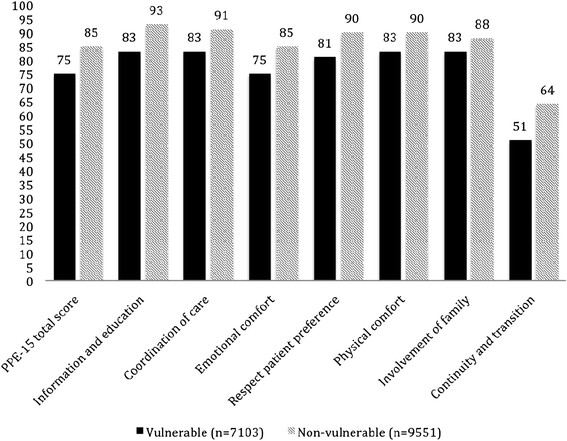
The response rate was 66% (n = 34 603). Cronbach's alpha was 0.87. The correlation between the PPE-15 total score and overall care satisfaction was high (0.62, p < 0.0001). Good self-rated health (SRH) and having Swedish as native language were associated with better care experiences and poorer experiences with greater healthcare utilization, higher age, functional impairment and being female. All examined characteristics, except language, were significant predictors in the regression model and SRH was the strongest predictor; however, the model explained only 7% of the total variance. Vulnerable patients (i.e. poor SRH and functional impairment) reported significantly less positive care experiences than did non-vulnerable patients (mean PPE-15 score 75 vs 85; p < 0.0001).
Our results supported the internal validity of the Swedish adapted version of the PPE-15. The explanatory value of the examined patient socio-demographic and health characteristics was low, suggesting the need for exploring other patient-related determinants of care experiences. Our findings also suggest a care paradox: patients in greatest need of hospital care are least satisfied with the quality of the care they receive.
标准化患者调查被广泛用于从患者角度评估医疗保健质量。此类调查的一个重要目的是识别不同患者群体之间的护理差异。本研究的目的是 1.)评估适应后的瑞典版 Picker 患者护理体验量表-15(PPE-15)调查的有效性方面,2.)研究各种社会人口学和健康特征对预测患者护理体验的解释能力。
采用回顾性横断面研究设计。2010 年,瑞典各地地区和大学医院内科病房出院的患者受邀参加定期进行的全国医院护理体验调查。使用 Cronbach's alpha 和项目-量表相关性评估 PPE-15 的内部有效性。使用 Pearson 积矩相关系数比较 PPE-15 总分与整体护理满意度评分,使用 Spearman 相关系数比较 PPE-15 总分与各种患者特征。进行多元线性回归分析,以检验各种患者特征对 PPE-15 评分的影响。
应答率为 66%(n=34603)。Cronbach's alpha 为 0.87。PPE-15 总分与整体护理满意度之间的相关性较高(0.62,p<0.0001)。自我报告健康状况良好(SRH)和母语为瑞典语与更好的护理体验相关,而更多的医疗保健利用、更高的年龄、功能障碍和女性则与较差的护理体验相关。除语言外,所有检查的特征均为回归模型中的显著预测因子,而 SRH 是最强的预测因子;然而,该模型仅解释了总方差的 7%。脆弱患者(即 SRH 差和功能障碍)报告的护理体验明显不如非脆弱患者积极(平均 PPE-15 评分 75 分与 85 分;p<0.0001)。
我们的结果支持适应后的瑞典版 PPE-15 的内部有效性。检查的患者社会人口学和健康特征的解释能力较低,这表明需要探索其他与患者相关的护理体验决定因素。我们的研究结果还表明存在一种护理悖论:最需要医院护理的患者对他们所接受的护理质量最不满意。