Division of Biostatistics, Graduate Institute of Epidemiology and Preventive Medicine, College of Public Health, National Taiwan University, Taipei, Taiwan.
Gut. 2013 May;62(5):676-82. doi: 10.1136/gutjnl-2012-302240. Epub 2012 Jun 14.
To evaluate the benefit of mass eradication of Helicobacter pylori infection in reducing premalignant gastric lesions.
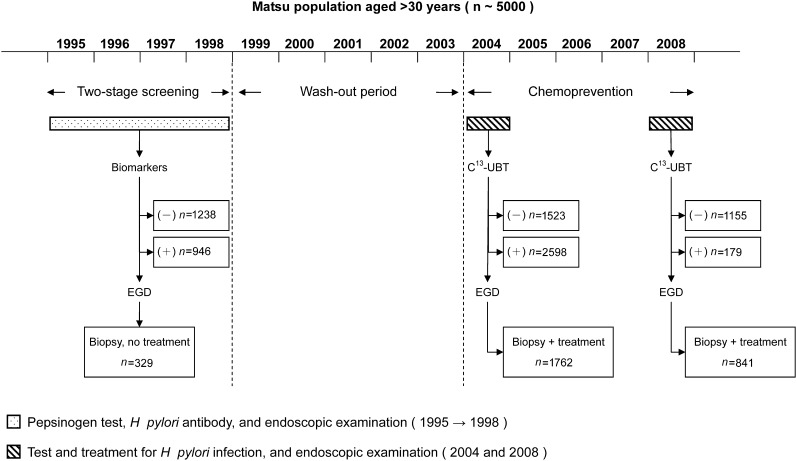
Mass eradication of H pylori infection was started from 2004 for a Taiwanese population with prevalent H pylori infection, who were >30 years of age. Participants positive for the (13)C-urea breath test underwent endoscopic screening and 1-week clarithromycin-based triple therapy. For subjects whose initial treatment failed, 10-day levofloxacin-based triple therapy was administered. The main outcome measures were changes in the prevalence of H pylori infection and premalignant gastric lesions, and changes in the incidence of premalignant gastric lesions and gastric cancer before (1995-2003) and after (2004-2008) chemoprevention using various comparators.
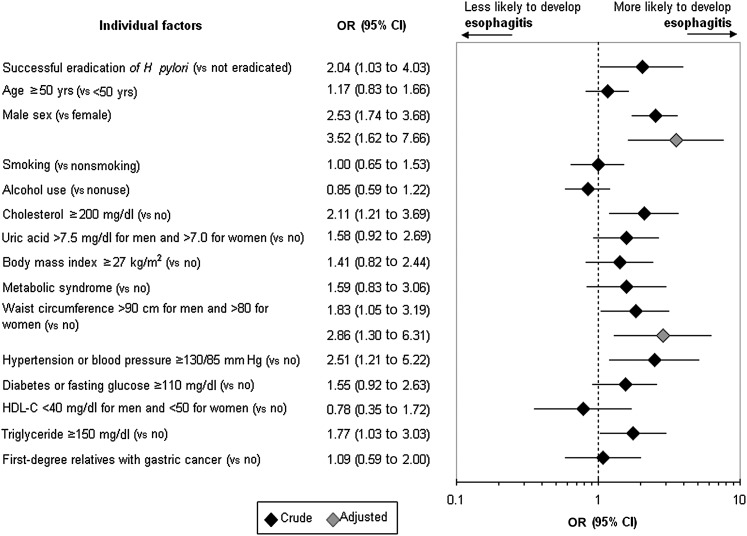
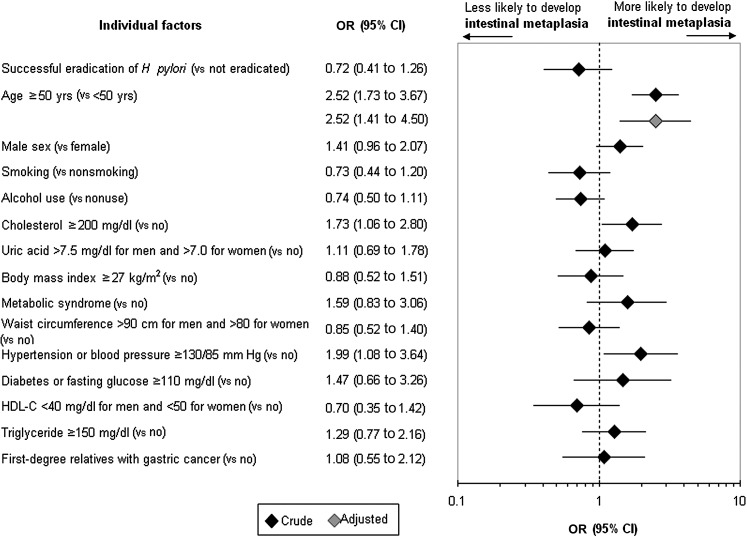
The reduction in H pylori infection was 78.7% (95% CI 76.8% to 80.7%), and the estimated incidence of re-infection/recrudescence was 1% (95% CI 0.6% to 1.4%) per person-year. The effectiveness of reducing the incidence of gastric atrophy resulting from chemoprevention was significant at 77.2% (95% CI 72.3% to 81.2%), while the reduction in intestinal metaplasia was not significant. Compared with the 5-year period before chemoprevention and in the absence of endoscopic screening, the effectiveness in reducing gastric cancer incidence during the chemoprevention period was 25% (rate ratio 0.753, 95% CI 0.372 to 1.524). The reduction in peptic ulcer disease was 67.4% (95% CI 52.2% to 77.8%), while the incidence of oesophagitis was 6% (95% CI 5.1% to 6.9%) after treatment.
Population-based eradication of H pylori infection has led to a significant reduction in gastric atrophy at the expense of increased oesophagitis. The ultimate benefit in reducing gastric cancer incidence and its mortality should be validated by a further long-term follow-up.
评估大规模根除幽门螺杆菌感染对减少癌前胃病变的益处。
从 2004 年开始,对感染幽门螺杆菌的台湾人群(年龄>30 岁)进行大规模根除感染。(13)C-尿素呼气试验阳性者接受内镜筛查和 1 周克拉霉素三联疗法。对于初始治疗失败的患者,给予 10 天左氧氟沙星三联疗法。主要观察指标是幽门螺杆菌感染和癌前胃病变的流行率变化,以及在使用各种对照剂进行化学预防之前(1995-2003 年)和之后(2004-2008 年)癌前胃病变和胃癌的发病率变化。
幽门螺杆菌感染的减少率为 78.7%(95%CI76.8%至 80.7%),估计每人每年的再感染/复发率为 1%(95%CI0.6%至 1.4%)。化学预防引起的胃萎缩发病率的降低效果显著,为 77.2%(95%CI72.3%至 81.2%),而肠化生的减少不显著。与化学预防前的 5 年相比,并且在没有内镜筛查的情况下,化学预防期间胃癌发病率的降低效果为 25%(率比 0.753,95%CI0.372 至 1.524)。消化性溃疡病的减少率为 67.4%(95%CI52.2%至 77.8%),而治疗后食管炎的发病率为 6%(95%CI5.1%至 6.9%)。
基于人群的幽门螺杆菌根除感染导致胃萎缩显著减少,而食管炎增加。通过进一步的长期随访,应验证降低胃癌发病率及其死亡率的最终获益。