• 文献检索
  • 文档翻译
  • 深度研究
  • 学术资讯
  • Suppr Zotero 插件Zotero 插件
  • 邀请有礼
  • 套餐&价格
  • 历史记录
应用&插件
Suppr Zotero 插件Zotero 插件浏览器插件Mac 客户端Windows 客户端微信小程序
定价
高级版会员购买积分包购买API积分包
服务
文献检索文档翻译深度研究API 文档MCP 服务
关于我们
关于 Suppr公司介绍联系我们用户协议隐私条款
关注我们

Suppr 超能文献

核心技术专利:CN118964589B侵权必究
粤ICP备2023148730 号-1Suppr @ 2026

文献检索

告别复杂PubMed语法,用中文像聊天一样搜索,搜遍4000万医学文献。AI智能推荐,让科研检索更轻松。

立即免费搜索

文件翻译

保留排版,准确专业,支持PDF/Word/PPT等文件格式,支持 12+语言互译。

免费翻译文档

深度研究

AI帮你快速写综述,25分钟生成高质量综述,智能提取关键信息,辅助科研写作。

立即免费体验

对 MHC 多样性在恶魔面部肿瘤病中的作用的新认识。

New insights into the role of MHC diversity in devil facial tumour disease.

机构信息

Faculty of Veterinary Science, University of Sydney, Sydney, Australia.

出版信息

PLoS One. 2012;7(6):e36955. doi: 10.1371/journal.pone.0036955. Epub 2012 Jun 6.

DOI:10.1371/journal.pone.0036955
PMID:22701561
原文链接:https://pmc.ncbi.nlm.nih.gov/articles/PMC3368896/
Abstract

BACKGROUND

Devil facial tumour disease (DFTD) is a fatal contagious cancer that has decimated Tasmanian devil populations. The tumour has spread without invoking immune responses, possibly due to low levels of Major Histocompatibility Complex (MHC) diversity in Tasmanian devils. Animals from a region in north-western Tasmania have lower infection rates than those in the east of the state. This area is a genetic transition zone between sub-populations, with individuals from north-western Tasmania displaying greater diversity than eastern devils at MHC genes, primarily through MHC class I gene copy number variation. Here we test the hypothesis that animals that remain healthy and tumour free show predictable differences at MHC loci compared to animals that develop the disease.

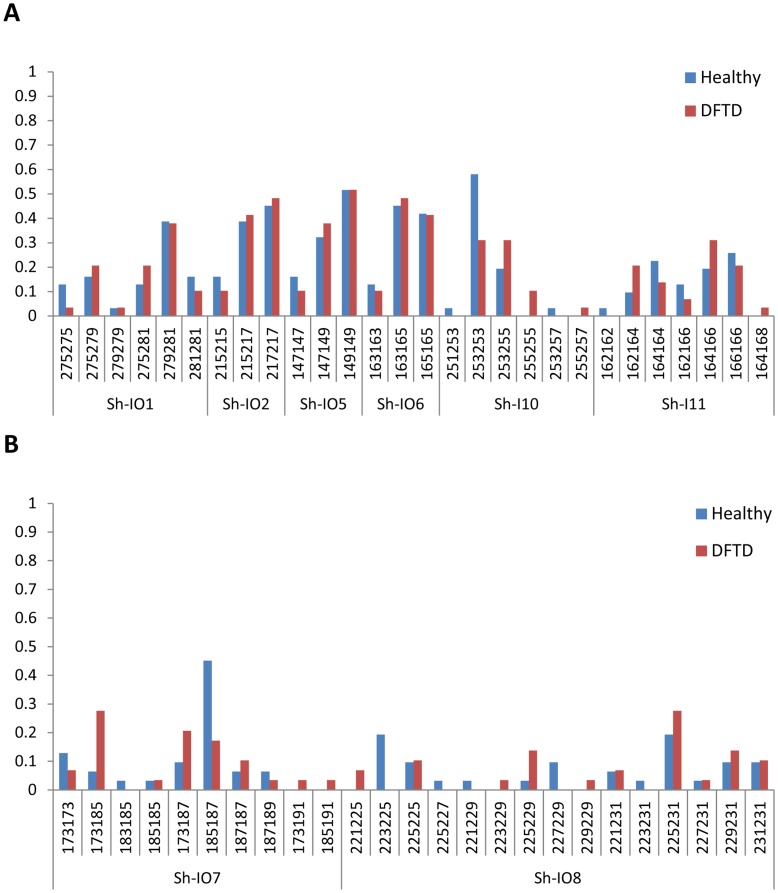
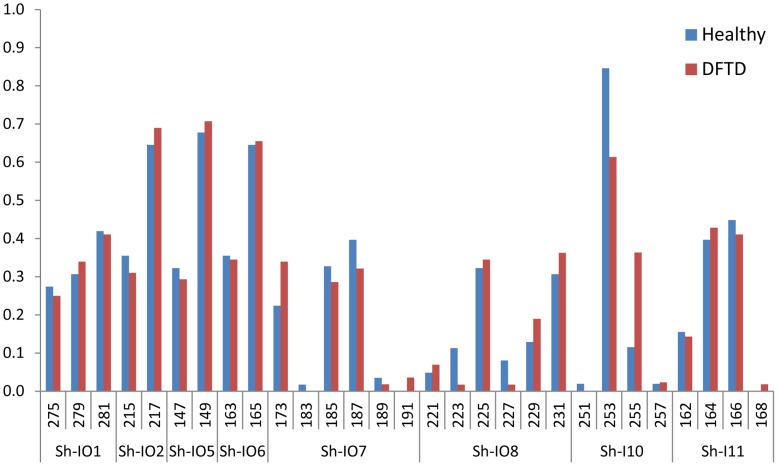
METHODOLOGY/PRINCIPAL FINDINGS: We compared MHC class I sequences in 29 healthy and 22 diseased Tasmanian devils from West Pencil Pine, a population in north-western Tasmania exhibiting reduced disease impacts of DFTD. Amplified alleles were assigned to four loci, Saha-UA, Saha-UB, Saha-UC and Saha-UD based on recently obtained genomic sequence data. Copy number variation (caused by a deletion) at Saha-UA was confirmed using a PCR assay. No association between the frequency of this deletion and disease status was identified. All individuals had alleles at Saha-UD, disproving theories of disease susceptibility relating to copy number variation at this locus. Genetic variation between the two sub-groups (healthy and diseased) was also compared using eight MHC-linked microsatellite markers. No significant differences were identified in allele frequency, however differences were noted in the genotype frequencies of two microsatellites located near non-antigen presenting genes within the MHC.

CONCLUSIONS/SIGNIFICANCE: We did not find predictable differences in MHC class I copy number variation to account for differences in susceptibility to DFTD. Genotypic data was equivocal but indentified genomic areas for further study.

摘要

背景

恶魔面部肿瘤病(DFTD)是一种致命的传染性癌症,已使塔斯马尼亚恶魔数量锐减。这种肿瘤在没有引发免疫反应的情况下扩散,可能是由于塔斯马尼亚恶魔的主要组织相容性复合体(MHC)多样性较低。来自塔斯马尼亚西北部一个地区的动物比该州东部的动物感染率低。该地区是亚种群之间的遗传过渡区,来自塔斯马尼亚西北部的个体在 MHC 基因上比东部恶魔表现出更大的多样性,主要是通过 MHC Ⅰ类基因拷贝数变异。在这里,我们检验了这样一个假设,即保持健康且无肿瘤的动物在 MHC 基因座上表现出可预测的差异,与患有该疾病的动物相比。

方法/主要发现:我们比较了来自塔斯马尼亚西北部 West Pencil Pine 的 29 只健康和 22 只患有恶魔面部肿瘤病的恶魔的 MHC Ⅰ类序列,该种群的 DFTD 疾病影响较小。根据最近获得的基因组序列数据,将扩增的等位基因分配到四个基因座 Saha-UA、Saha-UB、Saha-UC 和 Saha-UD 上。使用 PCR 测定法证实了 Saha-UA 处的拷贝数变异(由缺失引起)。未发现这种缺失与疾病状态之间存在关联。所有个体都有 Saha-UD 的等位基因,驳斥了与该基因座拷贝数变异相关的疾病易感性理论。还使用八个 MHC 连锁微卫星标记比较了两个亚组(健康和患病)之间的遗传变异。未发现等位基因频率存在显著差异,但在 MHC 内非抗原呈递基因附近的两个微卫星的基因型频率上注意到了差异。

结论/意义:我们没有发现 MHC Ⅰ类拷贝数变异的可预测差异可以解释对 DFTD 易感性的差异。基因型数据模棱两可,但确定了进一步研究的基因组区域。

https://cdn.ncbi.nlm.nih.gov/pmc/blobs/0dd7/3368896/2e5468dd277c/pone.0036955.g003.jpg
https://cdn.ncbi.nlm.nih.gov/pmc/blobs/0dd7/3368896/e8456488e1e8/pone.0036955.g001.jpg
https://cdn.ncbi.nlm.nih.gov/pmc/blobs/0dd7/3368896/dbcaf25b8a15/pone.0036955.g002.jpg
https://cdn.ncbi.nlm.nih.gov/pmc/blobs/0dd7/3368896/2e5468dd277c/pone.0036955.g003.jpg
https://cdn.ncbi.nlm.nih.gov/pmc/blobs/0dd7/3368896/e8456488e1e8/pone.0036955.g001.jpg
https://cdn.ncbi.nlm.nih.gov/pmc/blobs/0dd7/3368896/dbcaf25b8a15/pone.0036955.g002.jpg
https://cdn.ncbi.nlm.nih.gov/pmc/blobs/0dd7/3368896/2e5468dd277c/pone.0036955.g003.jpg

相似文献

1
New insights into the role of MHC diversity in devil facial tumour disease.对 MHC 多样性在恶魔面部肿瘤病中的作用的新认识。
PLoS One. 2012;7(6):e36955. doi: 10.1371/journal.pone.0036955. Epub 2012 Jun 6.
2
MHC gene copy number variation in Tasmanian devils: implications for the spread of a contagious cancer.塔斯马尼亚恶魔 MHC 基因拷贝数变异:对传染性癌症传播的影响。
Proc Biol Sci. 2010 Jul 7;277(1690):2001-6. doi: 10.1098/rspb.2009.2362. Epub 2010 Mar 10.
3
Low major histocompatibility complex diversity in the Tasmanian devil predates European settlement and may explain susceptibility to disease epidemics.塔斯马尼亚恶魔体内主要组织相容性复合体多样性较低,这种情况早于欧洲人的定居,可能解释了其对疾病流行的易感性。
Biol Lett. 2012 Dec 5;9(1):20120900. doi: 10.1098/rsbl.2012.0900. Print 2013 Feb 23.
4
Antigen-presenting genes and genomic copy number variations in the Tasmanian devil MHC.抗原呈递基因和塔斯马尼亚恶魔 MHC 的基因组拷贝数变异。
BMC Genomics. 2012 Mar 12;13:87. doi: 10.1186/1471-2164-13-87.
5
Lessons learnt from the Tasmanian devil facial tumour regarding immune function in cancer.从袋獾面部肿瘤中汲取的关于癌症免疫功能的经验教训。
Mamm Genome. 2018 Dec;29(11-12):731-738. doi: 10.1007/s00335-018-9782-3. Epub 2018 Sep 17.
6
Expression of the Nonclassical MHC Class I, Saha-UD in the Transmissible Cancer Devil Facial Tumour Disease (DFTD).非经典MHC I类分子Saha-UD在可传播性癌症袋獾面部肿瘤疾病(DFTD)中的表达
Pathogens. 2022 Mar 14;11(3):351. doi: 10.3390/pathogens11030351.
7
Reduced effect of Tasmanian devil facial tumor disease at the disease front.塔斯马尼亚恶魔面部肿瘤病在疾病前沿的影响降低。
Conserv Biol. 2012 Feb;26(1):124-34. doi: 10.1111/j.1523-1739.2011.01747.x. Epub 2011 Oct 6.
8
Allorecognition in the Tasmanian devil (Sarcophilus harrisii), an endangered marsupial species with limited genetic diversity.塔斯马尼亚恶魔(袋獾)中的同种异体识别,一种濒危的有袋目物种,遗传多样性有限。
PLoS One. 2011;6(7):e22402. doi: 10.1371/journal.pone.0022402. Epub 2011 Jul 21.
9
Immunization Strategies Producing a Humoral IgG Immune Response against Devil Facial Tumor Disease in the Majority of Tasmanian Devils Destined for Wild Release.免疫策略在大多数计划野外放归的袋獾中产生针对恶魔面部肿瘤疾病的体液 IgG 免疫应答。
Front Immunol. 2018 Feb 19;9:259. doi: 10.3389/fimmu.2018.00259. eCollection 2018.
10
Biting injuries and transmission of Tasmanian devil facial tumour disease.噬咬伤与袋獾面部肿瘤疾病的传播。
J Anim Ecol. 2013 Jan;82(1):182-90. doi: 10.1111/j.1365-2656.2012.02025.x. Epub 2012 Sep 3.

引用本文的文献

1
Using bioinformatics to investigate functional diversity: a case study of MHC diversity in koalas.运用生物信息学探究功能多样性:以树袋熊 MHC 多样性为例的研究。
Immunogenetics. 2024 Dec;76(5-6):381-395. doi: 10.1007/s00251-024-01356-6. Epub 2024 Oct 5.
2
Improved high-throughput MHC typing for non-model species using long-read sequencing.利用长读测序提高非模式物种的高通量 MHC 分型。
Mol Ecol Resour. 2022 Apr;22(3):862-876. doi: 10.1111/1755-0998.13511. Epub 2021 Oct 6.
3
Two Decades of the Impact of Tasmanian Devil Facial Tumor Disease.

本文引用的文献

1
ANALYZING TABLES OF STATISTICAL TESTS.分析统计检验表
Evolution. 1989 Jan;43(1):223-225. doi: 10.1111/j.1558-5646.1989.tb04220.x.
2
GenAlEx 6.5: genetic analysis in Excel. Population genetic software for teaching and research--an update.GenAlEx 6.5:Excel 中的遗传分析。用于教学和研究的种群遗传软件--更新。
Bioinformatics. 2012 Oct 1;28(19):2537-9. doi: 10.1093/bioinformatics/bts460. Epub 2012 Jul 20.
3
Low MHC class II diversity in the Tasmanian devil (Sarcophilus harrisii).塔斯马尼亚袋獾(Sarcophilus harrisii)中 MHC Ⅱ类的低多样性。
袋獾面部肿瘤病二十年的影响
Integr Comp Biol. 2018 Dec 1;58(6):1043-1054. doi: 10.1093/icb/icy118.
4
The newly-arisen Devil facial tumour disease 2 (DFT2) reveals a mechanism for the emergence of a contagious cancer.新出现的恶魔面部肿瘤病 2(DFT2)揭示了一种传染性癌症的出现机制。
Elife. 2018 Aug 14;7:e35314. doi: 10.7554/eLife.35314.
5
The devil is in the details: Genomics of transmissible cancers in Tasmanian devils.细节决定成败:袋獾可传播癌症的基因组学
PLoS Pathog. 2018 Aug 2;14(8):e1007098. doi: 10.1371/journal.ppat.1007098. eCollection 2018 Aug.
6
MHC diversity and female age underpin reproductive success in an Australian icon; the Tasmanian Devil.MHC 多样性和雌性年龄是澳大利亚标志性物种——袋獾生殖成功的基础。
Sci Rep. 2018 Mar 8;8(1):4175. doi: 10.1038/s41598-018-20934-9.
7
Immunization Strategies Producing a Humoral IgG Immune Response against Devil Facial Tumor Disease in the Majority of Tasmanian Devils Destined for Wild Release.免疫策略在大多数计划野外放归的袋獾中产生针对恶魔面部肿瘤疾病的体液 IgG 免疫应答。
Front Immunol. 2018 Feb 19;9:259. doi: 10.3389/fimmu.2018.00259. eCollection 2018.
8
The role of MHC genes in contagious cancer: the story of Tasmanian devils.MHC基因在传染性癌症中的作用:袋獾的故事。
Immunogenetics. 2017 Aug;69(8-9):537-545. doi: 10.1007/s00251-017-0991-9. Epub 2017 Jul 11.
9
Variants in the host genome may inhibit tumour growth in devil facial tumours: evidence from genome-wide association.宿主基因组中的变异可能会抑制恶魔面部肿瘤的生长:来自全基因组关联的证据。
Sci Rep. 2017 Mar 24;7(1):423. doi: 10.1038/s41598-017-00439-7.
10
Regression of devil facial tumour disease following immunotherapy in immunised Tasmanian devils.免疫治疗后免疫的袋獾面部肿瘤疾病消退。
Sci Rep. 2017 Mar 9;7:43827. doi: 10.1038/srep43827.
Immunogenetics. 2012 Jul;64(7):525-33. doi: 10.1007/s00251-012-0614-4. Epub 2012 Mar 31.
4
Antigen-presenting genes and genomic copy number variations in the Tasmanian devil MHC.抗原呈递基因和塔斯马尼亚恶魔 MHC 的基因组拷贝数变异。
BMC Genomics. 2012 Mar 12;13:87. doi: 10.1186/1471-2164-13-87.
5
Reduced effect of Tasmanian devil facial tumor disease at the disease front.塔斯马尼亚恶魔面部肿瘤病在疾病前沿的影响降低。
Conserv Biol. 2012 Feb;26(1):124-34. doi: 10.1111/j.1523-1739.2011.01747.x. Epub 2011 Oct 6.
6
Allorecognition in the Tasmanian devil (Sarcophilus harrisii), an endangered marsupial species with limited genetic diversity.塔斯马尼亚恶魔(袋獾)中的同种异体识别,一种濒危的有袋目物种,遗传多样性有限。
PLoS One. 2011;6(7):e22402. doi: 10.1371/journal.pone.0022402. Epub 2011 Jul 21.
7
Genetic diversity and population structure of the endangered marsupial Sarcophilus harrisii (Tasmanian devil).濒危有袋动物袋獾(塔斯马尼亚恶魔)的遗传多样性和种群结构。
Proc Natl Acad Sci U S A. 2011 Jul 26;108(30):12348-53. doi: 10.1073/pnas.1102838108. Epub 2011 Jun 27.
8
MEGA5: molecular evolutionary genetics analysis using maximum likelihood, evolutionary distance, and maximum parsimony methods.MEGA5:用于最大似然法、进化距离法和最大简约法的分子进化遗传学分析。
Mol Biol Evol. 2011 Oct;28(10):2731-9. doi: 10.1093/molbev/msr121. Epub 2011 May 4.
9
The role of the Major Histocompatibility Complex in the spread of contagious cancers.主要组织相容性复合体在传染性癌症传播中的作用。
Mamm Genome. 2011 Feb;22(1-2):83-90. doi: 10.1007/s00335-010-9294-2. Epub 2010 Oct 21.
10
MHC gene copy number variation in Tasmanian devils: implications for the spread of a contagious cancer.塔斯马尼亚恶魔 MHC 基因拷贝数变异:对传染性癌症传播的影响。
Proc Biol Sci. 2010 Jul 7;277(1690):2001-6. doi: 10.1098/rspb.2009.2362. Epub 2010 Mar 10.