Department of Functional Genomics and Cancer, Institut de Génétique et de Biologie Moléculaire et Cellulaire (IGBMC), CNRS UMR 7104, INSERM U 964, Université de Strasbourg, Illkirch, France.
PLoS One. 2012;7(6):e38769. doi: 10.1371/journal.pone.0038769. Epub 2012 Jun 11.
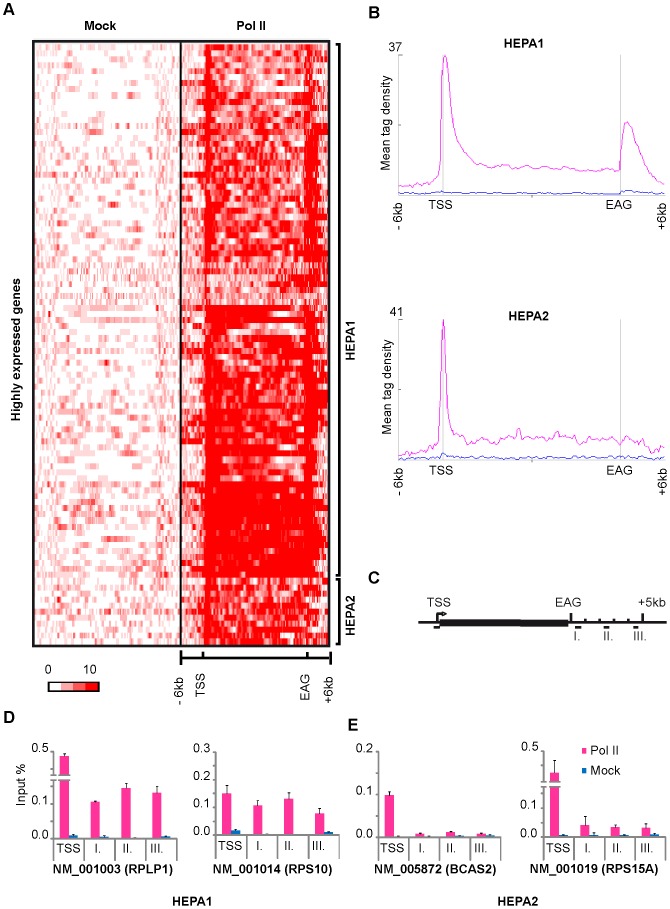
Recent genome-wide chromatin immunoprecipitation coupled high throughput sequencing (ChIP-seq) analyses performed in various eukaryotic organisms, analysed RNA Polymerase II (Pol II) pausing around the transcription start sites of genes. In this study we have further investigated genome-wide binding of Pol II downstream of the 3' end of the annotated genes (EAGs) by ChIP-seq in human cells. At almost all expressed genes we observed Pol II occupancy downstream of the EAGs suggesting that Pol II pausing 3' from the transcription units is a rather common phenomenon. Downstream of EAGs Pol II transcripts can also be detected by global run-on and sequencing, suggesting the presence of functionally active Pol II. Based on Pol II occupancy downstream of EAGs we could distinguish distinct clusters of Pol II pause patterns. On core histone genes, coding for non-polyadenylated transcripts, Pol II occupancy is quickly dropping after the EAG. In contrast, on genes, whose transcripts undergo polyA tail addition [poly(A)(+)], Pol II occupancy downstream of the EAGs can be detected up to 4-6 kb. Inhibition of polyadenylation significantly increased Pol II occupancy downstream of EAGs at poly(A)(+) genes, but not at the EAGs of core histone genes. The differential genome-wide Pol II occupancy profiles 3' of the EAGs have also been confirmed in mouse embryonic stem (mES) cells, indicating that Pol II pauses genome-wide downstream of the EAGs in mammalian cells. Moreover, in mES cells the sharp drop of Pol II signal at the EAG of core histone genes seems to be independent of the phosphorylation status of the C-terminal domain of the large subunit of Pol II. Thus, our study uncovers a potential link between different mRNA 3' end processing mechanisms and consequent Pol II transcription termination processes.
最近,在各种真核生物中进行的全基因组染色质免疫沉淀结合高通量测序(ChIP-seq)分析,分析了 RNA 聚合酶 II(Pol II)在基因转录起始位点周围的暂停。在这项研究中,我们通过 ChIP-seq 进一步研究了人类细胞中注释基因(EAG)3'端下游全基因组范围内的 Pol II 结合。在几乎所有表达的基因中,我们观察到 Pol II 在 EAG 下游的占据,这表明 Pol II 在转录单元 3'处的暂停是一种相当普遍的现象。通过全局运行和测序也可以检测到 EAG 下游的 Pol II 转录本,这表明存在功能活跃的 Pol II。基于 EAG 下游的 Pol II 占据,我们可以区分出不同的 Pol II 暂停模式簇。在编码非多聚腺苷酸化转录物的核心组蛋白基因上,Pol II 占据在 EAG 后迅速下降。相比之下,在其转录物经历多聚 A 尾添加的基因上,EAG 下游的 Pol II 占据可以检测到 4-6 kb。多聚腺苷酸化的抑制显著增加了 Pol II 在多聚 A(+)基因的 EAG 下游的占据,但在核心组蛋白基因的 EAG 上则没有。EAG 下游全基因组范围内的 Pol II 占据谱也在小鼠胚胎干细胞(mES)中得到了证实,这表明在哺乳动物细胞中,Pol II 在 EAG 下游全基因组范围内暂停。此外,在 mES 细胞中,核心组蛋白基因 EAG 处 Pol II 信号的急剧下降似乎与 Pol II 大亚基 C 末端结构域的磷酸化状态无关。因此,我们的研究揭示了不同 mRNA 3'端加工机制与随后的 Pol II 转录终止过程之间的潜在联系。