Epicentre, Paris, France.
PLoS Negl Trop Dis. 2012;6(6):e1662. doi: 10.1371/journal.pntd.0001662. Epub 2012 Jun 5.
Human African trypanosomiasis is fatal without treatment. The long post-treatment follow-up (24 months) required to assess cure complicates patient management and is a major obstacle in the development of new therapies. We analyzed individual patient data from 12 programs conducted by Médecins Sans Frontières in Uganda, Sudan, Angola, Central African Republic, Republic of Congo and Democratic Republic of Congo searching for early efficacy indicators.
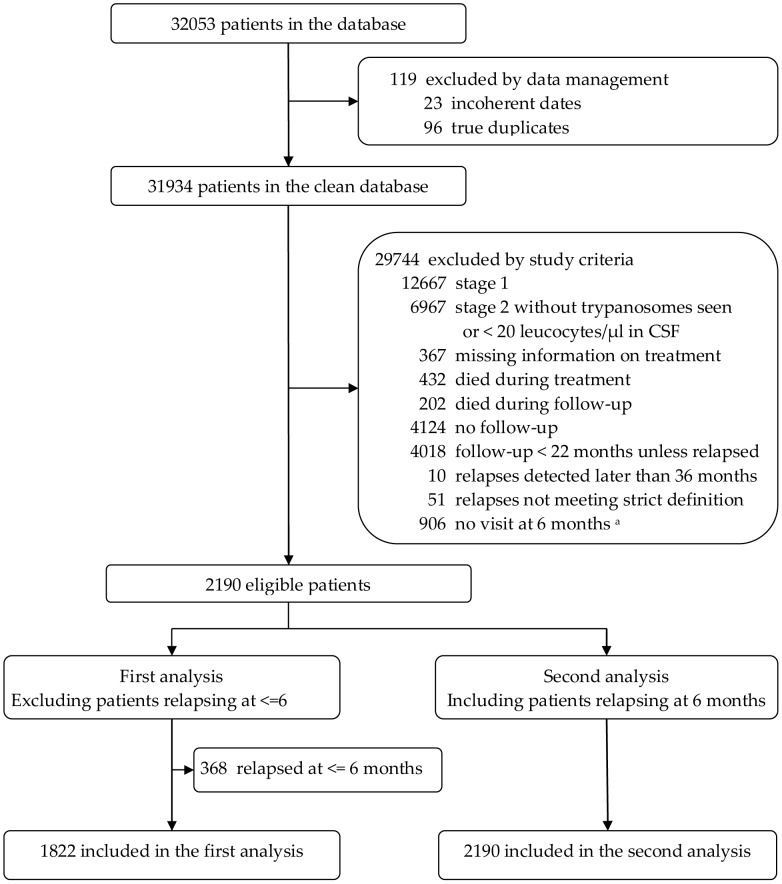
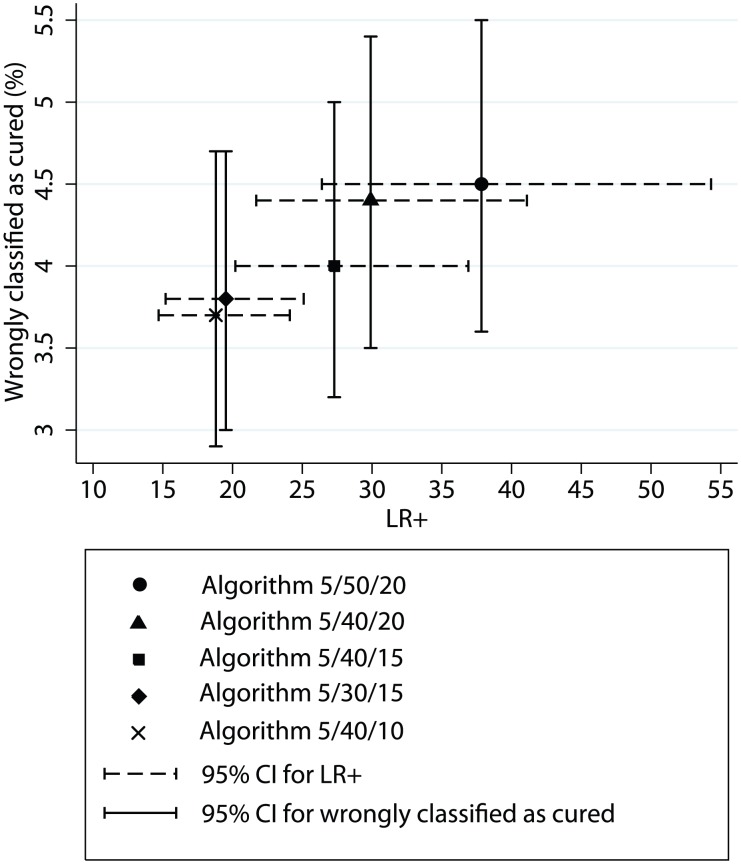
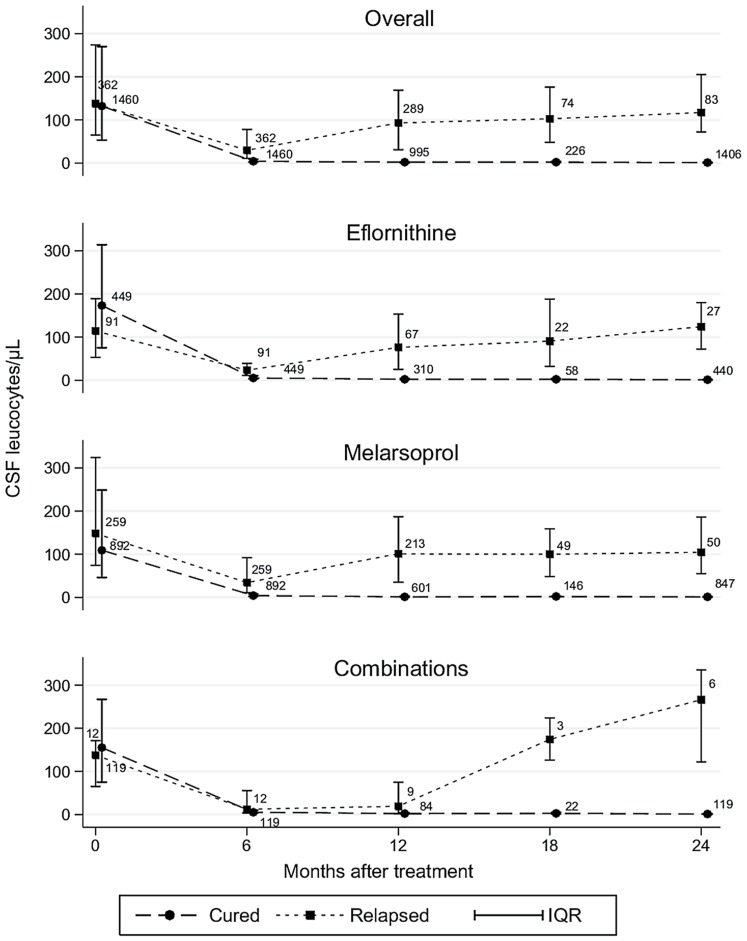
METHODOLOGY/PRINCIPAL FINDINGS: Patients analyzed had confirmed second-stage disease with complete follow-up and confirmed outcome (cure or relapse), and had CSF leucocytes counts (CSFLC) performed at 6 months post-treatment. We excluded patients with uncertain efficacy outcome: incomplete follow-up, death, relapse diagnosed with CSFLC below 50/µL and no trypanosomes. We analyzed the 6-month CSFLC via receiver-operator-characteristic curves. For each cut-off value we calculated sensitivity, specificity and likelihood ratios (LR+ and LR-). We assessed the association of the optimal cut-off with the probability of relapsing via random-intercept logistic regression. We also explored two-step (6 and 12 months) composite algorithms using the CSFLC. The most accurate cut-off to predict outcome was 10 leucocytes/µL (n=1822, 76.2% sensitivity, 80.4% specificity, 3.89 LR+, 0.29 LR-). Multivariate analysis confirmed its association with outcome (odds ratio=17.2). The best algorithm established cure at 6 months with < =5 leucocytes/µL and relapse with > =50 leucocytes/µL; patients between these values were discriminated at 12 months by a 20 leucocytes/µL cut-off (n=2190, 87.4% sensitivity, 97.7% specificity, 37.84 LR+, 0.13 LR-).
CONCLUSIONS/SIGNIFICANCE: The 6-month CSFLC can predict outcome with some limitations. Two-step algorithms enhance the accuracy but impose 12-month follow-up for some patients. For early estimation of efficacy in clinical trials and for individual patients in the field, several options exist that can be used according to priorities.
如果不治疗,人体感染非洲锥虫病会致命。为了评估治愈情况,需要进行长达 24 个月的治疗后随访,这增加了患者管理的复杂性,也是新疗法开发的主要障碍。我们分析了无国界医生组织在乌干达、苏丹、安哥拉、中非共和国、刚果共和国和刚果民主共和国开展的 12 个项目的个别患者数据,以寻找早期疗效指标。
方法/主要发现:分析的患者具有确诊的二期疾病,完成了随访并确定了结局(治愈或复发),并且在治疗后 6 个月进行了脑脊液白细胞计数(CSFLC)。我们排除了疗效结局不确定的患者:随访不完整、死亡、CSFLC 低于 50/µL 诊断为复发且没有锥虫的患者。我们通过接收者操作特征曲线分析了 6 个月时的 CSFLC。对于每个截止值,我们计算了敏感性、特异性和比值比(LR+和 LR-)。我们通过随机截距逻辑回归评估了最佳截止值与复发概率的关系。我们还探索了使用 CSFLC 的两步(6 个月和 12 个月)综合算法。预测结局的最准确截止值为 10 个白细胞/µL(n=1822,76.2%的敏感性,80.4%的特异性,3.89 的 LR+,0.29 的 LR-)。多变量分析证实了其与结局的相关性(比值比=17.2)。最佳算法在 6 个月时治愈定义为< =5 个白细胞/µL,复发定义为> =50 个白细胞/µL;在这些值之间的患者在 12 个月时通过 20 个白细胞/µL 的截止值区分(n=2190,87.4%的敏感性,97.7%的特异性,37.84 的 LR+,0.13 的 LR-)。
结论/意义:6 个月时的 CSFLC 可以预测结局,但存在一些局限性。两步算法提高了准确性,但对某些患者需要 12 个月的随访。对于临床试验中的早期疗效评估和现场的个别患者,有多种选择可供根据优先级使用。