Casqueiro Juliana, Casqueiro Janine, Alves Cresio
Department of Pediatrics, Pediatric Endocrinology Unit, Hospital Universitario Prof. Edgard Santos, Faculty of Medicine, Federal University of Bahia, Salvador, Bahia, Brazil.
Indian J Endocrinol Metab. 2012 Mar;16 Suppl 1(Suppl1):S27-36. doi: 10.4103/2230-8210.94253.
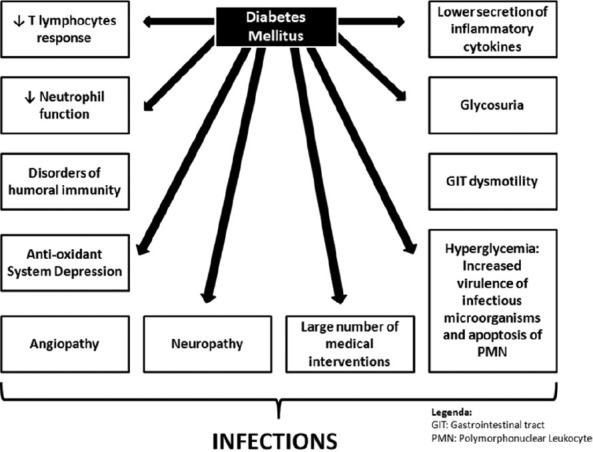
In general, infectious diseases are more frequent and/or serious in patients with diabetes mellitus, which potentially increases their morbimortality. The greater frequency of infections in diabetic patients is caused by the hyperglycemic environment that favors immune dysfunction (e.g., damage to the neutrophil function, depression of the antioxidant system, and humoral immunity), micro- and macro-angiopathies, neuropathy, decrease in the antibacterial activity of urine, gastrointestinal and urinary dysmotility, and greater number of medical interventions in these patients. The infections affect all organs and systems. Some of these problems are seen mostly in diabetic people, such as foot infections, malignant external otitis, rhinocerebral mucormycosis, and gangrenous cholecystitis. In addition to the increased morbidity, infectious processes may be the first manifestation of diabetes mellitus or the precipitating factors for complications inherent to the disease, such as diabetic ketoacidosis and hypoglycemia. Immunization with anti-pneumococcal and influenza vaccines is recommended to reduce hospitalizations, deaths, and medical expenses.
一般来说,糖尿病患者更容易发生感染性疾病,且病情往往更严重,这可能会增加他们的病亡率。糖尿病患者感染频率更高是由高血糖环境导致的,这种环境有利于免疫功能障碍(如中性粒细胞功能受损、抗氧化系统抑制和体液免疫)、微血管和大血管病变、神经病变、尿液抗菌活性降低、胃肠道和泌尿道动力障碍,以及这些患者接受的医疗干预较多。感染会影响所有器官和系统。其中一些问题在糖尿病患者中最为常见,如足部感染、恶性外耳道炎、鼻脑毛霉菌病和坏疽性胆囊炎。除了发病率增加外,感染过程可能是糖尿病的首发表现,也可能是该疾病固有并发症(如糖尿病酮症酸中毒和低血糖)的诱发因素。建议接种抗肺炎球菌和流感疫苗,以减少住院率、死亡率和医疗费用。