Laboratory of Fibre and Cellulose Technology, Åbo Akademi University, Porthansgatan 3, FI-20500 Turku, Finland.
Molecules. 2012 Jun 15;17(6):7458-502. doi: 10.3390/molecules17067458.
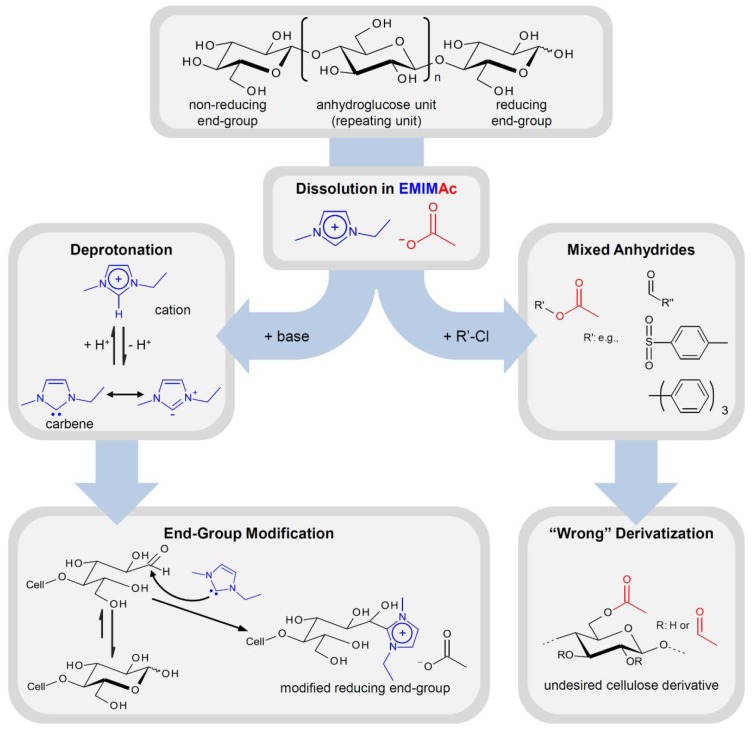
In the past decade, ionic liquids (ILs) have received enormous interest as solvents for cellulose. They have been studied intensively for fractionation and biorefining of lignocellulosic biomass, for dissolution of the polysaccharide, for preparation of cellulosic fibers, and in particular as reaction media for the homogeneous preparation of highly engineered polysaccharide derivatives. ILs show great potential for application on a commercial scale regarding recyclability, high dissolution power, and their broad structural diversity. However, a critical analysis reveals that these promising features are combined with serious drawbacks that need to be addressed in order to utilize ILs for the efficient synthesis of cellulose derivatives. This review presents a comprehensive overview about chemical modification of cellulose in ILs. Difficulties encountered thereby are discussed critically and current as well as future developments in this field of polysaccharide research are outlined.
在过去的十年中,离子液体(ILs)作为纤维素的溶剂受到了极大的关注。它们已被广泛研究用于木质纤维素生物质的分级和生物炼制、多糖的溶解、纤维素纤维的制备,特别是作为均相制备高工程化多糖衍生物的反应介质。ILs 在可回收性、高溶解能力和广泛的结构多样性方面具有巨大的商业应用潜力。然而,通过批判性分析发现,这些有前景的特性与严重的缺点相结合,需要加以解决,才能将 ILs 用于高效合成纤维素衍生物。本综述全面概述了在 ILs 中对纤维素进行化学修饰的情况。文中还批判性地讨论了所遇到的困难,并概述了多糖研究领域的当前和未来的发展。